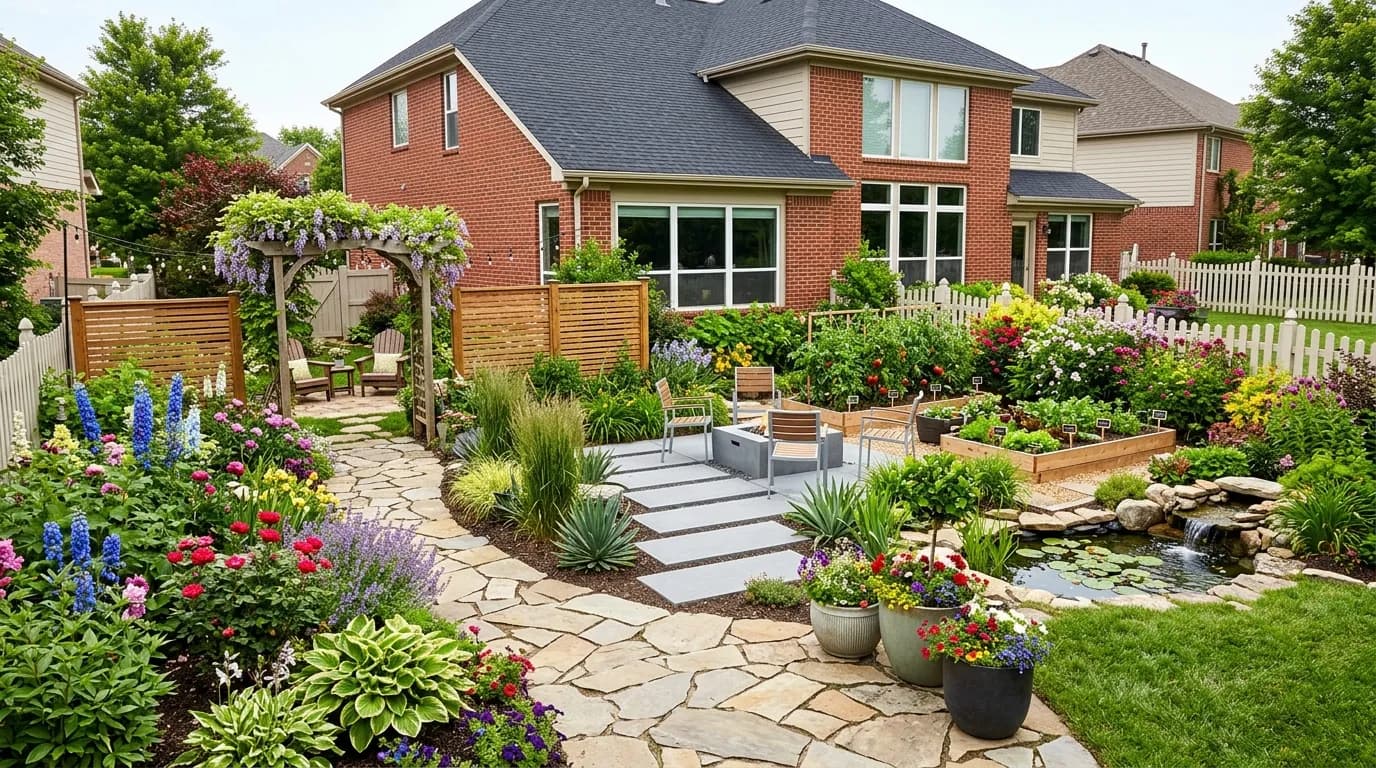
A backyard garden is one of the most rewarding home improvements you can make — and one of the most personal. Unlike a kitchen remodel or bathroom renovation, your backyard garden reflects exactly what you love: the colors, the textures, the way you want to feel when you step outside.
This guide covers 40 backyard garden ideas organized by style, from naturalistic wildflower gardens to formal structured designs, plus ideas for small spaces, sloped yards, and every budget level. Each section includes plant recommendations, estimated costs, and design principles you can apply immediately.
Cottage Garden Ideas
Cottage gardens feel simultaneously romantic and effortless — a mix of flowering perennials, climbing roses, and self-seeding annuals that spills gently beyond its borders.
1. The Classic English Cottage Garden
Dense plantings of roses, delphiniums, foxglove, salvia, and lavender. No formal structure — plants weave together. Key design move: vary heights dramatically (knee-high salvias next to 6-foot delphiniums). Best in USDA zones 5–8.
2. Cottage Garden with Gravel Path
A winding gravel or crushed stone path through cottage plantings creates access without formal structure. Use 1/4-inch pea gravel or decomposed granite. Edge with steel landscape edging to prevent gravel migration.
3. Cottage Garden Fence Border
Plant cottage favorites (climbing roses, clematis, hollyhock, echinacea) against an existing fence for a backdrop that makes modest yards feel like countryside gardens.
4. Raised Cottage Bed
6-inch raised beds with reclaimed timber or stone edging filled with cottage mix — easier to maintain, better drainage, warmer soil for earlier spring starts.
Modern & Minimalist Garden Ideas
5. Architectural Plant Garden
Mass plantings of a single dramatic plant — ornamental grass, agave, or clipped boxwood — for bold simplicity. Modern gardens succeed through restraint: fewer species, more repetition.
6. Black and White Garden
White flowering plants (white echinacea, white gaura, white agapanthus) against dark foliage (black mondo grass, dark-leaf heuchera, purple smoke tree). Dramatic, sophisticated.
7. Geometric Garden Beds
Clean rectangular or circular raised beds in a symmetrical layout with decomposed granite or concrete paths. Works best for mid-century modern, contemporary, and ranch-style homes.
8. Gravel Garden with Specimen Plants
Decomposed granite mulch with widely-spaced specimen plants (Japanese maple, ornamental grasses, yucca). Extremely low maintenance. Popular in California and the Southwest.
9. Roof Garden or Elevated Deck Garden
Modular planter boxes on a deck or rooftop create a green room above grade. Use lightweight growing medium (perlite-heavy mix). Succulents, herbs, and ornamental grasses are best choices.
Naturalistic & Wildlife Garden Ideas
10. Native Meadow Garden
Replace turf with a native meadow mix: prairie dropseed, little bluestem, black-eyed Susan, coneflower, and native asters. Year-round seed heads feed birds through winter. Self-seeds gradually. Year 1 is the hardest (weed management); year 3 onward is nearly effortless.
11. Pollinator Garden
Dense planting of nectar-rich natives: milkweed for monarchs, joe-pye weed and ironweed for swallowtails, native roses and clovers for bees. Site in full sun. One 10x6 ft pollinator bed can host 50+ butterfly species in a single season.
12. Rain Garden
Designed low-spot planted with deep-rooted natives (swamp milkweed, cardinal flower, blue wild indigo) that tolerate wet conditions after rain and dry conditions between storms. Solves drainage problems while creating habitat. Size at 10–20% of the watershed area draining into it.
13. Woodland Garden
Under existing trees: layer hostas, ferns, astilbe, bleeding heart, and Solomon's seal for a lush forest floor garden. Works in almost any shaded backyard. Get an AI design for your wooded yard at /redesign.
14. Bog Garden
If you have consistently wet soil that other plants struggle in, embrace it: bog iris, blue flag iris, cattails, native sedges, and pitcher plants thrive in saturated conditions. Creates a micro-ecosystem unlike any other garden type.
Edible & Kitchen Garden Ideas
15. French Potager Garden
Traditional French kitchen garden: vegetables and herbs arranged in geometric beds, often with a central focal point (sundial, birdbath, or espalier fruit tree). Beautiful AND productive. Best in a full-sun location near the kitchen.
16. Raised Bed Vegetable Garden
4x8 ft cedar raised beds (12 inches deep) are the gold standard for backyard food production. Standard spacing: 18–24 inches between beds for comfortable access. Start with 2–3 beds; add more as you learn what you grow most.
17. Herb Spiral
A spiraling raised mound (3–4 feet tall, 6 feet diameter) with herbs arranged by water needs — drought-tolerant herbs at the hot, dry top (rosemary, thyme); moisture-loving herbs at the cool, moist base (parsley, mint, chives). Space-efficient and visually striking.
18. Espalier Fruit Tree Fence
Train apple, pear, or fig trees flat against a south-facing fence or wall in a fan, horizontal tier, or Belgian fence pattern. Maximizes fruit production in small spaces. Budget: $150–$400 per tree including training support.
19. Container Edible Garden
For concrete, pavers, or decks: large containers (15+ gallons) with tomatoes, peppers, herbs, and compact varieties like patio cucumbers. Budget: $300–$800 for a functional 6-container setup.
20. Food Forest Garden
Multi-layer food production: tall fruit trees (canopy), dwarf fruits (sub-canopy), berry shrubs, perennial vegetables, ground covers (strawberry), root vegetables, and climbing plants (grape, kiwi). Most intensive to establish, most productive and self-sustaining long-term.
🌿 See Your Backyard Garden in 60 Seconds
The hardest part of a backyard garden redesign is visualizing the transformation before you start. Yardcast generates 3 photorealistic AI garden designs from your yard photos in under a minute.
Upload photos, describe your garden style and budget, and see exactly how your backyard could look. No landscape architect appointment required, no waiting weeks. Free to preview. $29 for the full 44-page plan with plant lists and cost estimates.
Formal Garden Ideas
21. Boxwood Parterre Garden
Clipped boxwood (or yew) hedges forming geometric patterns — diamonds, squares, knots — with colored gravel or low-growing ground covers filling the compartments. High maintenance but unmatched formal elegance.
22. Rose Garden
Dedicated rose garden with hybrid teas, climbing roses, and shrub roses. Classic design: concentric circles with a central focal point (sundial or urn). Roses are high-maintenance but the fragrance and blooms are unmatched.
23. Topiary Garden
Clipped evergreens (arborvitae, yew, holly, boxwood) in geometric or figurative shapes. Start with simple cones and spheres before attempting complex forms. Budget: $200–$600 per established topiary specimen.
24. Italian Formal Garden
Symmetrical layout with stone or terracotta urns, gravel paths, boxwood hedges, and Mediterranean plants (lavender, rosemary, olive trees in containers). Works for homes with Mediterranean, Tuscan, or stucco architecture.
Small Backyard Garden Ideas
25. Vertical Garden Wall
Pocket planting systems or modular panels on a fence or wall. Grow herbs, succulents, or annual flowers in 2–3 square feet of floor space. Budget: $100–$500 for a basic system; $500–$3,000 for custom built-in systems.
26. Courtyard Garden
For small enclosed spaces: one focal plant (Japanese maple, ornamental banana, large-container agave), gravel ground cover, a water feature, and strategic uplighting. Small spaces reward bold choices.
27. Window Box Garden
Window boxes under every window and along the porch railing give a cottage feeling without requiring garden beds. Budget: $50–$150 per box installed.
28. Micro Prairie Strip
A 3x12 ft strip of native prairie plants along a fence, driveway edge, or property line. Looks intentional, attracts pollinators, needs almost no care after establishment.
29. Patio Garden Containers
Group containers in odd numbers (3, 5, 7) at varying heights using pot risers, overturned pots, or step shelving. Create a "container garden room" without any in-ground planting.
Backyard Garden Ideas by Budget
Under $500 — Weekend Projects
30. Seed-Grown Meadow Strip
Sow a native meadow mix (1 oz covers 100 sq ft) in a cleared and raked strip. Total cost: $20–$50 per 100 sq ft. First year is mostly foliage; second year blooms prolifically.
31. Reclaimed Material Raised Bed
Build a raised bed from reclaimed scaffolding planks, old railway sleepers, or cinder blocks. Fill with a 60/40 topsoil/compost mix. Budget: $50–$200 for a 4x8 bed.
32. Divide and Transplant
Divide mature hostas, daylilies, ornamental grasses, and irises from neighbors or friends. Transplant free divisions to create instant garden structure at zero plant cost.
$500–$2,000 — Weekend Transformations
33. Gravel Garden with Planted Pockets
Remove turf from 200–400 sq ft, lay landscape fabric, cover with 3 inches of decorative gravel, cut X-shaped holes for plants. Total cost: $400–$900 depending on gravel type.
34. Defined Garden Bed System
Install steel landscape edging to define beds, add 4 inches of quality mulch, plant 20–30 perennials. Budget: $600–$1,500 for a 200 sq ft bed including edging, mulch, and plants.
35. Garden Path Installation
Flagstone, stepping stone, or crushed granite path through a planted area adds structure and access. Budget: $300–$900 depending on material and length.
$2,000–$8,000 — Full Transformations
36. Complete Lawn-to-Garden Conversion
Remove turf (rented sod cutter: $150/day), install irrigation drip system ($500–$1,500), build 2–3 raised beds ($300–$600), plant 60–100 plants ($600–$1,200), add 4 inches of mulch ($200–$400). Total: $2,000–$4,500 for a typical backyard.
37. Cottage Garden with Structures
Installed cottage garden with one wood arbor or pergola, planted with roses and flowering perennials, stone path, and stone edging. Budget: $4,000–$8,000.
Year-Round Garden Planning
The best backyard gardens have something interesting in every season. Design for this intentionally:
| Season | Plants to Include |
|---|---|
| Early Spring | Crocus, snowdrop, hellebore, forsythia, flowering cherry |
| Late Spring | Tulips, alliums, bleeding heart, viburnum, azalea |
| Summer | Echinacea, black-eyed Susan, salvia, phlox, roses, hydrangea |
| Fall | Asters, ornamental grasses (seed heads), sedum, goldenrod |
| Winter | Evergreen structure (boxwood, holly, yew), seed heads, ornamental bark |
Backyard Garden Maintenance by Type
| Garden Type | Annual Hours | Skill Level | Cost/Year |
|---|---|---|---|
| Native meadow | 4–8 hrs | Low | $50–$150 |
| Cottage garden | 20–40 hrs | Medium | $100–$300 |
| Formal boxwood garden | 40–80 hrs | High | $300–$800 |
| Vegetable garden | 2–4 hrs/week in season | Medium | $200–$500 |
| Modern gravel garden | 4–10 hrs | Low | $50–$150 |
| Rain garden | 8–15 hrs yr 1, 4 hrs after | Low | $50–$100 |
Start Your Backyard Garden Design
38. Define your garden rooms. Break the backyard into zones: outdoor dining, relaxation, play, garden beds. Assign each zone a purpose before planting anything.
39. Work with your existing trees. Design around trees you're keeping — they define the microclimate. Full-sun beds south of the trees; shade gardens under and north of them.
40. Start small, expand. One 10x6 ft garden bed, fully planted and mulched, makes a bigger visual impact than three beds half-planted. Do less, better, first.
The biggest barrier to a beautiful backyard garden isn't budget or plants — it's knowing what you want and how it will look. See exactly what your backyard could become with a free AI design at yardcast.ai/redesign. Upload your photos, describe your style, and get a photorealistic preview in 60 seconds.