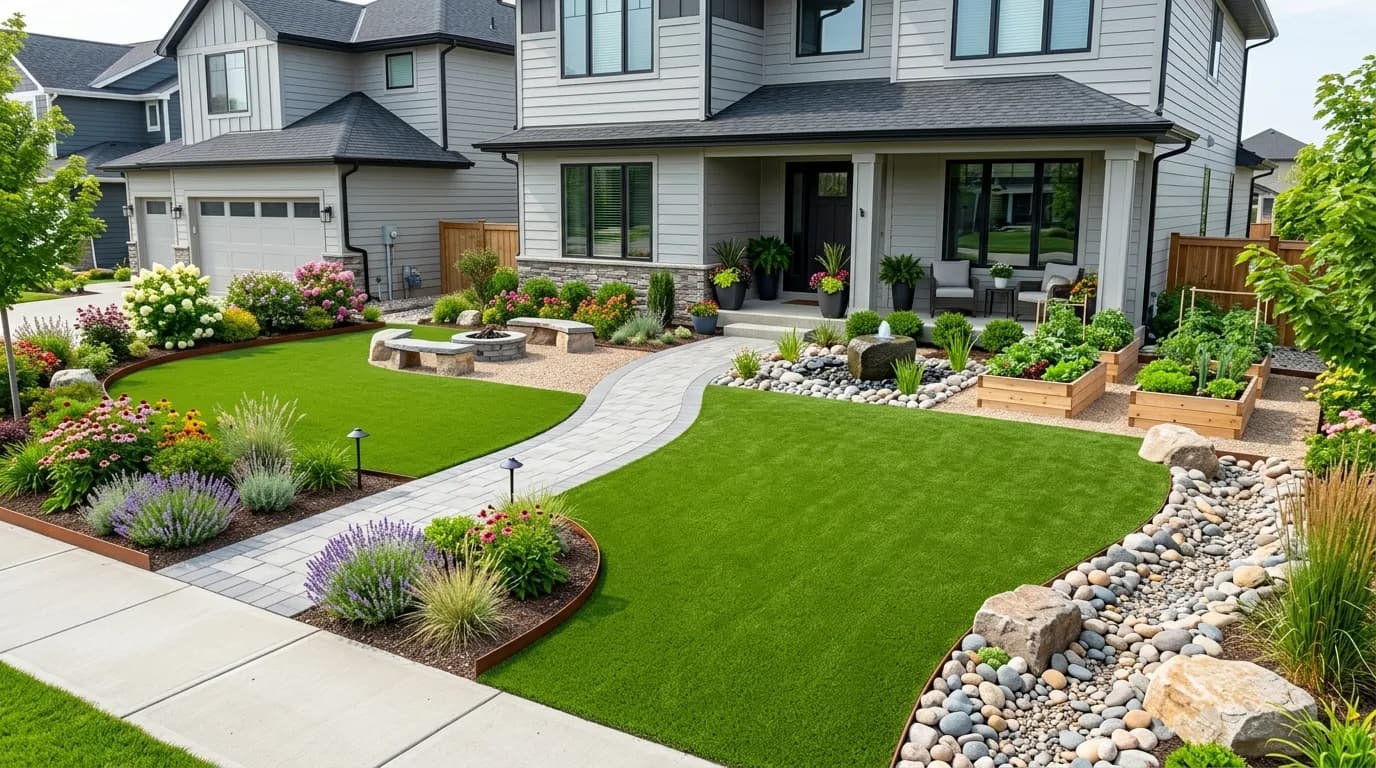
Artificial grass is no longer the bright green plastic carpet of the 1970s. Today's premium synthetic turf looks and feels remarkably close to real grass — and for the right applications, it solves problems that no amount of irrigation, fertilizer, or lawn care can fix. This guide covers 30 of the best artificial grass landscaping ideas for 2026, with cost information, installation tips, and honest advice on where synthetic turf works well and where it doesn't.
Why Homeowners Are Choosing Artificial Grass in 2026
Several powerful trends are driving rapid adoption:
Water restrictions. California, Arizona, Nevada, and Texas have all passed or proposed lawn replacement rebate programs as water scarcity becomes critical. In California, homeowners receive $1–$3 per square foot in rebates for replacing real grass with synthetic turf or drought-tolerant plants.
Maintenance elimination. Mowing, fertilizing, aerating, overseeding, and treating weeds consume an average of 150 hours per year for a homeowner with a 3,000 sq ft lawn. Artificial grass eliminates all of it.
Pet and high-traffic durability. Real grass in dog runs, play areas, and high-traffic paths turns to mud and bare dirt within weeks. Quality artificial turf handles this punishment indefinitely.
Climate adaptability. From freezing Minnesota winters to Phoenix summers, well-installed artificial turf stays green year-round without seasonal stress, brown patches, or die-off.
That said, artificial grass has real limitations: heat retention in direct sun (surface can reach 150–165°F on hot days), a higher upfront cost than seeding real grass, environmental concerns around microplastic runoff in some products, and aesthetic limitations in formal garden contexts. Understanding where synthetic turf works well — and where it doesn't — is the foundation of any successful installation.
Front Yard Artificial Grass Ideas
1. Full Front Lawn Replacement
The most straightforward application: replace an existing real grass front lawn with premium synthetic turf. Done well (quality turf + proper base preparation), this looks beautiful and adds meaningful curb appeal. Done cheaply (low-pile, overly green turf on a poor base), it looks obviously fake.
Keys to success: Choose a turf with varied blade heights and colors (mixing green, olive, and tan blades). Install on 4 inches of crushed aggregate base for proper drainage. Use a silica sand/crumb rubber infill blend. Add a perimeter border of real plants — low-growing shrubs, ornamental grasses, succulents — for a natural transition.
Cost: $8–$18 per sq ft installed; $12,000–$27,000 for a typical 1,500 sq ft front lawn
2. Partial Lawn with Landscape Bed Integration
Use artificial turf as the central panel in the front yard, surrounded by a wide planted border. The planted border — real shrubs, ornamental grasses, and perennials — provides color, texture, and seasonal interest that artificial turf cannot, while the turf provides clean green in the center.
This hybrid approach looks more designed than wall-to-wall artificial turf and keeps the visual complexity of a real garden while eliminating the highest-maintenance element (the lawn).
3. Geometric Turf Panels Between Hardscape
One of the most modern front yard applications: separate the front yard into geometric sections with concrete or paver hardscape, and fill the green sections with artificial turf. The turf becomes an element in a designed composition rather than a lawn substitute. Result: a highly structured, modern front yard that reads as designed landscape, not default grass.
> Curious how artificial grass would look in your specific yard? Generate a free AI landscape design at Yardcast → Upload your yard photos and see 3 photorealistic design options — showing plant choices, hardscape, and lawn treatment all tailored to your home.
4. Narrow Strip Replacement
The hardest grass to maintain: the 3–4 foot strip between the sidewalk and street (the hell strip or boulevard strip). This area is subject to foot traffic, road salt, dog waste, and irregular watering — real grass struggles here. Artificial turf is one of the best solutions, either alone or combined with pavers and drought-tolerant plants.
Cost: $300–$800 for a typical 50 linear foot hell strip
5. Cottage Front Yard with Turf Accent
In a cottage-style garden with abundant flowering borders, a small patch of perfectly green artificial turf as a central element — framed by overflowing cottage plantings — works beautifully. The precision of perfect green lawn contrasting with the wild abundance of cottage planting is a classic combination.
Backyard Artificial Grass Ideas
6. Full Backyard Replacement
In hot, dry climates, replacing an entire backyard lawn with artificial turf transforms maintenance requirements. Add a smart irrigation system for the planted borders and trees (which still need water even when the lawn doesn't), and total irrigation drops by 50–70%.
7. Dog Run and Pet Area
Artificial turf is one of the best surfaces for dog areas. Real grass becomes muddy, compacted, and bare within weeks under a dog's use. Quality pet-grade artificial turf (with antimicrobial infill and superior drainage backing) handles even heavy dog traffic indefinitely. Hose it down weekly; no other maintenance required.
Look for: A drainage rate of 30+ inches per hour, antimicrobial infill (zeolite or deodorizing granules), and a face weight of 60+ oz per yard for heavy use areas.
Cost: $3,000–$8,000 for a typical 300–500 sq ft dog run
8. Children's Play Area
A level, soft, drainage-friendly surface for a children's play area is one of the best uses of artificial turf. Remove all potential fall-hazard hard surfaces and replace with artificial turf rated for impact attenuation (measured in G-max). Many premium synthetic turfs have a G-max of 120 or below — equivalent to wood chips or rubber — when installed with proper shock pad underlay.
9. Pool Surround
Artificial turf around a pool eliminates two major problems: muddy feet tracking into the pool (real grass) and hot, rough concrete baking your feet (traditional pool decking). Premium artificial turf stays relatively cool, provides a soft walking surface, and doesn't require watering. Use a high-drainage backing rated for splash environments.
Note: Surface temperature of artificial turf in direct sun can be significant — a pool nearby helps cool feet between swims, which makes pool + turf a natural combination.
10. Shaded Backyard Where Real Grass Won't Grow
Real grass needs 4+ hours of direct sun per day. If your backyard is heavily shaded, real grass will never look good regardless of how much seed, fertilizer, or care you apply. Artificial turf, pavers, groundcover plants (hostas, pachysandra, creeping jenny), or gravel are the only real solutions. Artificial turf gives you the visual of green lawn even in deep shade.
Sport and Recreation Turf Ideas
11. Putting Green
A private putting green on artificial turf is one of the highest-enjoyment installations you can make. Modern putting green turf (short pile, multiple cup inserts, undulation built in) is virtually indistinguishable from a professionally maintained golf course green. Add a short rough surround in slightly taller turf and a few ornamental grasses at the border for a complete course look.
Cost: $15,000–$35,000 for a professional installation with undulation and 3–4 cups; $5,000–$12,000 for a simpler flat installation
12. Practice Tee and Chipping Area
Beyond putting, add a synthetic turf tee mat and chipping area for a complete backyard golf practice facility. Use commercial-grade driving range turf (dense, durable, real-feel pile) for the tee box.
13. Backyard Soccer or Lacrosse Field
A large backyard (50×80 feet minimum) can accommodate a full youth soccer or lacrosse field in synthetic turf. Use a medium-height infilled turf (50mm pile height, crumb rubber infill) for the most realistic ball roll and play characteristics.
14. Bocce or Lawn Bowling Surface
Extremely low-pile artificial turf (4–8mm pile height, sand-only infill) creates an excellent bocce ball court surface that's more consistent and weather-resistant than traditional oyster shell. Available in classic green or realistic tan/buff colors.
15. Rooftop or Balcony Terrace Turf
Artificial turf is the most practical green surface for a rooftop terrace, balcony, or deck. Lightweight panels (as light as 0.8 lbs/sq ft) lay directly over most decking surfaces. No irrigation, no soil, no weight load issues. The visual warmth of green grass on a rooftop dramatically improves the space.
Cost: $4,000–$10,000 for a 500–800 sq ft rooftop terrace
Design and Installation Tips
16. Choosing the Right Turf Pile Height
| Use | Recommended Pile Height | Blade Style |
|---|---|---|
| Front lawn (high visibility) | 30–40mm | S-blade or W-blade |
| Backyard general use | 35–50mm | Tri-blade or C-blade |
| Dog areas | 25–35mm (drains better) | S-blade |
| Play areas | 35–50mm + shock pad | Flat blade |
| Putting green | 10–15mm | Nylon putting green fiber |
| Bocce/lawn bowling | 4–8mm | Straight blade |
17. Base Preparation is Everything
The most common artificial turf installation failure: inadequate base preparation. Proper base = 4 inches crushed aggregate (decomposed granite or Class II road base) compacted to 95%+ density. On top: 1 inch of sharp washed sand, screeded flat. Install weed barrier fabric before the aggregate base. Without this foundation, turf sags, puddles, and develops bumps within 1–2 years.
Never install directly on soil or existing lawn. Remove all organic material first.
18. Infill Selection
| Infill Type | Best For | Cost | Notes |
|---|---|---|---|
| Silica sand | General use, aesthetics | Low | Doesn't cushion; keeps turf blades upright |
| Crumb rubber | Sports fields, play areas | Medium | Better cushion; retains heat in sun |
| Zeolite | Pet areas | Medium | Odor absorption, antimicrobial |
| Durafill (cork+rubber) | Putting greens, premium | High | Organic, cool-temp, eco-friendly |
| ThermoPlastic (TPE) | Premium play + sports | High | Non-toxic, recyclable, lower heat |
19. Edging and Transitions
Where artificial turf meets hardscape (concrete, pavers, gravel) or planting beds, the transition detail determines whether the installation looks professional or DIY. Options: galvanized nails through the turf edge into a wood or concrete border; steel edging bent to the curved edge; concrete edging poured to hold the turf face in place. The cleanest look: a 1-inch reveal where the turf meets a paver or concrete edge.
20. Natural-Looking Installation Techniques
What makes artificial turf look fake: single-color blades, no blade height variation, flat seams, visible infill, overly uniform surface, no transition plantings. What makes it look natural: multi-tone blades (3+ colors mixed), thatch layer visible at base, seams aligned with yard geometry and hidden, planted border at every edge, appropriate infill depth that hides backing completely.
Climate-Specific Artificial Grass Considerations
21. Hot Climates (California, Arizona, Texas, Florida)
Artificial turf in hot climates gets hot. Surface temperatures in direct sun in Phoenix can reach 165°F+ in summer — too hot to walk on barefoot. Mitigation options: cool-infill products (crumb rubber + cork or TPE), shade trees planted along south and west edges, and cooling misting systems. Many homeowners in hot climates use artificial turf in shaded areas or north-facing yards, where heat is less extreme.
Heat reduction tip: Water the turf surface with a hose — it cools to comfortable walking temperature in 5–10 minutes and stays cool for 30–60 minutes.
22. Cold Climates (Midwest, Northeast, Mountain)
Artificial turf handles cold climates well. It doesn't die in winter, doesn't need to be overseeded in fall, and returns to full beauty in spring without any care. Snow compacts on the turf surface and melts normally. Freezing and thawing don't damage quality turf. The main consideration: avoid metal edging that becomes a tripping hazard under snow.
23. High Rainfall Climates (Pacific Northwest, Southeast)
Premium artificial turf with a perforated backing and proper aggregate base drains 25–50 inches of water per hour — far faster than natural soil. In high-rainfall climates, drainage is the key spec to check. Avoid any turf with non-perforated backing in wet climates; it holds water and creates standing puddles.
24. Water Rebate Opportunities
Check your local water utility's rebate programs. California's SoCal Water Smart program offers $1–$3 per square foot for artificial turf installation replacing real grass. Las Vegas Valley Water District offers $3/sq ft. Many Texas utilities offer $0.50–$1/sq ft. These rebates can offset $1,500–$6,000 of installation cost on a typical residential lawn.
Maintaining Artificial Grass
25. Weekly Maintenance Routine
Unlike real grass, artificial turf maintenance is minimal: brush the turf fibers upright with a stiff broom or power broom once per week (or after heavy use). Rinse with a hose to remove dust, pollen, and light debris. Remove leaves and organic matter before they decompose — a leaf blower works well. Total time: 10–15 minutes per week.
26. Pet Waste Management
Solid waste: remove immediately (as you would from any surface). Liquid waste: high-quality pet turf with zeolite infill and high-drainage backing handles urine naturally. Optional upgrade: flush thoroughly with water and a diluted enzyme cleaner to prevent odor buildup. Annual: have the infill refreshed by a professional if heavy pet use.
27. Artificial Turf Longevity and Warranty
Quality artificial turf installed correctly lasts 15–25 years. Most premium manufacturers (Shaw, ForeverLawn, SYNLawn, Global Syn-Turf) warranty their products for 15 years against UV fade and manufacturing defects. The typical cost per year of a $15,000 installation lasting 20 years: $750/year — comparable to annual lawn care costs for a real grass lawn of similar size.
Frequently Asked Questions About Artificial Grass Landscaping
Q: Does artificial grass look fake?
A: Premium synthetic turf installed correctly looks surprisingly realistic. The giveaways that it's fake: overly uniform color, no blade variation, perfectly flat surface with no imperfections, and no transition plantings at the edges. High-quality turf (50+ oz face weight, multi-tone blades, proper infill) at 20 feet is virtually indistinguishable from a well-maintained natural lawn. Budget turf (under $2/sq ft material) looks obviously synthetic.
Q: Is artificial grass eco-friendly?
A: The answer is genuinely complicated. Artificial turf eliminates fertilizer and pesticide use (positive), dramatically reduces water consumption (strongly positive in drought regions), and requires no gasoline mowing (positive). Downsides: manufacturing uses synthetic materials, infill materials (especially crumb rubber) are under ongoing research for microplastic concerns, and end-of-life disposal is difficult. The net environmental impact depends heavily on the region and what it replaces.
Q: Can you install artificial grass yourself?
A: DIY installation is possible for small areas (under 500 sq ft) if you're comfortable with physical work. The critical steps that determine success: removing all existing organic material, compacting a 4-inch crushed aggregate base to 95% density, screeding a sand layer perfectly flat, cutting turf accurately (errors waste expensive material), securing edges properly, and applying infill evenly. Professional installation costs $4–$8/sq ft for labor; the difference in end result is usually worth it for visible areas.
Q: How hot does artificial grass get in summer?
A: In direct summer sun, artificial turf surface temperature can reach 125–165°F depending on climate. This makes walking barefoot uncomfortable on hot days. Mitigation: shade trees, cool-infill products, and hosing down the surface (cools immediately to comfortable temperature). Artificial turf in shaded areas stays significantly cooler and is often comfortable barefoot even in summer.