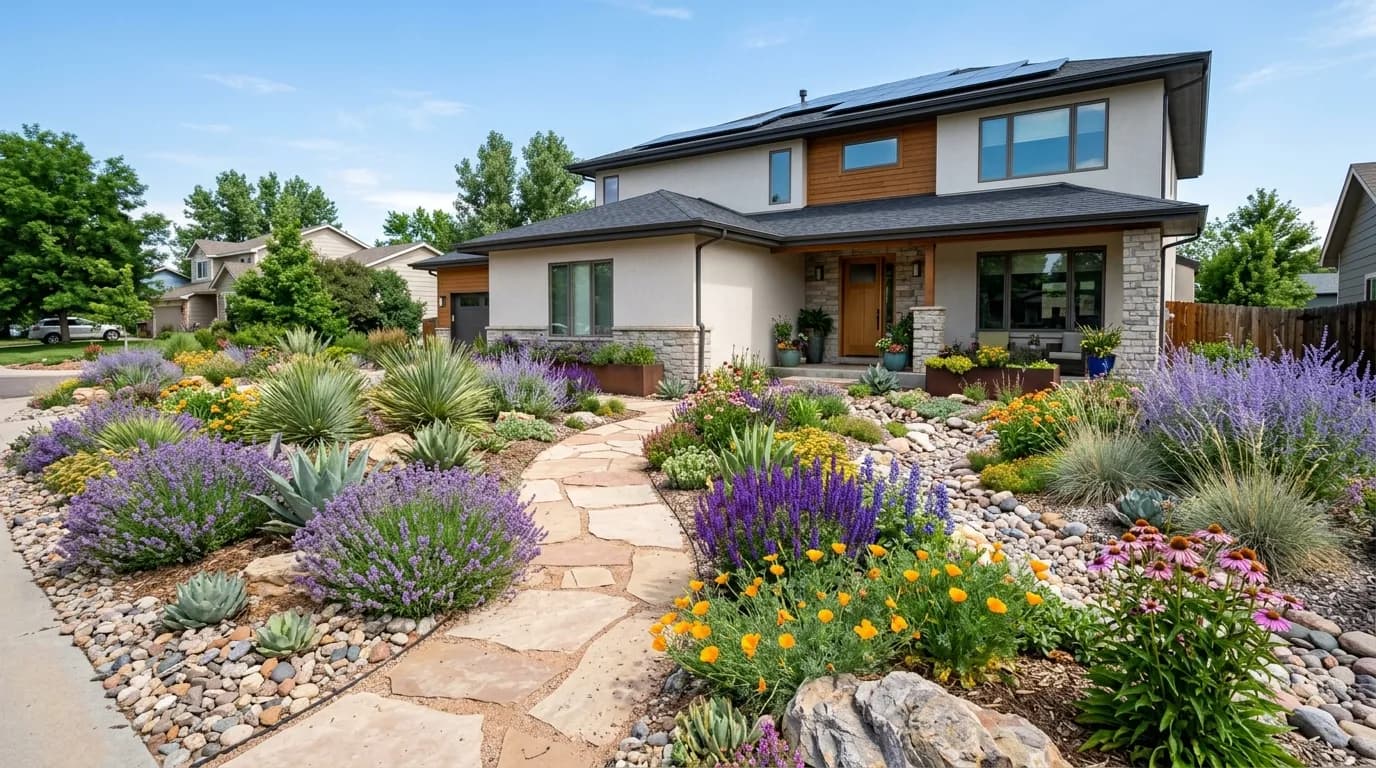
Xeriscaping has transformed from a drought-emergency measure into one of the most desirable and sophisticated landscaping approaches in America. With water costs rising, climate patterns shifting, and homeowners increasingly valuing low-maintenance beauty over labor-intensive grass, xeriscaping has moved decisively into the mainstream.
Here's everything you need to know to design, install, and maintain a beautiful xeriscape — whether you're in the desert Southwest or the humid Northeast.
What Xeriscaping Actually Is
The term "xeriscape" comes from the Greek xeros (dry) + landscape. It was coined in Denver in 1981 by the Denver Water Department as a framework for water-efficient landscaping. Despite its dry-sounding name, xeriscaping does not mean rocks and cacti — that's a caricature. Done well, xeriscaping is lush, colorful, and alive.
True xeriscaping means: designing a landscape to minimize or eliminate supplemental irrigation by matching plants to site conditions, managing water efficiently, and improving soil health. In many humid climates, a well-designed xeriscape doesn't need irrigation at all after the first season.
The 7 Official Principles of Xeriscaping
The Denver Water Department's original framework remains the definitive guide:
Principle 1: Planning and Design
Everything starts here. Before buying a single plant, document your site: sun/shade patterns throughout the day, existing soil type, drainage (where does water pool?), existing plants worth keeping, and your goals for the space.
Group plants by water needs in "hydrozones" — driest plants together, moisture-lovers together. This makes irrigation efficient and prevents the common mistake of overwatering drought-tolerant plants.
Practical tools: Draw a simple site map (to scale if possible), note sun/shade patterns at 9am, noon, and 3pm, and test your soil type with the basic jar test (fill a jar with soil and water, shake, let settle — layers reveal clay/silt/sand ratio).
Principle 2: Soil Improvement
Most soil benefits from organic matter, which improves both drainage in clay soils and water retention in sandy soils. Before planting:
- Test your soil pH (test kits at garden centers, $10-15)
- Add 3-4 inches of compost and work it into the top 8-10 inches
- Consider a professional soil test from your county extension office ($15-25) for pH, nutrient levels, and recommendations
For desert/xeriscape gardens specifically: Many drought-tolerant plants actually perform better in poor, lean soil — amending too heavily can promote excessive lush growth that requires more water and is less drought-hardy. Research your specific plants' soil preferences.
Principle 3: Appropriate Plant Selection
This is the heart of xeriscaping. The right plant in the right place performs beautifully with minimal water. The wrong plant — even a technically drought-tolerant species — in the wrong conditions (wrong soil, wrong sun, wrong zone) will struggle and require extra attention.
Selection criteria:
- 1Native to your region (evolved to thrive on local rainfall)
- 2Appropriate for your hardiness zone (can survive your winters and summers)
- 3Matched to your site conditions (sun, soil type, drainage)
- 4Mature size fits the space (avoid future pruning problems)
See the plant tables later in this guide for specific recommendations by region.
Principle 4: Efficient Irrigation
Xeriscaping doesn't mean zero irrigation — it means using water efficiently when irrigation is needed. The two key upgrades:
Drip irrigation delivers water directly to root zones, eliminating evaporation losses of 30-50% common with overhead sprinklers. A basic drip system can be installed DIY for $200-500 for a typical home garden.
Smart irrigation controllers (Rachio, RainBird Smart, Orbit B-hyve) automatically skip watering when rain is forecast or when soil moisture sensors indicate adequate moisture. Studies show smart controllers reduce irrigation water use by 40-70% compared to timer-based systems.
Principle 5: Mulching
Mulch is the single most important drought-mitigation tool in any landscape. A 3-4 inch layer of mulch reduces evaporation by 50-70%, keeps roots cooler in summer heat, suppresses weeds (reducing competition for moisture), and moderates soil temperature swings.
Mulch types for xeriscape gardens:
| Mulch Type | Best For | Longevity | Notes |
|---|---|---|---|
| Decomposed granite (DG) | Southwest, desert | Permanent | Looks native; reflects some heat |
| River rock/gravel | Any region | Permanent | Can increase soil heat in Southwest |
| Shredded bark/wood chips | Cooler climates | 2-3 years | Improves soil as it decomposes |
| Pine straw | Southeast | 1-2 years | Acidifies soil slightly; good for pines and hollies |
| Cedar bark | Any region | 2-3 years | Natural pest-deterrent properties |
Do not use: Plastic sheeting under mulch (it prevents water infiltration and soil respiration), colored mulch (dyes can be toxic to soil biology), rubber mulch (hot in summer, doesn't decompose).
Principle 6: Practical Turf Areas
Traditional turfgrass is the biggest water consumer in most landscapes — it accounts for 50-70% of residential water use. Xeriscape doesn't require eliminating all lawn, but it does encourage limiting it to areas where it provides clear functional value: play areas, high-traffic zones, visual lawn areas visible from the street.
Lawn alternatives for low-water areas:
| Alternative | Zones | Water Needs | Walkable? | Mowing? |
|---|---|---|---|---|
| Buffalo grass | 4-8 | Very low | Yes | Occasional |
| Blue grama grass | 3-7 | Very low | Light | 1x/year |
| Creeping thyme | 4-9 | Low | Yes | No |
| Clover/microclover | 3-9 | Low | Yes | Optional |
| Sedum groundcover | 3-10 | Very low | Light | No |
| Gravel + decomposed granite | All | None | Yes | No |
Principle 7: Appropriate Maintenance
Xeriscaping reduces maintenance but doesn't eliminate it. What remains: annual mulch top-off (30 minutes per 100 sq ft), spring pruning of dead growth, occasional irrigation during establishment, and monitoring for the rare pest or disease issue.
What you eliminate: weekly mowing, frequent watering, annual replanting of tender annuals, monthly fertilizing, and perpetual weed battles in unmulched beds.
Best Xeriscape Plants by Region
Southwest (Arizona, New Mexico, Nevada, Utah)
Ground level: Desert marigold, globe mallow, fairy duster, trailing lantana
Mid-layer: Texas sage, red yucca, salvia greggii, desert spoon
Structure: Agave, prickly pear, ocotillo, saguaro (AZ only)
Trees: Palo verde, desert willow, mesquite, blue palo verde
Southern California (Mediterranean climate)
Ground level: California poppy, creeping rosemary, silver carpet, ice plant (on slopes)
Mid-layer: Lavender, ceanothus, salvia, rockrose (Cistus)
Structure: Manzanita, coffeeberry, toyon
Trees: Palo verde, olive, California oak, Mediterranean cypress
Texas
Ground level: Blackfoot daisy, prairie verbena, horseherb (shade)
Mid-layer: Autumn sage, esperanza, cenizo, flame acanthus
Structure: Yucca, sotol, native agaves
Trees: Texas mountain laurel, desert willow, live oak, Texas ash
Mountain West (Colorado, Utah, Idaho, Wyoming)
Ground level: Creeping phlox, sedum, woolly thyme
Mid-layer: Russian sage, penstemon, Apache plume, rabbitbrush
Structure: Agave parryi (cold-hardy), yucca, blue grama grass
Trees: Pinyon pine, juniper, serviceberry, quaking aspen
Mid-Atlantic and Southeast
Xeriscaping is less common here due to summer rainfall, but drought-tolerant plants reduce irrigation needs dramatically:
Mid-layer: Native shrubs — beautyberry, native hollies, Virginia sweetspire
Groundcover: Creeping juniper, liriope, pachysandra (shade)
Trees: Southern live oak, eastern red cedar, crape myrtle (SE), native serviceberry
Real Cost Savings from Xeriscaping
Water bills: The average US household spends $1,800/year on water. Outdoor irrigation accounts for 30% = $540/year. Xeriscaping reduces outdoor water use by 50-75%, saving $270-405/year — a savings that continues forever.
Maintenance time: Lawn mowing and maintenance takes 4+ hours/week for the average lawn owner. A xeriscape reduces this to 1-2 hours/week of incidental tidying, saving 100+ hours per year.
Long-term plant costs: Native and drought-tolerant plants don't need annual replacement. A well-designed xeriscape's plant costs approach zero after establishment — unlike annual beds that need replanting every spring.
ROI calculation for a typical 500 sq ft lawn conversion:
- Installation cost: $3,000-6,000
- Annual water savings: $200-400
- Annual time savings (valued at $20/hr): $1,500-2,000
- Combined annual value: $1,700-2,400
- Payback period: 1.5-3.5 years — then pure savings forever
Design Your Xeriscape with AI
Yardcast's AI landscape design tool creates regionally-appropriate xeriscape designs based on photos of your actual yard. Enter your zip code and preferences, and the AI recommends plants adapted to your specific hardiness zone and annual rainfall. See a complete design in both bed options before committing to any plants or installation.
[Design a beautiful xeriscape →](/redesign)