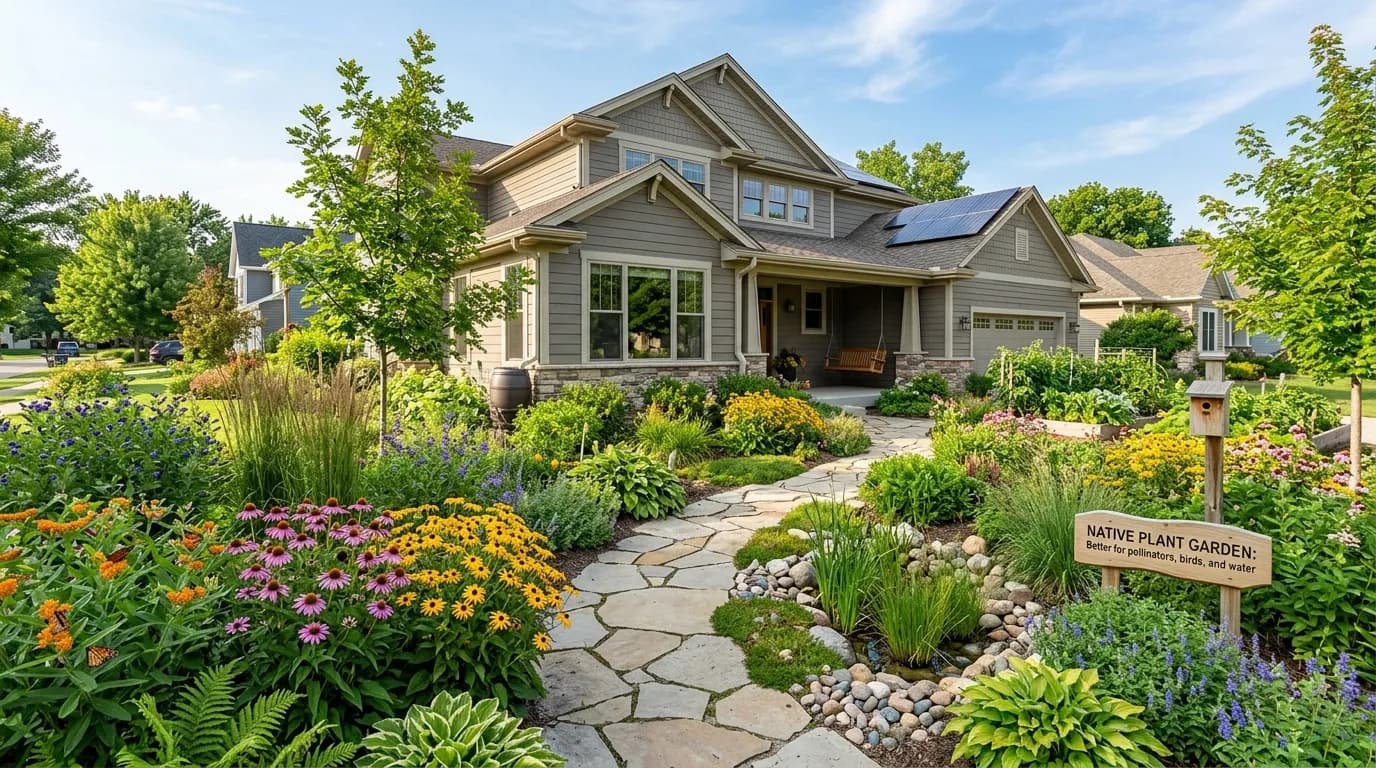
Native plants — species that evolved naturally in your region over thousands of years — offer advantages that no exotic or cultivated variety can match. If you're only going to make one change to your landscaping approach, switching to more native plants might deliver more value than any other single decision.
What Makes a Plant "Native"?
A native plant is one that occurred naturally in a specific region before European colonization. "Native" is always defined relative to a specific geography — a plant native to the Midwest prairies is exotic in the Pacific Northwest. The distinction matters because native plants have co-evolved with your local soil microbiomes, climate patterns, pollinators, and wildlife over millennia.
Important clarification: Most plants sold as "natives" at garden centers are actually native species but may be cultivars (selected varieties with different flower colors or foliage). These cultivars vary in their ecological value — some are as beneficial as wild-type natives, others have been bred in ways that reduce pollen or nectar production. When in doubt, opt for straight native species or "nativar" cultivars known to retain wildlife value.
The 6 Compelling Benefits of Native Plants
1. Dramatically Lower Water Use
Native plants evolved with your local rainfall patterns. They're adapted to your region's wet and dry cycles, which means they've developed root systems capable of tapping deeper water sources and storing moisture through dry periods. Most established native plants in their appropriate region need zero supplemental irrigation after the first 1-2 growing seasons.
In numbers: According to the EPA, conventional landscaping uses 30% of residential water — about 9 billion gallons per day nationally. Native plant landscapes typically use 50-75% less water than conventional landscaping. On a typical $150/month water bill, that's $900-1,350 in annual savings.
2. Elimination of Pesticides
Native plants have co-evolved with local insects and pathogens for thousands of years. They've developed natural chemical defenses against most local pests. As a result, established native plants rarely experience the pest pressures that plague exotic plants — no Japanese beetle infestations on plants that aren't host plants for Japanese beetles, no exotic fungal diseases on plants that evolved with local fungi.
Ecosystem benefit: Pesticides applied to landscapes don't stay in the yard. Runoff carries them into waterways, where they kill aquatic insects, fish, and the birds that depend on them. A native plant garden requires no pesticides and stops contributing to this cycle.
3. Supporting Biodiversity and Wildlife
This is perhaps the most compelling argument for native plants, made famous by entomologist Doug Tallamy in "Bringing Nature Home": native plants support dramatically more wildlife than exotic species.
The numbers from Tallamy's research:
- Native oaks support 557 species of caterpillars
- Non-native Ginkgo trees support 5 caterpillar species
- Chickadees need 350-570 caterpillars just to raise one clutch of babies
- Caterpillars only eat specific native host plants
The implication: a yard full of exotic ornamentals, however beautiful, is a biological desert. A yard with native plants becomes a functioning ecosystem — supporting insects, which support birds, which support the food chain.
4. Carbon Sequestration and Soil Health
Native plants, especially prairie grasses and wildflowers, have evolved remarkably deep root systems — some prairie species have roots extending 10-15 feet underground. These deep roots sequester enormous amounts of carbon, improve soil structure, prevent erosion, and create channels for water infiltration that reduce runoff.
Compared to a turfgrass lawn (shallow roots, 2-4 inches), a native prairie garden can sequester 10x more carbon per acre and reduce stormwater runoff by 80%.
5. Year-Round Interest Without Effort
The best-designed native plant gardens are gorgeous in every season:
- Spring: Early bloomers like trillium, bloodroot, wild blue phlox
- Summer: Prairie standouts like coneflower, black-eyed Susan, bee balm, ironweed
- Fall: Asters, goldenrod, ornamental grasses with dramatic seed heads
- Winter: Seed heads provide food for birds; the structure of grasses holds snow
And unlike annual or exotic plantings, native perennials come back every year without replanting or intensive care.
6. Lower Long-Term Cost
The establishment period (Year 1-2) requires watering, but after that, a properly planted native garden's ongoing costs approach zero. No fertilizer, no pesticides, minimal watering (or none), and most perennials spread slowly to fill in gaps over time — actually reducing planting costs year over year.
5-year cost comparison per 500 sq ft bed:
| Approach | Year 1 | Year 2-5 (each) | 5-Year Total |
|---|---|---|---|
| Traditional annual beds | $400 | $350 | $1,800 |
| Exotic perennial bed | $600 | $200 | $1,400 |
| Native plant garden | $700 | $50 | $900 |
Native Plants by Region
Northeast (Zones 4-7)
Key species: Purple coneflower (Echinacea purpurea), black-eyed Susan (Rudbeckia hirta), New England aster (Symphyotrichum novae-angliae), switchgrass (Panicum virgatum), inkberry holly (Ilex glabra), wild blue indigo (Baptisia australis)
Top tree: Eastern redbud, white oak, serviceberry
Southeast (Zones 7-10)
Key species: Beautyberry (Callicarpa americana), coral honeysuckle (Lonicera sempervirens), muhly grass (Muhlenbergia capillaris), native azaleas, buttonbush
Top tree: Southern magnolia, longleaf pine, live oak
Midwest and Great Plains (Zones 4-6)
Key species: Prairie dropseed (Sporobolus heterolepis), wild bergamot (Monarda fistulosa), Joe Pye weed (Eutrochium purpureum), little bluestem (Schizachyrium scoparium), rattlesnake master
Top tree: Bur oak, river birch, shagbark hickory
Southwest (Zones 7-10)
Key species: Desert marigold (Baileya multiradiata), red yucca (Hesperaloe parviflora), Texas sage (Leucophyllum frutescens), penstemon varieties, black-foot daisy
Top tree: Texas mountain laurel, desert willow, palo verde
West Coast and Pacific Northwest (Zones 6-10)
Key species: California poppy (Eschscholzia californica), manzanita (Arctostaphylos spp.), ceanothus varieties, sword fern, red flowering currant, deer grass
Top tree: Pacific dogwood, madrone, bigleaf maple
How to Transition to Native Plants
Start Small — The Replacement Method
The least overwhelming approach: when an existing plant dies or needs replacing, replace it with a native equivalent. Over 5-7 years, your landscape gradually transitions.
The Bed-by-Bed Approach
Pick one bed per season. Remove existing plants (or phase them out), amend the soil, and plant a cohesive native bed. Each season, one more bed becomes a functioning native habitat.
The No-Mow Zone
Designate a back corner or low-visibility area as a native meadow. Stop mowing, add a few aggressive native grasses and wildflowers, and let it naturalize over 2-3 seasons.
Find the Right Natives for Your Yard
The key is matching natives to your specific conditions — not all natives grow everywhere. Yardcast's AI landscape design tool analyzes your zip code and hardiness zone to recommend native plants that will thrive in your specific yard. See a custom design in both bed options featuring regionally-appropriate natives, with plant lists and installation guides.
[Design a native plant landscape for your yard →](/redesign)