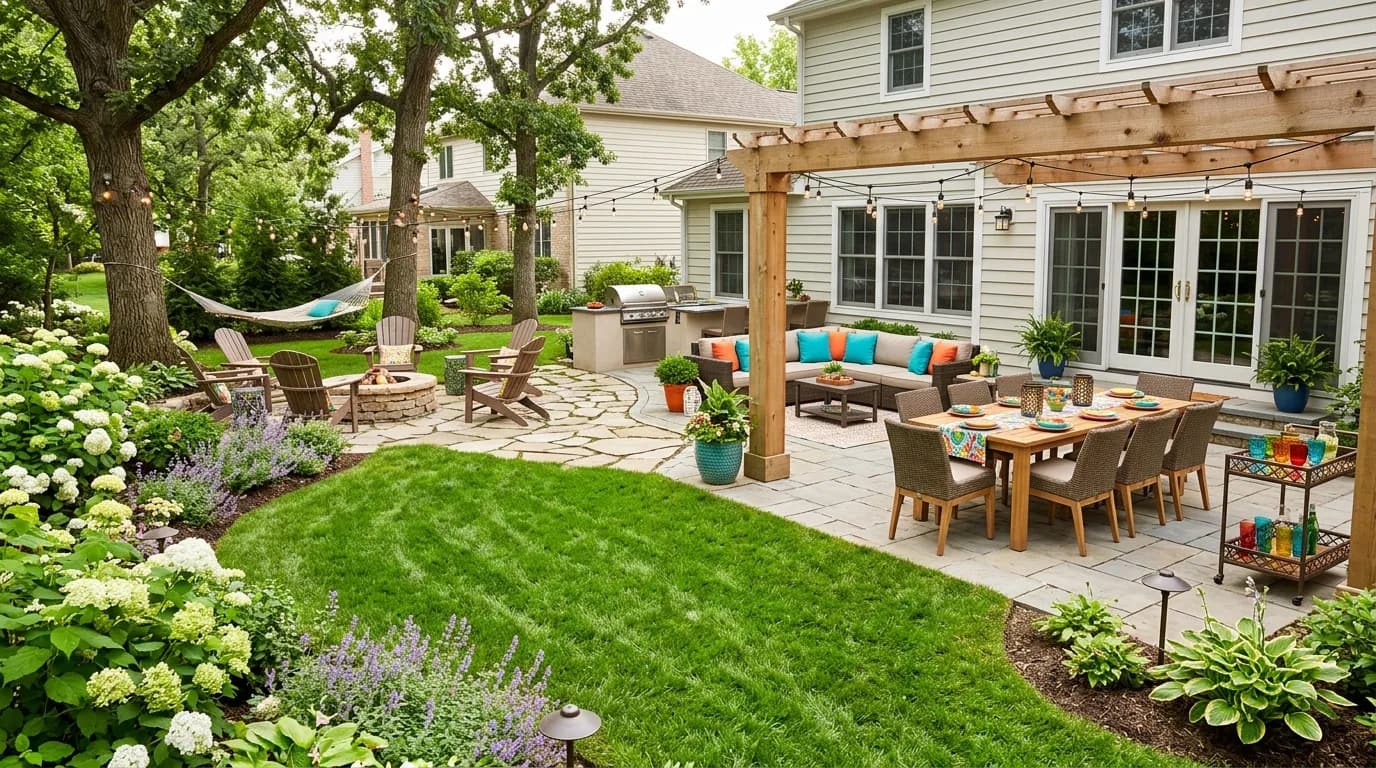
The best outdoor entertaining spaces share one thing in common: they were designed for it. Not stumbled into, not improvised — designed. That means thinking about where people naturally flow, where they gather, how they move between spaces, and what makes them want to stay.
This guide covers 40 concrete outdoor entertaining ideas organized by zone, from dining and cooking to games, lighting, and atmosphere — plus the layout principles that make everything work together.
Why Outdoor Design Makes or Breaks a Party
Bad outdoor entertaining setups share predictable flaws: the grill is too far from the seating, there's no shade for the afternoon host spot, the lighting cuts out at 8pm, the lawn gets torn up after one rainy party, and guests have nowhere comfortable to stand and mingle.
Good design eliminates those problems before they happen. And most of it isn't expensive — it's spatial.
[Before you invest in furniture or a grill, see what your full backyard layout could look like →](/redesign) Upload a photo of your yard and get three AI-generated design concepts showing furniture placement, zones, plantings, and more. Free to preview.
Outdoor Dining Area Ideas
The dining zone is the anchor of any entertaining space. Get this right and everything else falls into place.
1. Define the space with a rug. Outdoor rugs (polypropylene, rated for exterior use) visually anchor a dining set and make it feel like a real room. They're also surprisingly durable — machine washable and fade-resistant.
2. Size up your dining table. Most people undersize. A table for 8 is rarely too big, but a table for 4 at a party of 12 is a disaster. Look for expandable tables (they fold out from 6-seat to 10-seat) or plan for a second table for overflow.
3. Add a buffet surface. Even a folding table covered with a tablecloth gives guests somewhere to set down plates and you somewhere to lay out food. A sideboard or bar cart is better — it's permanent and functional.
4. Use a pergola or shade sail. Afternoon sun is the enemy of outdoor dining. A pergola, shade sail, or large cantilever umbrella at the dining area makes a 3pm dinner party possible. Size it large enough to cover the full table plus chairs with 2 feet of clearance.
5. Install string lights over the dining area. Nothing transforms an outdoor dining area faster than overhead string lights. Run them in a grid or zigzag between posts, trees, or a pergola. Use warm white (2700K) for ambiance — bright daylight white feels clinical.
6. Create a drink station. A bar cart, outdoor mini-fridge, or dedicated drinks table keeps guests from crowding the kitchen. Stock it with ice, glasses, and mixers. Add a decorative lantern or string light above it to make it look intentional.
7. Add seating variety. Don't limit yourself to chairs. Add a bench on one side of the table (more flexible seating, seats more people), a bar-height spot for perchers, or poufs for guests who want to spread out.
8. Elevate with real dinnerware. Melamine plates that look like real ceramic (they're unbreakable) make outdoor dining feel 10× more intentional than plastic. Same goes for acrylic wine glasses — they look like glass, behave like plastic.
Outdoor Kitchen and Cooking Ideas
9. Position your grill strategically. The grill should be close to the kitchen (for ingredient runs) but not crowded into a corner — you need 3 feet of clearance on the sides for safe operation and for the cook to have room without feeling trapped.
10. Add a prep surface next to the grill. A simple stainless steel cart or built-in side shelf gives you somewhere to put raw proteins, resting meat, and tools. This is the single biggest quality-of-life upgrade for outdoor cooking.
11. Consider a pizza oven. Outdoor pizza ovens have become significantly more affordable ($300–$800 for countertop propane models like the Ooni Koda). They run to 900°F and cook a Neapolitan-style pizza in 60 seconds — they're a conversation piece and genuinely great for entertaining.
12. Build a simple outdoor kitchen. A true outdoor kitchen — with a grill, refrigerator, side burner, and counter — runs $3,000–$15,000 professionally installed. But a modular approach (concrete blocks or cinder blocks clad in stucco, with a countertop) costs $800–$2,000 DIY. Look for prefab modular outdoor kitchen components that ship flat.
13. Add a side burner. A propane side burner lets you boil corn, sauté vegetables, or heat a pot of chili without going inside. Essential if you're cooking for 10+.
14. Install outdoor refrigeration. A dedicated outdoor mini-fridge (rated for exterior temperatures) keeps beverages cold without constant ice runs. Look for models rated to 35°F in full sun exposure.
15. Install good task lighting over the cooking area. You shouldn't have to cook in the dark. Gooseneck-style LED lights mounted to a pergola post or fence give you focused light on the cooking surface without blinding nearby guests.
Seating and Lounge Ideas
16. Create a separate lounge zone. The best outdoor entertaining spaces have at least two distinct areas: dining (with a table) and lounge (with a sectional or chairs around a fire feature). This separates conversations and gives the party more room to breathe.
17. Invest in a quality sectional. An outdoor sectional is the highest-impact lounge investment. Look for solution-dyed acrylic fabric (Sunbrella or equivalent) that resists fading, mold, and stains. Avoid polyester — it degrades in UV exposure within 2–3 seasons.
18. Add a fire pit or fireplace as the anchor. A fire feature is the gravitational center of any outdoor lounge. Everyone migrates toward it. Options range from a $200 cast iron fire pit to a $3,000 custom propane fire table. The fire table (with a gas flame behind tempered glass) is the most elegant option for a designed space.
19. Use ottomans as flexible seating. Outdoor ottomans do double duty: they're footrests, extra seats when you need them, and surfaces for drinks. Choose ones that have interior storage for throw blankets.
20. Add a hanging daybed or hammock chair. These are conversation pieces and actual seats people fight over. Hang a woven hammock chair from a pergola beam or standalone frame. For a more structured look, a hanging daybed (a suspended platform with a cushion) becomes the most-requested seat in the yard.
21. Provide blankets for cool evenings. A basket of outdoor-rated throw blankets near the fire pit area extends party time by hours. Guests who get cold leave; guests with blankets stay.
22. Add a porch swing. If you have a covered porch, pergola, or overhang, a porch swing adds charm and additional seating. Two-person swings work for small spaces; three-person swings become a gathering spot.
Designing which zones go where? Layout matters. [See three AI-designed outdoor entertainment layouts for your specific yard →](/redesign)
Outdoor Games and Activities
23. Designate a lawn games area. Even a 20×30 strip of lawn is enough for cornhole, bocce ball, or badminton. Edge it clearly so guests know it's the play zone, not a flower bed to avoid.
24. Install a permanent cornhole frame. Cornhole is the undisputed king of backyard games. A permanent set (painted to match your home's colors, stained wood) looks intentional rather than thrown together.
25. Add a bocce court. A regulation bocce court is 13×90 feet, but a casual backyard version can be 8×60. Define it with timber edging, fill with crushed oyster shell or decomposed granite, and you have one of the classiest backyard games setups possible.
26. Add a lawn bowling (pétanque) circle. Similar to bocce but using metal boules, pétanque requires a 15×30 foot gravel or decomposed granite court. Very French, very stylish.
27. Install a putting green. Synthetic putting greens ($1,500–$5,000 installed) are a niche but impressive entertainer's feature. Guests who golf love them; even guests who don't find them novelty.
28. Hang a giant outdoor movie screen. A 120-inch inflatable projector screen ($80–$200), a decent outdoor projector ($300–$600), and a Bluetooth speaker turn your backyard into a cinema. Movie nights outdoors in summer are genuinely magical.
Lighting Ideas for Outdoor Entertaining
29. Layer your lighting. Great outdoor lighting has three layers: ambient (string lights, lanterns), task (cooking area lights, stair lights), and accent (uplighting trees or features). A space that only has one type of lighting feels flat.
30. Uplight trees and focal points. Spike-mounted LED uplights aimed at trees or an architectural feature (stone wall, pergola post) create dramatic depth and make the yard feel like a resort. Use warm white (2700–3000K) for a golden look.
31. Add path lighting. Low-voltage path lights along walkways serve two functions: safety and ambiance. Solar stake lights are fine for light duty; hardwired low-voltage landscape lights are brighter and more reliable.
32. Use candlelight strategically. Pillar candles in hurricane lanterns on tabletops, floating candles in a water bowl, or real candles in hanging lanterns create a warmth that no LED replicates. Citronella candles pull double duty — light and mosquito deterrence.
33. Install smart outdoor lighting. Smart outdoor bulbs (Philips Hue Outdoor, Govee, or LIFX) let you change color, set schedules, and dim from your phone. Setting up a warm amber scene for a dinner party and transitioning to a party mode with colors afterward requires no wiring — just swap bulbs in standard sockets.
34. Add a fire pit as ambient light. A fire pit isn't just warmth — it's the best ambient light source in any backyard. Position it so it throws light across the lounge area and into the dining zone.
Atmosphere and Experience Ideas
35. Add outdoor speakers. A pair of weather-rated outdoor speakers (Klipsch AW-650, Polk Atrium, or Sonos Move) makes background music feel designed, not improvised. Hardwired to an outdoor receiver is the cleanest solution; Bluetooth speakers work well for occasional use.
36. Plant fragrant plants near the entertaining area. Lavender, rosemary, gardenias, jasmine, and chocolate mint all release fragrance when guests brush against them or a breeze picks up. Fragrance makes outdoor spaces feel lush and deliberate.
37. Create privacy around the entertaining zone. Nobody loves a party on display. A row of arborvitae, a privacy fence section, tall ornamental grasses, or a trellis with climbing vines turns an exposed backyard into an intimate outdoor room.
38. Add a misting system for summer heat. Misting systems spray a fine water mist that evaporates immediately and drops the ambient temperature by 15–20°F. They're available as DIY kits that connect to a standard hose bib ($80–$300) or as permanent installed systems. Essential if you entertain in a hot climate.
39. Use an outdoor rug to define every zone. Outdoor rugs don't just look good — they signal to guests where to gather. A rug under the dining table, another under the lounge sectional, and perhaps a runner along the path from the house all create a sense of intentional, designed spaces.
40. Add a dedicated wet bar or beverage station. A permanent or semi-permanent bar setup — a console table, bar cart, or built-in bar cabinet — positioned between the cooking and lounge zones serves everyone without traffic jams. Stock it with a cocktail shaker, glassware, and a few spirits. Add a small under-counter refrigerator for drinks and ice.
How to Plan an Outdoor Entertaining Layout
All 40 ideas above work better when they're part of a planned layout. The key zones for any outdoor entertaining space:
- 1Cooking zone (grill + prep surface)
- 2Dining zone (table + lighting)
- 3Lounge zone (seating + fire feature)
- 4Activity zone (lawn games, pool)
- 5Transition spaces (paths, steps, drink stations)
Zones should flow naturally — guests should be able to move from cooking to dining to lounge without navigating around obstacles. Paths should be at least 36 inches wide (48 inches preferred for entertaining traffic).
The fastest way to see this come together for your specific yard? Upload a photo to Yardcast and let the AI generate three full outdoor entertaining layout concepts — with furniture placement, planting zones, lighting areas, and cost estimates.
[Design your outdoor entertaining space at Yardcast — free to preview →](/redesign)
FAQ: Outdoor Entertaining Ideas
Q: What's the most important thing to get right when designing an outdoor entertaining space?
A: Flow and shade. Flow means guests can move naturally between cooking, dining, and lounge zones without obstacles. Shade means you can actually use the space on sunny afternoons — without it, many people avoid the yard between noon and 5pm in summer. Get these two things right and everything else is easier.
Q: How much does a well-designed outdoor entertaining space cost?
A: A complete outdoor entertaining setup ranges from $2,000–$5,000 for a furniture + fire pit + string lights upgrade of an existing patio, up to $15,000–$40,000 for a full outdoor kitchen, pergola, professional landscaping, and built-in features. Most homeowners see strong ROI — outdoor living spaces consistently add value at or above cost according to landscape industry data.
Q: What outdoor furniture fabric is best for entertaining?
A: Solution-dyed acrylic (Sunbrella is the industry standard) is far superior to polyester or canvas for outdoor use. It resists fading, mold, mildew, and stains, and can be cleaned with soap and water. The higher upfront cost pays back in a 7–10 year lifespan vs. 2–3 years for cheap polyester.
Q: How do I deal with mosquitoes at outdoor parties?
A: Layered approach: eliminate standing water within 50 feet (breeding grounds), add fans at the dining table (mosquitoes can't fly well in a breeze), burn citronella candles downwind of the seating area, spray with picaridin (less smell than DEET), and consider a mosquito misting system for frequent hosts. Avoid tiki torch oil — it's minimally effective and a fire hazard near guests.
Q: What's the best fire pit for outdoor entertaining?
A: For most hosts, a propane fire table (with a gas flame over glass beads or lava rock, behind a tempered glass surround) beats a wood-burning fire pit. No smoke, no ash, no mosquito-driving flame variations — just consistent, clean ambiance. Budget $400–$1,500 for a quality unit. For larger gatherings and s'mores culture, a large wood-burning ring (36-inch diameter or larger) creates more warmth and energy, at the cost of smoke management.
Q: How do I keep outdoor parties going after dark?
A: Three things: fire (a fire pit or fireplace draws people in after sunset), light (layered string lights, path lights, and candlelight make the space feel welcoming), and warmth (outdoor patio heaters or a fire feature extend the season into fall in most climates). With all three, outdoor parties rarely end because people get cold or dark — they end because it's late.
Q: What's the most underrated outdoor entertaining upgrade?
A: A dedicated beverage/bar station. Having a permanent spot for drinks — separate from the kitchen and the cooking zone — eliminates the single biggest source of party crowding and kitchen traffic. Even a simple console table or bar cart with ice, glassware, and a few bottles makes hosting feel effortless.
Q: How do I design zones in a small backyard?
A: Use furniture scale and rugs to define zones rather than distance. In a 15×25 foot patio, a dining table on a rug in one corner and a two-seat loveseat + fire bowl on another rug in the opposite corner creates two distinct zones that feel intentional. Vertical elements — a pergola over dining, a trellis behind the lounge — reinforce the separation without taking square footage.