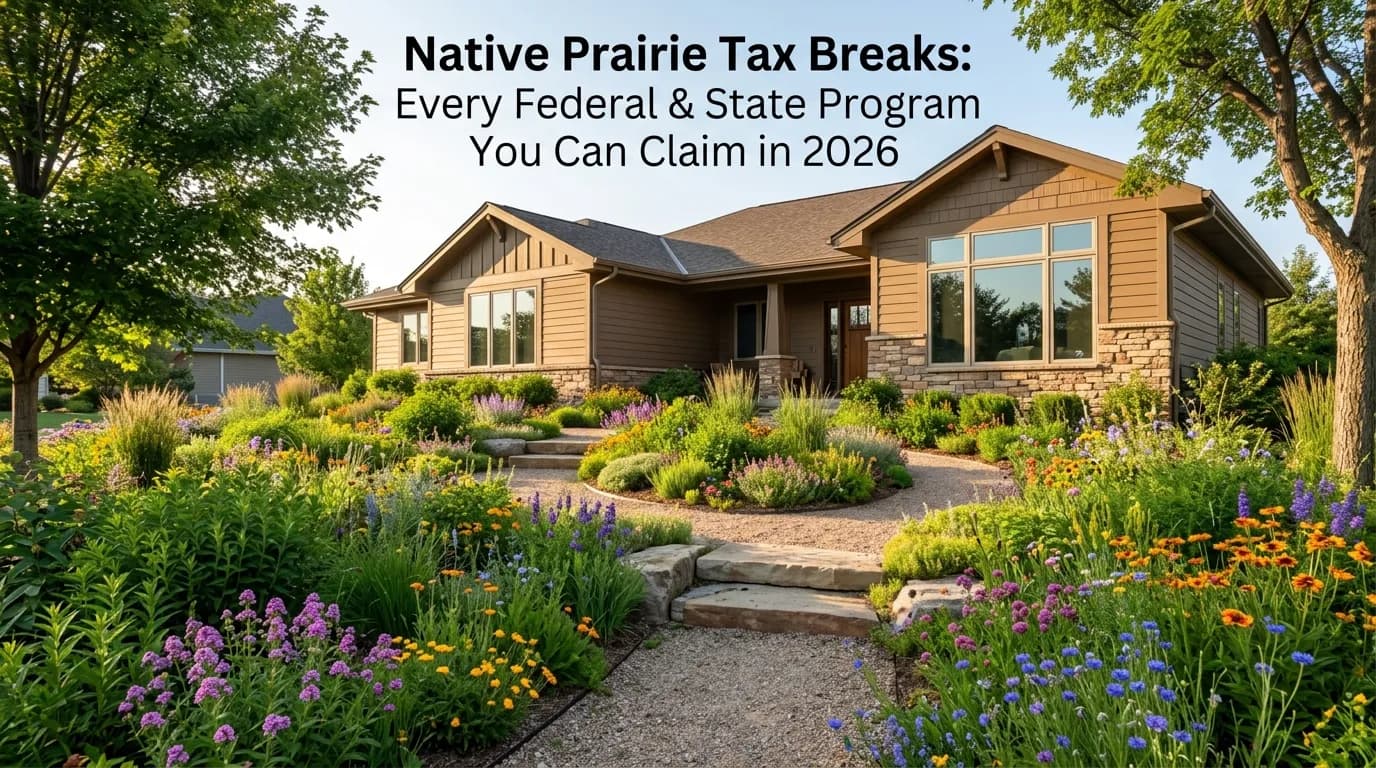
Most homeowners have no idea they can get paid to plant native. The federal government and over 30 states offer property tax reductions, conservation tax credits, cost-share programs, and direct annual payments for converting lawn or unused land to native prairie or meadow habitat.
This guide covers every major program available in 2026, organized by level — federal, state, and municipal.
Federal Programs
EQIP (Environmental Quality Incentives Program)
The USDA's NRCS administers EQIP, which pays landowners up to 75% of the cost of conservation practices — including native habitat restoration.
Who qualifies: Any landowner or land manager. You don't need to be a farmer. Residential properties, commercial properties, and rural land all qualify.
What it covers: Site preparation, native seed purchase, planting labor, equipment rental, ongoing management costs.
How much: Varies by state and practice, but typical cost-share is 50-75% of total project cost. Some historically underserved landowners qualify for 90%.
How to apply: Visit your local NRCS Service Center (every county has one). They'll do a free site assessment and help you through the application. The process takes 2-6 months.
CRP (Conservation Reserve Program)
The USDA's Farm Service Agency (FSA) offers annual rental payments for converting eligible land to native vegetation under 10-15 year contracts.
Who qualifies: Landowners with cropland or marginal agricultural land. The continuous signup option accepts applications year-round for certain practices including native prairie establishment.
How much: $80-300 per acre per year, depending on your region's soil rental rate. Plus a 50% cost-share on establishment costs and a signing incentive payment.
Example: A 5-acre conversion in Iowa at $250/acre/year = $1,250/year for 10-15 years = $12,500-$18,750 total. Plus they pay half the seed and site prep costs.
Conservation Easement Tax Deduction
If you permanently protect your native habitat through a conservation easement (donated to a qualified land trust), the IRS allows you to deduct the appraised value of the easement from your federal income tax.
How much: The deduction can equal 50% of your adjusted gross income per year, carried forward up to 15 years. Qualifying farmers and ranchers can deduct 100% of AGI.
Example: If your 10-acre native prairie easement is appraised at $100,000 and your AGI is $80,000, you can deduct $40,000 in year one and carry the remaining $60,000 forward.
CSP (Conservation Stewardship Program)
For land already in native habitat or conservation practices. Provides ongoing annual payments for maintaining and improving habitat quality.
State Programs by Region
Upper Midwest
Minnesota has the strongest native prairie protection in the country. Native prairie land is fully exempt from property tax under the Native Prairie Tax Exemption. The state also offers a Prairie Tax Credit for restoration.
Iowa offers a Prairie Heritage Fund tax credit and property tax exemption for land managed as native prairie. The state also has a Resource Enhancement and Protection (REAP) tax credit.
Illinois provides conservation stewardship tax credits. The Illinois Nature Preserves Commission can designate your prairie as a Nature Preserve, providing permanent protection and tax benefits.
Indiana offers the Classified Wildlife Habitat program, which can reduce property taxes by up to 50% on land managed for wildlife habitat including native prairie.
Ohio extends its Current Agricultural Use Valuation (CAUV) to conservation land, significantly reducing property tax assessments.
Northeast
Maryland offers a Conservation Property Tax Credit for land in conservation, including native habitat.
New York provides a Conservation Easement Tax Credit of 25% of the school district taxes on the easement property.
Connecticut has Open Space Tax Assessment that reduces property tax on land preserved in natural state.
Multiple municipalities throughout the Northeast offer stormwater fee credits of 25-100% for properties with native rain gardens, bioswales, or prairie plantings that reduce runoff.
Southeast
Virginia has one of the most generous programs: the Virginia Land Conservation Tax Credit allows a tax credit of 50% of the donated value of a conservation easement, up to $1 million, with a carry-forward period.
North Carolina offers a Conservation Tax Credit for qualified donations of property interests for conservation purposes.
Georgia provides the Conservation Use Valuation Assessment (CUVA), which assesses property at its conservation use value rather than fair market value, dramatically reducing property taxes.
Mountain West
Colorado leads the nation with its Conservation Easement Tax Credit, offering a state income tax credit of up to $1.5 million for donated conservation easements.
Montana offers an Open Space Land classification that reduces property tax on land maintained as open space, including native habitat.
Pacific Northwest
Oregon has the Wildlife Habitat Conservation and Management program, which reduces property taxes on land managed for wildlife habitat.
Washington has the Open Space Taxation Act, which assesses land at its current use value rather than highest and best use when maintained as open space.
Municipal Programs (Often Overlooked)
Many cities and counties offer stormwater utility fee credits for properties with:
- Native rain gardens that capture runoff
- Permeable surfaces
- Native prairie or meadow plantings
- Green roofs with native vegetation
These credits can reduce stormwater fees by 25-100%. Contact your local stormwater utility to find out what's available.
How to Get Started
- 1Call your county NRCS office — free site assessment, free program guidance
- 2Contact your county assessor — ask about conservation/wildlife habitat property tax classifications
- 3Check your state's conservation agency — each state has programs beyond what we've listed
- 4Call your municipality — ask about stormwater fee credits
- 5Consult a tax professional — conservation tax deductions can be complex
- 6Contact a local land trust — they handle conservation easements
The money is there. You just have to apply for it.
Ready to see what a native prairie looks like on YOUR property? Use our AI design tool to visualize it, then apply for the programs that fit your situation. Check our complete native prairie guide for regional seed mixes and installation instructions.