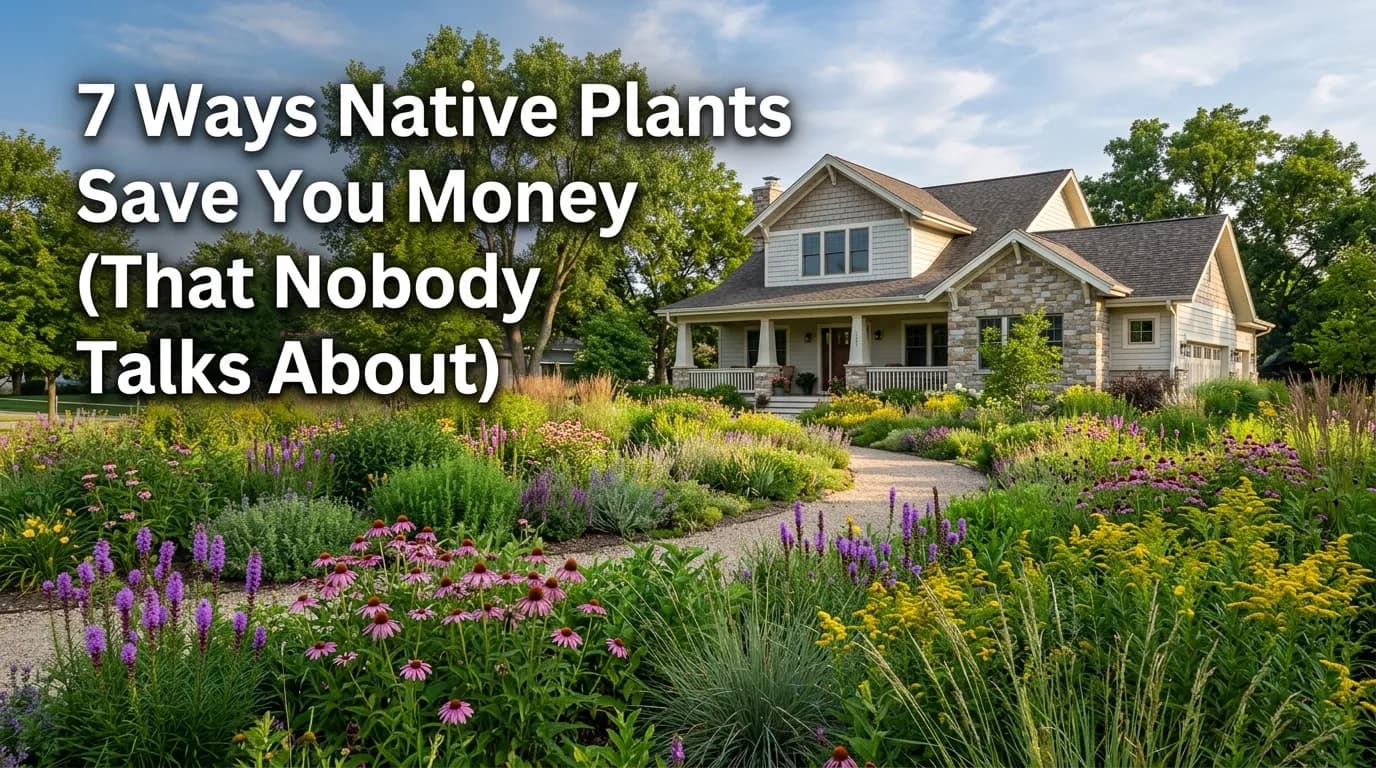
Everyone knows native plants reduce mowing costs. But the financial benefits go way deeper than most people realize. Here are 7 money-saving advantages of native landscaping that are rarely discussed.
1. Stormwater Fee Credits ($50-500/year)
If you live in a city or suburb, you're probably paying a stormwater utility fee — typically $5-50/month based on the amount of impervious surface (roof, driveway, patio) on your property.
Many municipalities offer credits of 25-100% for properties that manage stormwater on-site with:
- Native rain gardens
- Bioswales
- Permeable surfaces
- Prairie plantings that absorb runoff
How to claim: Contact your local stormwater utility and ask about credit programs. Some require a simple application; others need a site inspection. The credit applies every billing cycle as long as you maintain the practice.
Example: Louisville, KY found that its urban trees and native plantings provide $389 million in annual stormwater management benefits to the city.
2. Reduced Energy Bills ($100-400/year)
Strategically placed native trees and shrubs can reduce home energy costs by:
- Summer cooling: Shade trees on the south and west sides of your home can reduce air conditioning costs by 15-35%
- Winter windbreaks: Evergreen plantings on the north/northwest side reduce heating costs by 10-25%
- Ground temperature: Native groundcover and prairie grasses keep soil cooler than bare ground or pavement, reducing the heat island effect around your home
The USDA Forest Service estimates that properly placed trees save homeowners $100-400/year in energy costs.
3. Zero Chemical Input ($200-600/year)
Native plants evolved in your local ecosystem. They don't need:
- Fertilizer: $200-400/year eliminated
- Herbicide: $100-200/year eliminated
- Pesticide: $50-150/year eliminated
- Fungicide: $25-75/year eliminated
Beyond the direct cost savings, you also eliminate the health and environmental costs of chemical exposure — something increasingly important to families with children and pets.
4. Property Tax Reductions ($100-2,000+/year)
Over 30 states offer property tax reductions for land managed as wildlife habitat, native prairie, or conservation land. Programs include:
- Direct property tax exemption (Minnesota's native prairie exemption)
- Reduced assessment value (Indiana's Classified Wildlife Habitat — up to 50% reduction)
- Conservation use valuation (Georgia's CUVA — assessed at conservation value, not market value)
Even a modest 10-20% reduction on a $300,000 property could save $300-600/year in property taxes — every single year.
5. Increased Property Value (5-12%)
Multiple studies confirm that well-designed native landscaping increases property value:
- University of Vermont: 5-12% increase
- USDA Forest Service: 7% average increase from mature trees and native plantings
- National Association of Realtors: 75% of agents say landscaped homes sell faster
- Virginia Tech: native plantings with defined borders increased buyer willingness to pay by 8-12%
On a $400,000 home, a 7% increase = $28,000 in added value.
The key insight: Your native landscape must be DESIGNED, not just planted. Clean edges, intentional plant placement, mowed borders around meadow areas — this signals "this is on purpose" rather than "this is neglected."
6. USDA Direct Payments ($80-300/acre/year)
Through the CRP (Conservation Reserve Program), EQIP, and CSP, the federal government will literally pay you to plant native:
- CRP: $80-300/acre/year in rental payments for 10-15 years
- EQIP: Pays 50-75% of establishment costs
- CSP: Ongoing annual payments for habitat management
These aren't small checks. A 5-acre prairie conversion in a good soil rental rate area could generate $1,000-1,500/year in CRP payments.
7. Avoided Infrastructure Costs ($500-5,000+ over time)
Native plantings prevent expensive problems:
- Erosion control: Native roots (6-15 feet deep) prevent soil erosion that can damage foundations, driveways, and drainage systems. Fixing erosion damage: $2,000-10,000+
- Foundation protection: Deep-rooted natives manage soil moisture, reducing foundation heaving and cracking. Foundation repairs: $5,000-30,000+
- Drainage management: Rain gardens and bioswales handle stormwater naturally, reducing the need for French drains ($2,000-6,000) or regrading ($1,000-3,000)
- Irrigation system elimination: No irrigation system means no $3,000-8,000 installation, no winterization, no repairs, no replacement every 15-20 years
The Total Picture
Adding up all 7 savings for a typical suburban property:
| Savings Category | Annual Savings |
|---|---|
| Eliminated lawn maintenance | $2,000-3,000 |
| Stormwater fee credits | $50-500 |
| Energy bill reduction | $100-400 |
| Chemical elimination | $200-600 |
| Property tax reduction | $100-2,000 |
| USDA payments (if applicable) | $0-1,500 |
| Avoided infrastructure | $200-500 (amortized) |
| Total annual savings | $2,650-8,500 |
Over 20 years at the midpoint ($5,000/year): $100,000 in total savings. Plus property value increase.
Native landscaping isn't just an environmental choice — it's one of the smartest financial decisions a homeowner can make.
Take the First Step
See what native landscaping looks like on YOUR property →
Read the complete tax break guide →