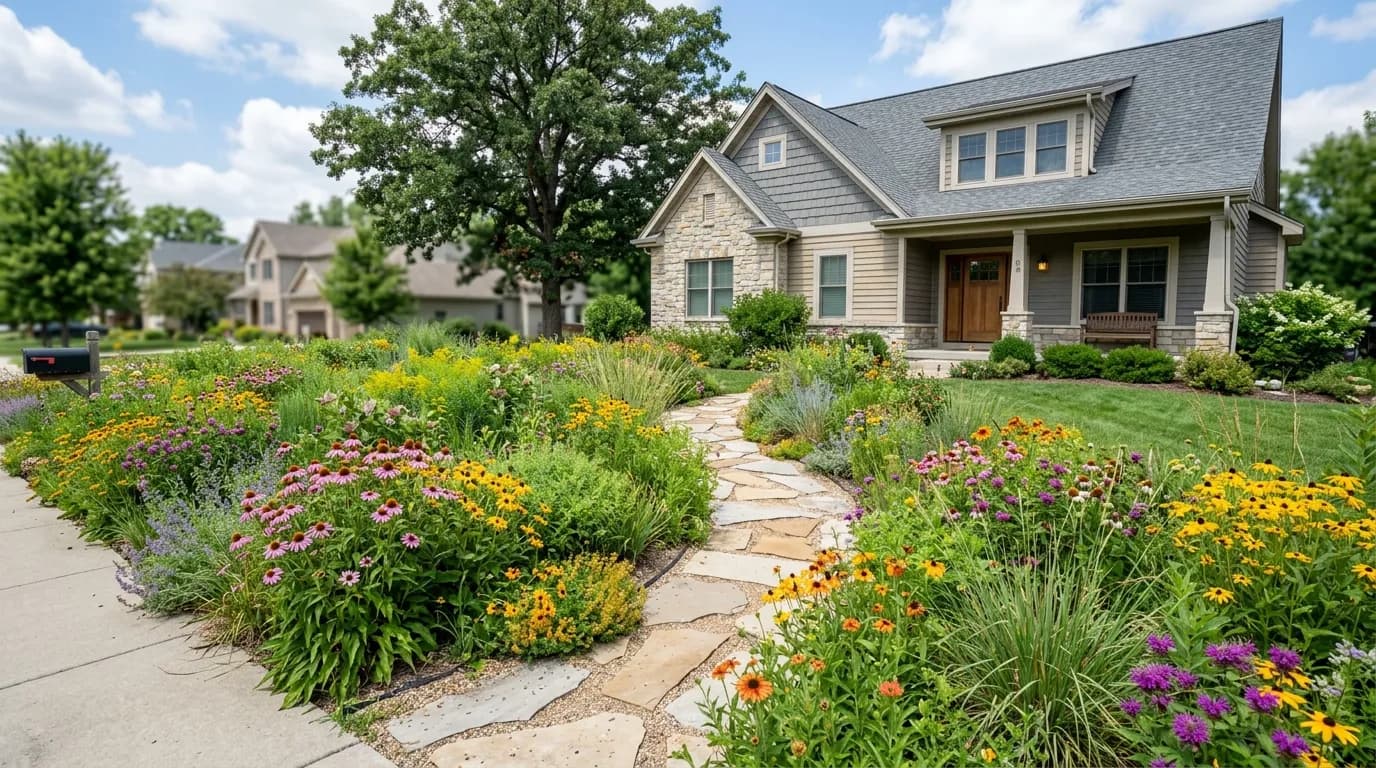
Starting a native prairie is one of the best decisions you'll make as a homeowner. But there's a lot of bad advice out there. This guide cuts through the noise and gives you the actual process that works — whether you're converting a 100 sq ft corner bed or an entire acre.
Before You Start: The Mindset Shift
A native prairie is NOT a lawn. It operates on completely different principles:
Lawn mindset: Control everything. Kill what doesn't belong. Force uniformity.
Prairie mindset: Establish the community. Let nature manage itself. Embrace diversity and seasonal change.
The first year will test your patience. Your prairie will look like weeds. Your neighbors might comment. That's normal. The saying is: "First year sleeps, second year creeps, third year leaps."
Trust the process.
Step 1: Site Assessment (1-2 Days)
Test Your Soil
Buy a $10 soil test kit or send a sample to your state extension office ($15-25 for a complete analysis). You need to know:
- pH: Most prairie plants prefer 5.5-7.5
- Soil type: Clay, sand, or loam (all work — you just choose different species)
- Drainage: Where does water pool? Where does it drain fast?
Map Your Sun
Walk your site at 8 AM, noon, and 4 PM on a clear day. Mark full sun (6+ hours), partial sun (3-6 hours), and shade. Most prairie species need full sun.
Check Regulations
- HOA: More and more allow native plantings. Many states have "Right to Garden" laws that override HOAs. Keep a mowed border (18-24 inches) around your prairie to show intentionality.
- Municipal codes: Some cities have height restrictions for vegetation (typically 8-12 inches in front yards). Prairies exceed this. Check if native plantings are exempt.
- Fire regulations: If you plan to use controlled burns for maintenance, check local burn permit requirements.
Contact NRCS
Visit your county's NRCS office (free). They'll:
- Assess your soil and site
- Recommend native species for your area
- Tell you which federal/state programs you qualify for
- Possibly pay for most of your project through EQIP
Step 2: Choose Your Approach
Option A: Small Test Patch (100-400 sq ft)
Best for: First-timers, skeptics, HOA-controlled neighborhoods
Convert a landscape island, the strip between sidewalk and street, or a section along the back fence. Low risk, high learning value. You can always expand later.
Cost: $50-200 in seed
Option B: Partial Conversion (1,000-5,000 sq ft)
Best for: Most homeowners
Keep lawn around the house for play and entertaining. Convert side yards, back corners, slopes, and hard-to-mow areas. Create a naturalized edge between lawn and prairie.
Cost: $100-500 in seed
Option C: Full Conversion (half acre+)
Best for: Rural properties, eco-focused homeowners, large lots
Go all in. Keep only a mowed path through the prairie and a maintained area near the house. Maximum ecological impact, maximum savings.
Cost: $150-400/acre in seed
Step 3: Site Preparation (4-8 Weeks)
This is the most important step. Existing grass and weeds MUST be eliminated before seeding, or they'll outcompete your native seeds.
Method 1: Smother (Best for most people)
- 1Mow existing vegetation as short as possible
- 2Cover with overlapping cardboard (no tape/staples visible)
- 3Top with 2-3 inches of compost or aged mulch
- 4Wait 6-8 weeks (spring/summer) or over winter
- 5The grass underneath dies and decomposes
Pros: No chemicals, builds soil, easy
Cons: Takes 6-8 weeks, cardboard can blow in wind
Method 2: Solarization (Best for small areas)
- 1Mow short
- 2Cover with clear plastic sheeting, secure edges with stones/soil
- 3Sun heats soil to 140°F+ killing seeds, roots, and pathogens
- 4Wait 4-6 weeks in summer
Pros: Kills weed seeds too, sterilizes soil
Cons: Only works in summer, plastic waste
Method 3: Repeated Mowing (Slowest but simplest)
- 1Mow to 1 inch every week for an entire growing season
- 2This exhausts grass root reserves
- 3In fall, scalp-mow to bare soil and seed
Pros: No materials needed
Cons: Takes a full season, less effective on aggressive grasses
Step 4: Select Your Seed Mix
The Formula
A good prairie seed mix is approximately:
- 60% native grasses (the structural backbone)
- 40% native wildflowers (the color, the pollinators)
- 15-25 species minimum (diversity = resilience)
By Region
Upper Midwest (Zones 3-5):
Grasses: Big Bluestem, Little Bluestem, Switchgrass, Prairie Dropseed, Side-Oats Grama, Indian Grass
Wildflowers: Purple Coneflower, Black-eyed Susan, Wild Bergamot, Blazing Star, Goldenrod, Milkweed, Aster, Baptisia
Great Plains (Zones 4-7):
Grasses: Buffalo Grass, Blue Grama, Big Bluestem, Little Bluestem, Western Wheatgrass
Wildflowers: Blanket Flower, Coneflower, Prairie Clover, Leadplant, Compass Plant
Northeast (Zones 4-7):
Grasses: Little Bluestem, Switchgrass, Purple Lovegrass, Virginia Wild Rye
Wildflowers: New England Aster, Butterfly Weed, Bee Balm, Joe Pye Weed, Cardinal Flower
Southeast (Zones 7-9):
Grasses: Switchgrass, Eastern Gamagrass, Muhly Grass, Split-beard Bluestem
Wildflowers: Blazing Star, Goldenrod, Partridge Pea, Ironweed, Tickseed Coreopsis
Where to Buy
Buy from regional native seed suppliers — NOT big box stores. Look for:
- "Local ecotype" or "source-identified" seed from within 200 miles
- PLS (Pure Live Seed) rating on the label
- Species appropriate for your specific state/county
Top suppliers: Prairie Moon Nursery, Ernst Seeds, Shooting Star Native Seeds, Roundstone Native Seed, Hamilton Native Outpost (varies by region).
Step 5: Seeding
When to Seed
Best: Late fall (November-December) — "dormant seeding." Seeds naturally stratify (cold treatment) over winter and germinate in spring when conditions are right. This is how prairies work in nature.
Also good: Early spring (March-April) after last frost. Cold-stratify seeds in your refrigerator for 4-6 weeks before spring planting if they haven't been pre-treated.
How to Seed
- 1Mix seed with sand — 4 parts sand to 1 part seed. This helps distribute tiny seeds evenly.
- 2Broadcast by hand (small areas) or with a seed spreader (large areas)
- 3Make two passes — half the seed going north-south, half going east-west for even coverage
- 4Rake lightly — seeds should be at or just below the soil surface (1/8 to 1/4 inch). DO NOT bury deep.
- 5Roll or walk — good seed-to-soil contact is critical. Walk the entire area or use a lawn roller.
- 6Do NOT mulch heavily — a very light straw cover (you should see 50% soil through it) is okay. Heavy mulch smothers native seeds.
Step 6: Year 1 Management (The Ugly Phase)
Your prairie will look terrible the first year. This is normal and expected. Here's what's happening:
Above ground: Annual weeds (foxtail, ragweed, lambsquarters) dominate. Your native seeds are barely visible — tiny grass blades and small wildflower rosettes.
Below ground: Your native grasses are building root systems 3-6 feet deep. They're investing 80% of their energy underground. The weeds are investing 80% above ground.
What to Do
- Mow to 6 inches whenever weeds reach 12 inches (usually 2-3 times in summer)
- This suppresses annual weeds without cutting native seedlings (which are shorter)
- DO NOT use herbicide — it will kill your native seedlings
- DO NOT water (unless extreme drought threatens seedling survival)
- DO NOT fertilize — native plants don't need it, and fertilizer helps weeds
- DO NOT pull weeds by hand — you'll disturb native seedlings' roots
The hardest part: Doing nothing. Trusting that the roots are growing underground even though the surface looks like a mess.
Step 7: Year 2 (The Creep Phase)
Native grasses start to fill in visibly. First wildflowers appear — usually Black-eyed Susan, Blanket Flower, and other early bloomers. Annual weeds decrease as native perennials establish dominance.
- Mow once in early spring (before native growth begins) to 4-6 inches
- Spot-pull any aggressive perennial weeds (thistles, etc.)
- Enjoy the first flowers
- Take photos — you'll want to compare to Year 3
Step 8: Year 3+ (The Leap)
Your prairie explodes. Native grasses reach full height (3-6 feet). Wildflowers bloom in succession from spring through fall. The root system is now 6-15 feet deep. Butterflies, bees, and birds move in.
Ongoing Maintenance (2-4 hours per year)
- One mow or controlled burn in late winter/early spring (February-March). Burns are ideal — they recycle nutrients, suppress woody invaders, and stimulate vigorous spring growth. Mowing to 4-6 inches is the alternative.
- Optional spot weeding if aggressive invasives appear
- Nothing else. No water. No fertilizer. No pesticide. Ever.
Common Mistakes to Avoid
- 1Skipping site prep — Seeding into existing grass is the #1 reason prairies fail
- 2Planting too deep — Prairie seeds are tiny. Surface or barely covered.
- 3Mowing too short in Year 1 — 6 inches, not 2 inches
- 4Panicking in Year 1 — It WILL look like weeds. That's normal.
- 5Using too much straw — Light cover only, or none
- 6Buying non-local seed — Local ecotype is important for adaptation
- 7Watering established prairie — They don't need it and overwatering encourages weeds
- 8Adding fertilizer — Natives evolved in low-nutrient soils. Fertilizer gives weeds the advantage.
Start Today
You can start planning your prairie right now:
- 1Browse our native plant profiles — 163 species with care guides and photos
- 2Take the free Native Planting course — 35 minutes, covers everything
- 3Visualize YOUR prairie with AI — upload a photo, see the transformation
- 4Read the complete tax break guide — find programs in your state
- 5Call your county NRCS office (free) — they'll assess your site and connect you to funding
The best time to start a prairie was 3 years ago. The second best time is this fall.