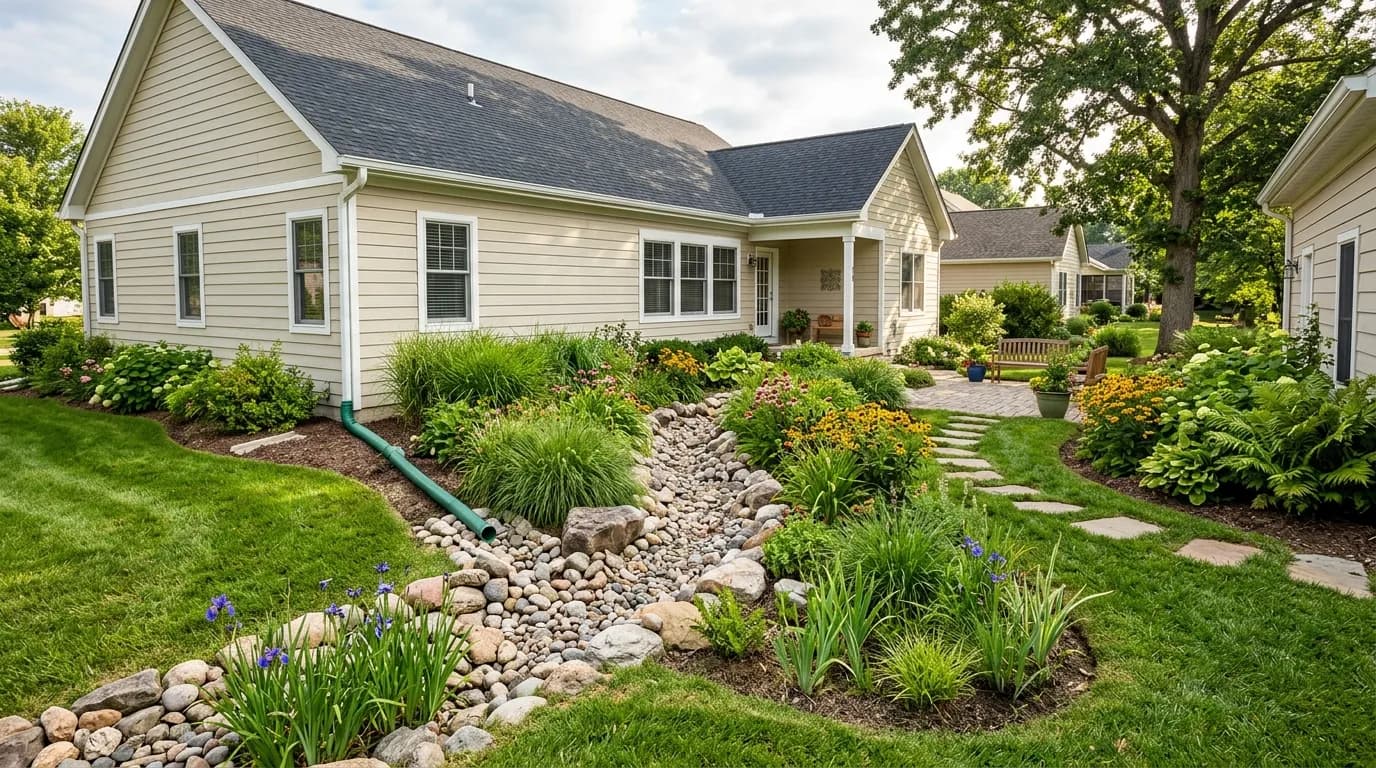
Bad drainage destroys foundations, kills plants, and makes yards unusable. The good news: most drainage problems have straightforward solutions.
Diagnose the Problem First
Signs of Poor Drainage
- Standing water 24+ hours after rain
- Soggy/mushy lawn areas
- Water pooling against foundation
- Moss or algae growing in lawn
- Basement dampness or leaking
- Erosion channels after rain
- Mosquito breeding areas
Common Causes
- 1Negative grade — ground slopes toward the house instead of away
- 2Clay soil — drains extremely slowly (less than 0.1 inch/hour)
- 3Compacted soil — heavy foot traffic or construction compacted the subsoil
- 4Downspout discharge — gutters dumping water at the foundation
- 5High water table — underground water level is near the surface
- 6Hardscape runoff — driveway, patio, or neighbor's property sheets water onto your yard
Solution 1: Fix Grading (The Foundation Fix)
The ground should slope away from your house at a minimum of 1% grade (1 inch drop per 8 feet). This is the single most important drainage principle.
How to fix it:
- 1Identify low spots with a 4-foot level and tape measure
- 2Add topsoil to create positive grade away from foundation
- 3Extend the grade at least 6–10 feet from the house
- 4Compact gently, seed or sod
Cost: $500–$2,000 DIY | $1,500–$5,000 professional
Effectiveness: Solves 60% of foundation water issues alone
Solution 2: French Drain
A perforated pipe buried in a gravel-filled trench that collects and redirects underground water.
How it works:
- 1Dig a trench 12–18" deep, 6–12" wide, sloped at 1% toward discharge point
- 2Line with landscape fabric
- 3Add 2" of gravel
- 4Lay 4" perforated pipe (holes facing down)
- 5Cover with gravel to within 2" of surface
- 6Fold landscape fabric over top
- 7Cover with topsoil or decorative rock
Cost: $10–$15/linear foot DIY | $25–$50/linear foot professional
Best for: Collecting groundwater, intercepting water flow from uphill
Solution 3: Dry Well
An underground chamber that collects runoff and lets it percolate into the soil slowly.
How it works:
- 1Dig a hole 3–4 feet deep, 3 feet diameter
- 2Fill with large gravel (4–6" stones) or install a prefab dry well basin
- 3Connect inlet pipe from problem area
- 4Cover with landscape fabric and backfill
Cost: $200–$500 DIY | $500–$1,500 professional
Best for: Collecting roof runoff, downspout discharge, small area drainage
Solution 4: Extend Downspouts
The easiest fix if your problem is foundation water from gutters.
Options:
- Splash blocks: $5–$15 each. Minimum solution.
- Downspout extensions: Rigid or flexible pipe extending 6–10 feet from house. $10–$30 each.
- Underground discharge: Buried pipe carrying water to a dry well or street. $200–$500 per downspout.
- Rain barrels: Capture and store water for garden use. 50–100 gallons each. $50–$200.
Solution 5: Rain Garden
A shallow, planted depression designed to capture and absorb runoff. The most beautiful drainage solution.
How to build:
- 1Locate at least 10 feet from foundation, in a natural low spot
- 2Dig a bowl-shaped depression 6–12" deep
- 3Amend soil with 50% compost for absorption
- 4Plant with native plants that tolerate both wet and dry conditions
- 5Add 2–3" mulch layer
Best plants for rain gardens:
- Switchgrass, blue flag iris, cardinal flower, Joe Pye weed, sedges, winterberry holly
Cost: $200–$800 DIY | $1,000–$3,000 professional
Benefit: Handles 30% more water than lawn, filters pollutants, attracts pollinators
Solution 6: Channel Drain (Trench Drain)
A narrow surface drain installed across driveways, patios, or anywhere sheet water flows.
Cost: $20–$40/linear foot installed
Best for: Driveway water entry to garage, patio runoff, between yard and hardscape
Solution 7: Catch Basin
A below-grade box with a grate that collects surface water and pipes it elsewhere.
Cost: $150–$400 each installed
Best for: Large low spots, areas where surface water collects
Solution 8: Swale
A shallow, broad ditch (like a gently sloping channel) that directs water flow across property. Can be planted with grass or native plants.
Cost: $2–$5/linear foot (grading only)
Best for: Large properties, redirecting overland flow, naturalistic landscapes
Solution 9: Pop-Up Emitter
A below-grade pipe that terminates in a pop-up valve at the discharge point. When water pressure builds, the valve pops open and releases water. When flow stops, it closes to prevent debris entry.
Cost: $50–$150 each (plus pipe)
Best for: Clean discharge points for downspout or French drain systems
Solution 10: Sump Pump (Interior)
For basements with chronic water intrusion. A pit collects water, pump discharges it outside.
Cost: $300–$600 DIY | $1,000–$3,000 professional
Best for: Basements below water table, serious foundation water issues
What NOT to Do
- 1Don't fill low spots with topsoil without fixing the cause — water will just puddle somewhere else
- 2Don't pipe water to your neighbor's property — this is illegal in most jurisdictions
- 3Don't ignore foundation water — a $500 grading fix now prevents a $15,000 foundation repair later
- 4Don't install a French drain without slope — a level French drain is just a trench full of water
- 5Don't use landscape fabric as a standalone solution — it doesn't solve drainage, only filters sediment
When to Call a Professional
- Foundation cracks or basement flooding
- Water table issues (need engineering)
- Municipal stormwater connections (permits required)
- Grading that involves heavy equipment
- Drainage affecting multiple properties
Every Yardcast design includes a drainage analysis with specific recommendations based on your yard's terrain, soil type, and local climate. No standing water, no guessing.