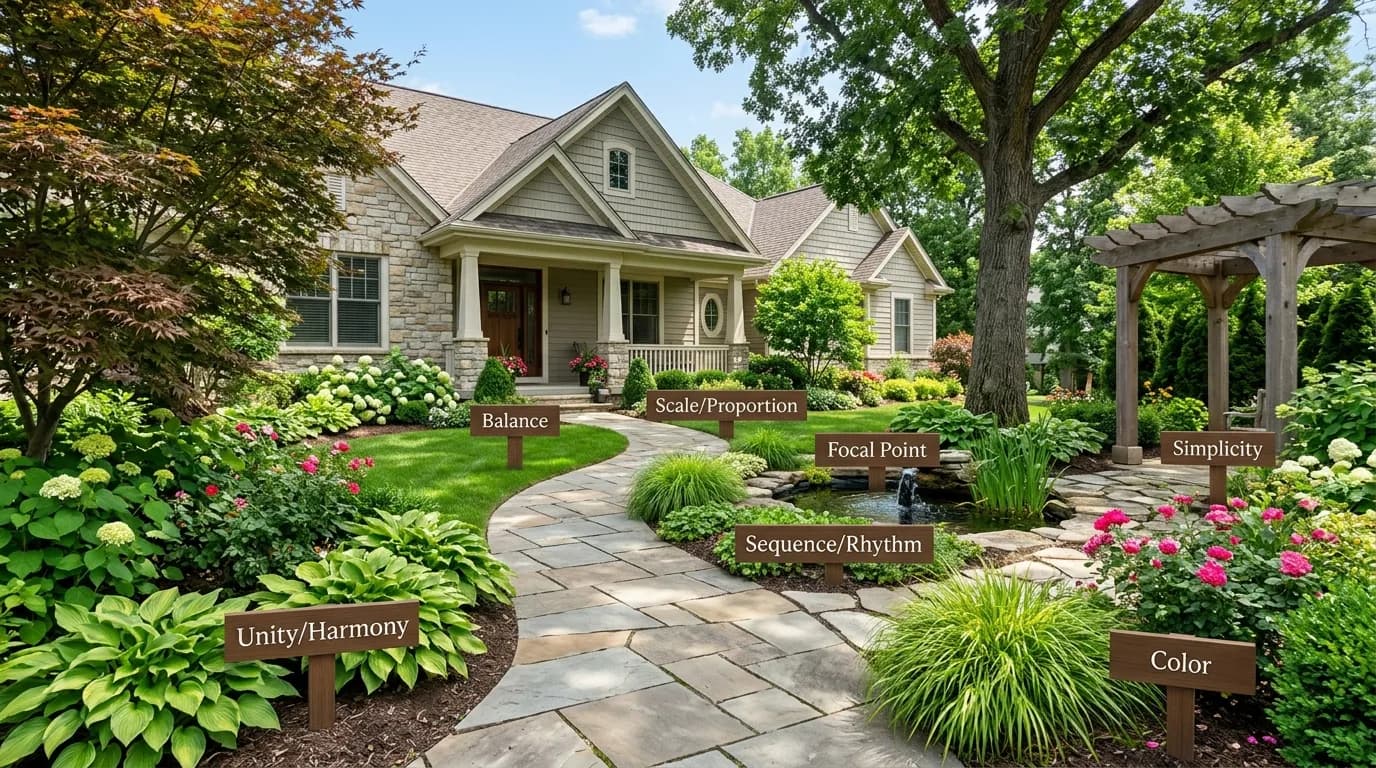
Walk into any award-winning garden and you'll feel something — maybe it's calm, maybe it's energy, maybe it's awe. That feeling isn't an accident. It's the result of deliberate design principles that professional landscape architects have refined over centuries.
Here are the 7 principles that separate a "nice yard" from a "wow, who designed this?"
1. Unity
Unity is the most important principle and the hardest to achieve. A unified design feels like one complete composition, not a collection of random plants.
How to create unity:
- Limit your palette. Use 10-12 plant species maximum. Repeat 2-3 anchor plants throughout the entire design.
- Choose a consistent material. If your patio is flagstone, use flagstone for stepping stones and wall caps too.
- Pick a theme. Modern, cottage, tropical — commit to one. A Japanese maple next to a cactus looks confused.
- Use one dominant color + 1-2 accent colors. A garden with 15 different flower colors is a carnival, not a design.
The echo principle: Take your 2-3 best plants and repeat them in at least 3 different locations. This creates visual rhythm — your eye connects the dots and perceives the whole space as intentional.
2. Balance
Balance is about visual weight on each side of a center point (real or imagined).
Symmetrical balance (formal): Mirror the left side on the right. Two matching rows of boxwood flanking a front door. Two identical urns on a patio. This creates authority and tradition — perfect for colonial and traditional homes.
Asymmetrical balance (informal): Different elements with equal visual weight. A large tree on the left balanced by a mass planting of shrubs on the right. A boulder balanced by a drift of ornamental grasses. This feels natural and dynamic.
Rule: One axis of symmetry is powerful. Two axes feel rigid. Zero feels chaotic. Pick one and commit.
3. Proportion & Scale
Proportion is the size relationship between elements. Scale is the size relationship between elements and their environment.
The golden rules:
- 1:3 ratio: Hardscape (patio, paths) should be about 1/3 of the total landscape area, with 2/3 planting. This feels right to the human eye.
- Plant height: The tallest plant in a bed should be no more than 1/2 the width of the bed. A 4-foot-wide bed? Keep plants under 2 feet tall.
- Tree scale: A canopy tree's mature spread should not exceed 1/3 of the lot width. A 50-foot lot? Plant a tree with a 15-foot canopy, not a 40-foot oak.
- Foundation plantings: Should be 2/3 the height of the wall they're against. Against an 8-foot wall, plant shrubs that mature at 5-6 feet.
4. Focalization (Focal Points)
Every great garden has a focal point — something that grabs your eye and anchors the composition. Without one, the eye wanders aimlessly.
What makes a good focal point:
- Contrast: Something different from its surroundings (a red maple in a sea of green)
- Position: At the end of a sight line, at path intersections, or at the center of a view from key windows
- Uniqueness: A specimen plant, a water feature, a sculpture, an unusual tree form
Rules:
- One primary focal point per garden "room." More than one creates competition.
- Frame focal points with flanking plants. A Japanese maple looks 10x better between two boxwoods than floating alone.
- Light it. The focal point should be the brightest thing in the garden after dark.
5. Line & Movement
Lines create movement and emotion. They determine how people physically and visually move through the space.
Straight lines → formal, forceful, direct. They lead the eye quickly to a destination. Use for modern designs, formal gardens, and direct paths.
Curved lines → informal, natural, mysterious. They slow the walker down, create discovery, and hide what's around the bend. Use for cottage gardens, natural designs, and woodland paths.
Vertical lines (columnar trees, tall grasses) → draw the eye up, make spaces feel larger, create energy.
Horizontal lines (low walls, ground-hugging plants) → create rest, calm, stability.
The design rule: Use ONE dominant line type. If your paths curve, your bed edges should curve too. A curving path with straight-edged beds feels conflicted.
6. Texture
Texture is the visual and tactile quality of plant surfaces. It's the most underused design principle — and the one that separates good gardens from great ones.
Coarse texture (large, bold leaves — hosta, hydrangea, elephant ear):
- Advances visually — makes things feel closer
- Creates intimacy — use near seating areas
- Holds attention — dramatic, eye-catching
- Use sparingly — too much feels heavy
Medium texture (average leaves — boxwood, viburnum, roses):
- Connects and transitions between coarse and fine
- Background player — doesn't compete for attention
- The "glue" that holds the design together
- Use liberally — 50-60% of your palette
Fine texture (small, delicate leaves — ornamental grasses, ferns, lavender):
- Recedes visually — makes things feel farther away
- Creates depth — makes small spaces feel larger
- Adds airiness and movement
- Use at the perimeter to extend perceived boundaries
The golden ratio: Coarse at focal points and near seating → medium in the middle → fine at the edges and perimeter. This gradient makes any yard feel twice as large.
7. Color
Color in the garden comes from flowers, foliage, bark, fruit, and hardscape. Professional designers use color theory — the same color wheel artists use.
Color schemes:
- Complementary (opposite colors): Purple + yellow, blue + orange. Maximum contrast, high energy. Use in entertaining areas.
- Analogous (adjacent colors): Purple + blue + violet, or red + orange + yellow. Harmonious, calming. Use in relaxation areas.
- Monochromatic (one color, different shades): All white, all blue, all pink. Sophisticated, elegant. Use in small spaces.
Warm colors (red, orange, yellow) advance — they feel closer and more energetic. Plant near entertainment spaces.
Cool colors (blue, purple, white) recede — they feel farther and calmer. Plant at the far edge to add perceived depth.
Green is a color. Designers often forget that green foliage comes in dozens of shades — chartreuse, emerald, blue-green, silver-green. An all-green garden with great texture variety is more sophisticated than a random flower explosion.
Putting It All Together
The best designs use all 7 principles simultaneously, but you don't need to think about all of them at once. Start with unity (pick a style and limited palette), add a focal point, choose your line type, and the rest will follow naturally.
Yardcast applies all 7 principles automatically — our AI design engine scores plants for color theory, texture gradient, and spatial layering, then generates compositions that follow professional design rules.
Try it yourself → — professional design principles, $29.99.