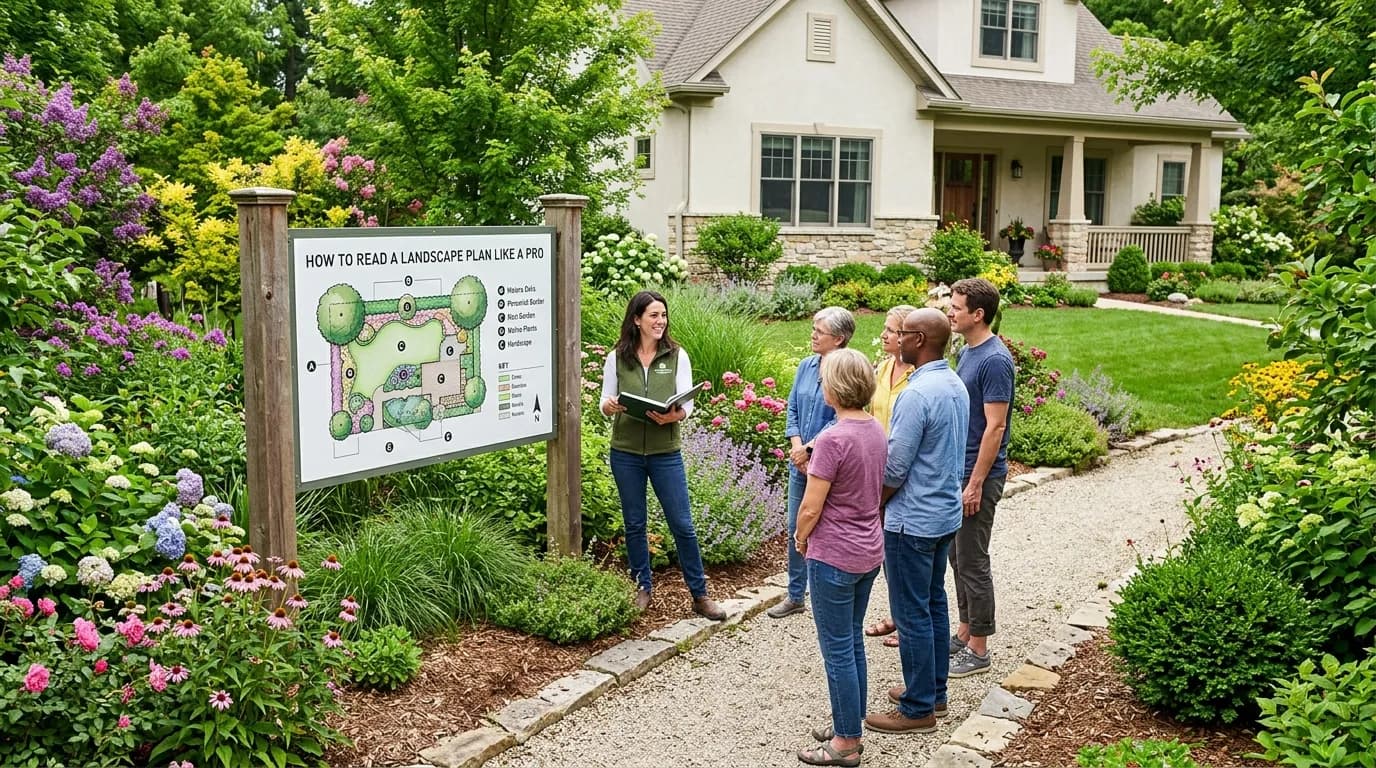
Whether you've received a professional landscape plan or generated one with AI, understanding how to read it is essential. Landscape plans use standardized symbols, scales, and conventions that can look like hieroglyphics to the uninitiated.
Here's your complete guide.
The Overhead View (Plan View)
The most common landscape drawing is the plan view — a bird's-eye view looking straight down at the property. Everything is shown from above:
- Circles represent trees and shrubs at their mature spread (not how big they are when planted)
- Irregular shapes represent planting beds
- Hatching (parallel lines) indicates paved areas
- Dashed lines show underground elements (irrigation, drainage, utilities)
- Solid lines show edges, walls, and property boundaries
The Scale Bar
Every professional plan includes a scale bar — usually something like "1 inch = 10 feet." This lets you measure actual distances on the plan. If a tree circle is 2 inches wide on the plan with a 1"=10' scale, the tree's mature canopy will be 20 feet across.
Pro tip: Always check the scale bar when comparing plants. Two trees that look the same size on the plan might be very different in reality if the scale changed between sheets.
Plant Symbols
Plants are drawn as circles viewed from above, sized to their mature width:
- Large solid circles (15-30ft): Canopy trees — the biggest elements in the design
- Medium circles (6-12ft): Shrubs and small trees
- Small circles with dots (2-4ft): Perennials and accents
- Elongated ovals: Ornamental grasses
- Tiny dot clusters: Groundcovers
- Hatched circles: Evergreen trees/shrubs (they keep their leaves year-round)
Each plant symbol has a label — usually an abbreviation with a quantity. For example, "JM (3)" means 3 Japanese Maples.
The Plant Schedule
The plant schedule is the "legend" for all those abbreviations. It's a table that lists:
| Symbol | Botanical Name | Common Name | Qty | Size | Spacing |
|---|---|---|---|---|---|
| JM | Acer palmatum | Japanese Maple | 3 | 15 gal | 20' o.c. |
| LH | Hydrangea paniculata | Limelight Hydrangea | 7 | 3 gal | 6' o.c. |
"o.c." means "on center" — measured from the center of one plant to the center of the next. So "6' o.c." means each plant is 6 feet from the next.
Container sizes tell you how big the plant is at purchase:
- 4" pot: Small perennial, $5-10
- 1 gallon: Small shrub or perennial, $8-15
- 3 gallon: Medium shrub, $15-30
- 5 gallon: Large shrub, $25-50
- 15 gallon: Small tree, $100-200
- 24" box: Large tree, $300-800
Elevation Drawings
Elevation drawings show the design from the side — like looking at a dollhouse with the front wall removed. They reveal:
- How tall each plant will grow at maturity
- The layering — canopy trees in back, shrubs in middle, groundcovers in front
- Height relationships between the house, fence, and plantings
- Where gaps exist that need filling
This is the drawing that answers the question "will my neighbor still be able to see into my yard?"
Hardscape Plans
Hardscape elements include anything built (not planted):
- Patio/deck: Usually shown with a pattern fill (herringbone for brick, grid for pavers)
- Pathways: Shown with parallel lines indicating edges
- Walls: Thick lines with hatching on the "solid" side
- Water features: Shown with wavy lines or blue fill
- Fire pit: Circle with an "X" through it
Grading and Drainage
Grading plans show how water flows across the property:
- Arrows indicate water flow direction
- Contour lines show elevation changes (closer together = steeper)
- "+" symbols indicate high points, "−" indicates low points
- Dashed lines with arrows show drainage pipe runs
- "CB" marks catch basins, "RG" marks rain gardens
Irrigation Plans
Irrigation plans show the watering system:
- Circles with wedges show spray head coverage patterns
- Dotted lines show drip irrigation runs
- Squares mark valve boxes
- "POC" marks the point of connection to the water supply
- Different colored zones indicate different watering schedules
How to Review Your Plan
When you receive a landscape plan (AI-generated or human-designed), check these things:
- 1Scale — Does everything fit? Measure key distances.
- 2Mature sizes — Are plant circles drawn at mature width? Will things overlap in 5 years?
- 3Spacing — Do plants have room to reach mature size without crowding?
- 4Sight lines — From key viewpoints (kitchen window, patio, front door), does the design frame views or block them?
- 5Sun/shade — Are sun-loving plants in the sunny spots and shade plants in the shade?
- 6Drainage — Does water flow away from the house, not toward it?
- 7Access — Can you still reach the hose bib, AC unit, and gates?
Get Your Own Professional Plan
Generate a complete landscape plan — including aerial layout, elevation profile, plant schedule, and 36+ pages of professional documentation — in 40–60 seconds.