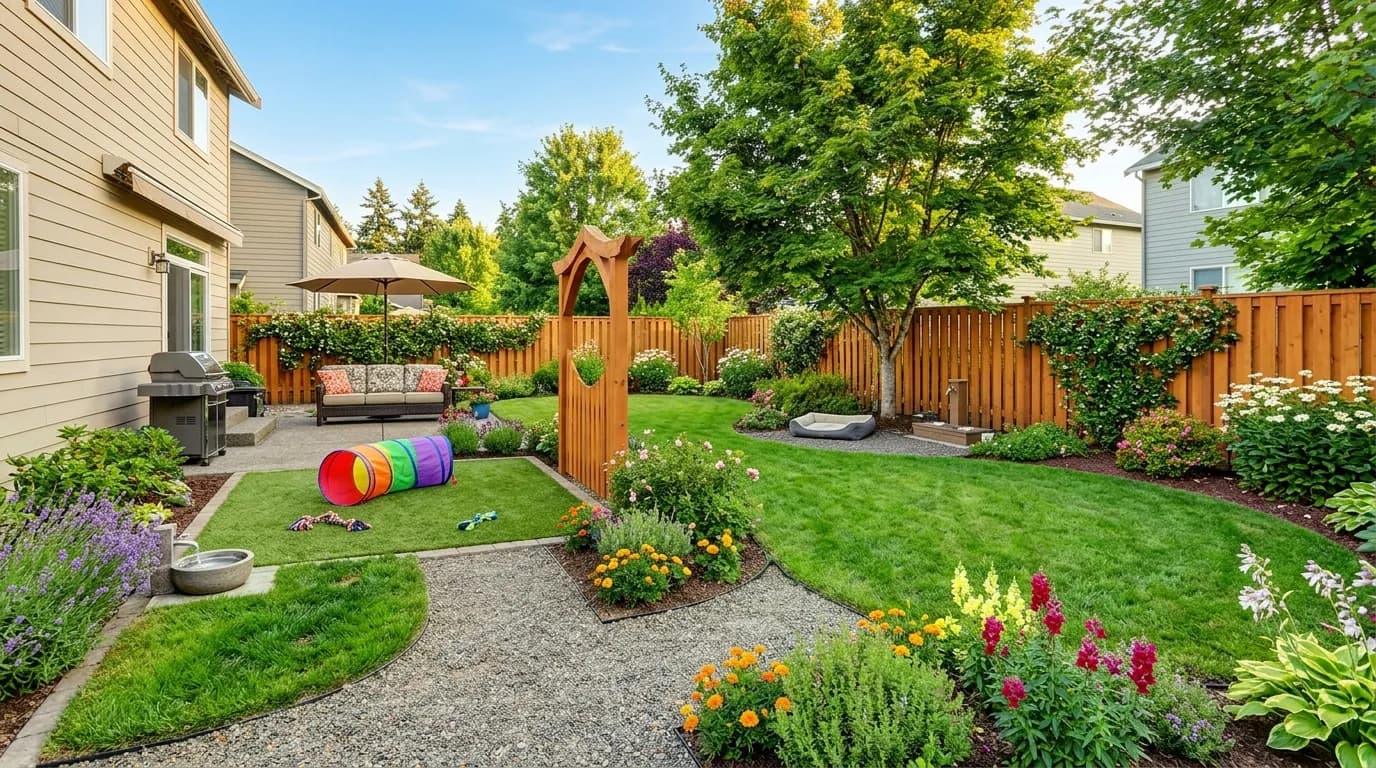
Your dog doesn't care about your landscaping. They care about running, digging, sniffing, and rolling in whatever smells interesting. A backyard designed without dogs in mind gets destroyed in one season — dug-up beds, dead grass, trampled plants, muddy paths worn into the lawn.
But designing with your dog in mind from the start? That's how you get a yard that's beautiful, functional for humans, and genuinely great for your dog — without the constant battle between your landscaping and their instincts.
These 35 ideas cover everything: fencing, ground covers, plant safety, dedicated play zones, and design strategies that survive even the most energetic dogs.
Why Most Backyards Fail Dogs (and Owners)
The typical backyard has three dog-unfriendly design flaws:
- 1Lawn monoculture — Grass is beautiful when untouched, but dog urine burns yellow spots, heavy play creates bare runs, and wet dogs track mud everywhere. Grass also has no defined "dog zone" — dogs go everywhere.
- 1Fragile or toxic plants — Many popular landscaping plants are toxic to dogs: sago palm, oleander, foxglove, Japanese yew, azalea. A dog-friendly yard requires auditing every plant for safety.
- 1No designated path — Dogs naturally run the same routes repeatedly. Without a designed path, they create their own — usually right through your best flower bed.
The fix: design with zones. A dedicated dog run or play area satisfies your dog's need to patrol and play. Defined paths channel their movement. Tough, non-toxic plants survive the contact they'll inevitably get.
Fencing First: Containment and Safety
1. Go taller than you think you need. Most people underestimate their dog's jumping ability. A 6-foot fence is the minimum for medium-to-large breeds. Athletic dogs (huskies, border collies, Belgian Malinois) need 8-foot fencing or a coyote roller system at the top. Measure your dog's standing reach and add 18 inches minimum.
2. Choose a dig-proof fence base. Many dogs dig under fences, not over them. Solutions: bury hardware cloth (heavy-gauge wire mesh) 12–18 inches below grade along the fence line, or pour a concrete footer along the fence bottom. Alternatively, bury large flat pavers horizontally along the base.
3. Consider a dedicated dog run. A fenced dog run — typically 4×10 to 6×20 feet depending on dog size — gives your dog a contained space and keeps the rest of the yard clean and landscaped. Line the floor with pea gravel or decomposed granite (drains urine, easy to hose down), and include shade.
4. Use horizontal or offset panel fencing for security. Horizontal fence boards without footholds are harder for dogs to climb. Avoid chain link if you have climbers — it's an easy ladder.
5. Ensure no gaps at base or gates. Check fence gaps after installation. Even a 4-inch gap is large enough for small dogs. Self-latching, dog-proof gate latches are essential — dogs figure out basic latch mechanisms fast.
Dog-Friendly Ground Covers
One of the most impactful decisions in a dog-friendly yard is what covers the ground. Here's a comparison:
| Ground Cover | Dog Urine Resistance | Durability | Maintenance | Best For |
|---|---|---|---|---|
| Bermuda grass | Medium | High | Medium | Warm climates, active dogs |
| Fescue blend | Low | Medium | Low | Zones 5–7, moderate activity |
| Clover lawn | High | High | Very low | All climates, eco-friendly |
| Pea gravel | Excellent | Very high | Low | Dog runs, paths |
| Decomposed granite | Excellent | Very high | Low | Dry climates, pathways |
| Artificial turf | Excellent | Very high | Low (rinse regularly) | Small yards, high-use areas |
| Mulch (cedar) | Good | Medium | Medium | Beds and borders |
6. Plant clover as a lawn alternative. White clover (Trifolium repens) and microclover resist dog urine far better than traditional grass, fix nitrogen instead of burning from it, and tolerate heavy foot traffic. A clover lawn is naturally soft, stays green in drought, requires no fertilizer, and mows at a high setting. It's also non-toxic to dogs — they can graze on it freely.
7. Use pea gravel in the dog run zone. Pea gravel (3/8 inch, rounded) is the single best material for a dedicated dog run. It drains urine immediately, doesn't hold odor, stays cool underfoot, and is easy to hose down. Depth: 3–4 inches over a compacted base. Dogs can dig in it but rarely go all the way through.
8. Install decomposed granite paths along fence lines. Dog patrol routes (along fence lines, between gates) are the highest-traffic areas in any yard. Install 18–24 inch wide decomposed granite paths along these routes so the adjacent lawn stays healthy.
9. Consider artificial turf for small yards. In small yards or urban spaces, artificial turf (specifically pet-grade with permeable backing) eliminates urine burn, is soft on paws, and looks consistently green. Requires periodic rinsing with a hose and enzyme cleaner to eliminate odor — but far less maintenance than real grass with dogs.
Dog-Safe Plants (Non-Toxic)
These plants are confirmed safe for dogs by the ASPCA and can be used throughout your yard without concern:
10. Roses (Rosa spp.) — Thorns are a minor hazard but the plant itself is non-toxic. Knockout roses are nearly indestructible.
11. Sunflowers (Helianthus annuus) — Tall, cheerful, and completely safe. Dogs might knock them over but won't be harmed by eating them.
12. Snapdragons (Antirrhinum) — Non-toxic annual that provides color without risk.
13. Asters — Fall-blooming perennial, safe for dogs, and attracts pollinators.
14. Camellia — Beautiful evergreen shrub, non-toxic to dogs and cats.
15. African violet — Non-toxic, great for shaded areas.
16. Bamboo — Non-toxic (real bamboo, Bambusa genus), though the running types can become invasive. Use clumping bamboo.
17. Blueberry shrubs — Dogs can eat blueberries and the plants are safe. A bonus: free dog treats in summer.
18. Impatiens — Classic shade annual, non-toxic, and tolerates dog contact.
19. Ferns (most varieties) — True ferns like Boston fern and sword fern are non-toxic. Avoid asparagus fern (toxic) and bracken fern.
20. Magnolia trees — Large and architecturally stunning; leaves, flowers, and bark are non-toxic.
Plants to Remove or Avoid
21. Remove sago palm immediately. Sago palm (Cycas revoluta) is one of the most deadly plants for dogs — a single seed can cause fatal liver failure. If you have one, remove it. Zero tolerance.
22. Keep dogs away from azaleas and rhododendrons. These popular foundation shrubs contain grayanotoxins that cause vomiting, weakness, and potentially dangerous cardiac effects in dogs.
23. Foxglove is toxic. Beautiful plant, but all parts of foxglove (Digitalis) are toxic — causes serious cardiac arrhythmia.
24. Japanese yew (Taxus cuspidata) — Extremely toxic. One of the most common landscape shrubs and one of the most deadly to dogs. Avoid entirely.
25. Lantana — The berries in particular are toxic. Keep dogs away from fruiting lantana.
26. Oleander — All parts are highly toxic. Fatal in small quantities. Remove if you have dogs.
> Ready to design a dog-friendly backyard that looks as good as it functions? Yardcast generates 3 professional landscape designs from your yard photos — specify "dog-friendly" in the style notes and get a design your whole family (including the four-legged ones) will love. Free to preview.
Dedicated Play Zones and Dog Features
27. Build a dig zone. Dogs dig. Instead of fighting it, give them a designated digging spot — a sandbox or a bed of loose soil and mulch in a back corner. Bury toys to encourage them to dig there instead of your flower beds. Define the zone clearly with edging so they understand the boundary.
28. Add a dog water feature. A small, low ground-level water bowl fountain or pet-safe water trickle keeps dogs hydrated and occupied in summer heat. Many dogs love playing in water — a small splash pad (off area, hose-fed) provides entertainment and keeps them cool.
29. Create a shaded rest area. Dogs overheat quickly. Ensure there's a shaded lounging spot — under a tree, beneath a pergola, or an actual dog house or shade sail. Concrete and dark paving radiates heat; provide a shaded surface with pea gravel, grass, or wood decking.
30. Install a pet-safe misting system. In hot climates (Zones 8–12), a misting system along a fence line or pergola keeps dogs cool without excessive water use. These low-pressure systems are low-cost to install and can drop ambient temperature 15–20°F.
31. Design a dog agility area. For high-energy breeds (border collies, Australian shepherds, labs), a small agility circuit — a low jump, weave poles, a tunnel — provides mental and physical stimulation that reduces destructive behavior. Many sets are under $100 and can be relocated.
32. Add pet-grade turf in a small "bathroom zone." Designate one corner for bathroom use, train your dog to use it, and line it with pet-grade turf or pea gravel. This concentrates urine damage to one replaceable spot instead of spreading it across the entire lawn.
Design Strategies for Dog Owners
33. Define beds with raised edging dogs can't easily cross. A 6–8 inch Belgian block or stone edging border creates a physical and visual barrier between beds and lawn. Many dogs learn to respect this boundary. It also protects plant roots from foot traffic.
34. Use large-scale, structural plants in beds. Small, delicate plants at dog nose height get sniffed, stepped on, and knocked over. Use large ornamental grasses, robust shrubs, and hedging plants that can take contact. Karl Foerster grass, Knock Out roses, and arborvitae withstand dog traffic far better than delicate perennials.
35. Plan paths wide enough for dogs AND people. A 4-foot wide path accommodates a person and a dog walking side-by-side — and dogs naturally want to walk with you. Decomposed granite or flagstone paths in a generous width look intentional and direct dog traffic away from planted areas.
Visualize Your Dog-Friendly Backyard Before You Build
Planning a dog-friendly yard is a balancing act — safety, durability, and aesthetics don't always point in the same direction. Yardcast's AI landscape design tool generates 3 photorealistic designs from your yard photos, incorporating your style preferences, climate zone, and functional requirements. Specify dog-friendly needs and see how the space can look before committing to a single plant or fence post.
Preview 3 professional designs for free at yardcast.ai/redesign — no account required, results in under 60 seconds.