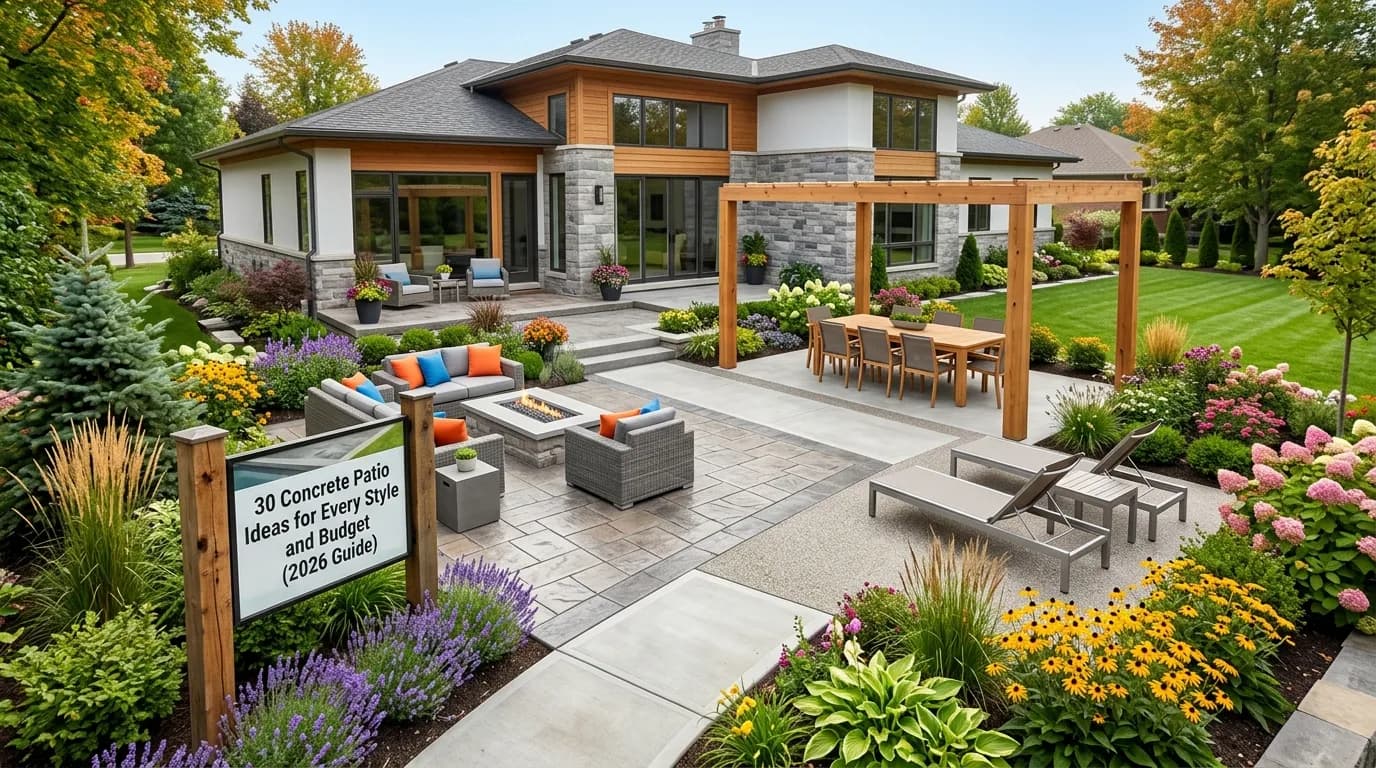
# 30 Concrete Patio Ideas for Every Style and Budget (2026 Guide)
A concrete patio is one of the best investments you can make in your outdoor space. It's durable, low-maintenance, endlessly customizable, and — compared to pavers, flagstone, or wood decking — surprisingly affordable. Whether you want a sleek modern slab or a textured surface that mimics natural stone, concrete delivers.
This guide covers 30 concrete patio ideas across every style and budget, complete with real 2026 cost ranges and design tips to help you get started.
Ready to visualize your patio as part of a complete yard transformation? Get 3 AI landscape designs free →
Plain and Brushed Concrete Patios
1. Standard Brushed Concrete
The classic. A broom-finished concrete slab has a lightly textured surface that improves traction, drains well, and ages gracefully. No frills, no extra cost — just a clean, functional surface.
Cost: $6–$10/sq ft installed | Most DIY-friendly
Best for: Utility-first spaces — behind garages, service areas, or as a base for furniture
2. Salt-Finish Concrete
Salt-finish concrete is created by pressing coarse rock salt into wet concrete then washing it out as it cures. The result is a subtly pitted, dimpled texture that looks intentional and provides excellent slip resistance.
Cost: $7–$11/sq ft installed
Best for: Pool surrounds, humid climates, barefoot-traffic areas
3. Exposed Aggregate Concrete
Aggregate concrete uses pebbles, crushed stone, or glass exposed at the surface by washing away the top layer of cement paste before it fully cures. The result is a textured, speckled surface with significant visual depth.
Cost: $8–$15/sq ft | Professional installation recommended for uniformity
Material options: River pebble, granite chips, recycled glass, quartz, or colored crushed stone
Best for: Modern, spa-style, or coastal aesthetics
4. Large Format Concrete Slab
A single poured concrete slab — often 20×30 feet or larger — creates a clean, bold, minimal aesthetic. Pair it with crisp landscape edging, linear plantings, and simple furniture for a high-design look.
Cost: $7–$12/sq ft
Design tip: Control joints (the saw-cut lines) can be planned as a design element rather than hidden
5. Concrete With Integrated Control Joints
Control joints prevent cracking — but they can also look intentional. On a large slab, plan the joint pattern as a grid, pinwheel, or diagonal design to create visual interest without any additional materials.
Cost: No extra cost — just planning
Decorative Concrete Patios
6. Stamped Concrete — Ashlar Slate Pattern
Stamped concrete uses textured rubber mats pressed into wet concrete to create patterns that mimic natural stone. The ashlar slate pattern (staggered rectangular cuts) is one of the most popular residential patterns.
Cost: $12–$20/sq ft | Professional installation required for consistent pattern
Colors available: 40–60 base pigment options; can add antiquing release agent for depth
Best for: Traditional, transitional, and colonial-style homes
7. Stamped Concrete — Cobblestone Pattern
The cobblestone stamp mimics old European street paving. Paired with a warm tan or sandstone pigment and dark grout line coloring, it creates a romantic, timeless aesthetic.
Cost: $13–$22/sq ft
Best for: French country, Tuscan, Mediterranean, or cottage-style homes
8. Stamped Concrete — Wood Plank Pattern
The wood plank stamp is one of the most convincing mimics in decorative concrete. From a distance, it looks remarkably like natural wood decking — without the rot, splinters, or refinishing required.
Cost: $14–$22/sq ft
Best for: Homes with existing wood trim or siding; cabin or farmhouse aesthetics
9. Stamped Concrete — Random Stone / Fieldstone Pattern
The fieldstone or random stone pattern mimics the look of hand-laid flagstone. Because each "stone" is irregular, installer imperfections are less visible — making this one of the more forgiving stamped patterns.
Cost: $12–$20/sq ft
10. Stamped Concrete — Herringbone Brick Pattern
The classic herringbone brick pattern gives a traditional, East Coast formal aesthetic. Pairs beautifully with red accent pigments, dark grout lines, and symmetrical garden plantings.
Cost: $13–$21/sq ft
Best for: Colonial, Federal, or traditional architectural styles
Stained and Colored Concrete Patios
11. Acid-Stained Concrete
Acid staining is one of the most striking decorative concrete techniques. A dilute acid solution reacts chemically with minerals in the cured concrete to produce mottled, marbled colors that vary across the surface — no two acid-stained slabs look alike.
Colors: Earth tones — warm browns, burnt oranges, sage greens, and turquoise blues are possible
Cost: $5–$15/sq ft applied to existing slab | Process cannot be reversed — test first
Best for: Modern, eclectic, or bohemian aesthetics
12. Integral Color Concrete
Pigment is mixed directly into the concrete before pouring. The result is uniform color throughout the slab — not just on the surface — so chips and scratches don't expose a gray base.
Popular colors: Sandstone, terracotta, slate gray, charcoal, sage
Cost: $2–$4/sq ft upcharge over plain concrete
13. Water-Based Stain (Acrylic Stain)
Acrylic stains penetrate the surface and provide more uniform color than acid staining. They come in a wider range of colors — including blues, greens, and reds — and can be applied to any concrete regardless of mineral content.
Cost: $2–$6/sq ft applied to existing slab | Requires periodic resealing
14. Two-Tone Concrete — Charcoal & Cream
Using two pigments — typically a dark border color with a lighter field color — creates a bold contrast that defines the patio's footprint and frames the space. Works especially well with geometric shapes.
Cost: $15–$25/sq ft (requires careful form work and pours)
15. Concrete With Colored Grout Lines
On stamped or scored concrete, grout lines (the recessed joints) can be filled with a contrasting colorant. Dark charcoal grout lines on a light buff stamped surface dramatically increase the three-dimensional appearance.
Cost: $1–$3/sq ft add-on
Modern and Designer Concrete Patios
16. Polished Concrete Patio
Mechanical grinding and polishing produces a glass-smooth, highly reflective surface. More common indoors, but exterior polished concrete is growing in modern architecture.
Cost: $8–$15/sq ft
Maintenance: Requires sealing every 2–3 years; show scratches more than textured surfaces
Best for: Ultra-modern, minimalist homes with indoor-outdoor living flows
17. Sandblasted Concrete
Sandblasting strips the surface cement paste to reveal aggregate and creates a uniform textured surface without stamps or patterns. The result looks organic and natural — similar to exposed aggregate but with finer texture.
Cost: $3–$6/sq ft add-on to existing slab
18. Concrete With Steel Edge Banding
A steel powder-coated edge band (Corten or galvanized) creates a clean, crisp border between the concrete slab and the surrounding landscape. Architecturally significant and practical — it locks aggregate edges in place.
Cost: $8–$18 per linear foot installed
Best for: Modern, industrial, or landscape architect-grade installations
19. Geometric Concrete Sections
Rather than one monolithic slab, pour multiple geometric concrete sections — squares, rectangles, or hexagons — separated by gravel, grass, or ground cover. The negative space between sections creates a stepping stone effect at patio scale.
Cost: $10–$18/sq ft for total area (includes negative space prep work)
20. Concrete + Ipe Wood Insets
Alternating concrete sections with horizontal Ipe (Brazilian hardwood) planks creates one of the most sophisticated outdoor surfaces available. The warm wood tones against cool gray concrete are a signature of high-end modern landscape design.
Cost: $20–$40/sq ft (premium materials and labor intensive)
Maintenance: Ipe requires oiling every 1–2 years to maintain color
Specialty Concrete Patio Designs
21. Curved Concrete Patio
Right angles aren't the only option. Curved forms — organic kidney shapes, rounded corners, sweeping arcs — soften the look of concrete and work beautifully with naturalistic plantings.
Cost: $2–$5/sq ft add-on (curved forms take longer to build)
22. Raised Concrete Patio
A raised platform — elevated 6–36 inches above grade — creates dramatic presence, expands views, and can be used to address a sloped yard. Add concrete or stone steps, flanking planters, and outdoor lighting for maximum impact.
Cost: $15–$30/sq ft (structural footing and retaining wall required)
23. Sunken Concrete Patio
Excavating 12–24 inches and pouring a sunken patio creates a sheltered, protected "outdoor room" feel. Excellent wind protection, natural privacy without fencing, and inherent intimacy.
Cost: $12–$25/sq ft (excavation adds cost)
24. Covered Concrete Patio With Pergola
Pairing a concrete slab with a pergola or shade structure creates a true outdoor living room. The patio defines the floor; the pergola defines the ceiling. Add outdoor fans, string lights, and a ceiling fan for year-round use.
Cost: Concrete slab $8–$15/sq ft + pergola $3,000–$12,000
25. Concrete Patio With Built-In Seating Walls
Poured concrete seat walls — typically 18 inches high, 16–18 inches deep — integrate seating directly into the patio's perimeter. They define the space, eliminate the need for bulky furniture, and double as retaining elements on sloped sites.
Cost: $40–$80 per linear foot for concrete seat walls
26. Concrete Patio With Integrated Fire Pit
A circular or square poured concrete fire pit — integrated into the patio's surface — is a sophisticated alternative to freestanding portable fire pits. Pair with a gas line hookup for on-demand flame.
Cost: Gas fire pit $2,000–$6,000 installed | Wood-burning pit $500–$2,000
27. Concrete Pool Surround
Around a pool, concrete offers maximum practicality: it's the most durable surface, easiest to clean, and provides consistent color management. Pair with a brushed or broom finish for slip resistance.
Cost: $8–$15/sq ft | Total pool deck of 800–1,200 sq ft: $6,400–$18,000
28. Stamped Concrete Driveway + Patio Combo
Using the same stamped concrete pattern and color across both the driveway approach and the entry patio creates cohesive curb appeal and can increase the perceived value of your home.
Cost: $12–$20/sq ft for stamped surface
29. Concrete Patio With Planting Pockets
Leaving open planting pockets in the concrete slab — either planned as part of the pour or cut in after curing — allows trees, ornamental grasses, or ground cover to grow through the surface.
Design tip: Use a clean geometric shape (square or rectangular) for a modern look; irregular shapes for naturalistic aesthetics
30. Concrete + Gravel Combination
Alternating poured concrete stepping platforms with compacted gravel or decomposed granite reduces materials cost, improves drainage, and creates a more relaxed, garden-style aesthetic.
Cost: $6–$12/sq ft for hybrid design
Concrete Patio Cost Guide (2026)
| Type | Cost Per Square Foot | 400 Sq Ft Total |
|---|---|---|
| Plain broom-finish | $6–$10 | $2,400–$4,000 |
| Exposed aggregate | $8–$15 | $3,200–$6,000 |
| Stamped concrete | $12–$22 | $4,800–$8,800 |
| Acid stained | $10–$18 | $4,000–$7,200 |
| Polished | $10–$18 | $4,000–$7,200 |
| Concrete + wood insets | $20–$40 | $8,000–$16,000 |
Factors that increase cost: Curves and irregular shapes, colored or stamped finishes, elevated or sunken patios, built-in seating walls, fire pit integration, remote locations with difficult concrete truck access.
How to Design Your Concrete Patio
Before you pour anything, design the surrounding landscape so the patio integrates naturally with your yard. The most common mistake is pouring a slab that "floats" without any connection to the surrounding plantings, structures, or pathways.
Get 3 AI landscape designs that show your concrete patio in context →
Yardcast generates photorealistic renders of your yard with the patio, plantings, lighting, and features all shown together — so you can visualize the full picture before spending a dollar on concrete.
FAQ: Concrete Patio Ideas
Q: What is the cheapest type of concrete patio?
A: A plain broom-finish concrete slab runs $6–$10 per square foot installed, making it the most affordable permanent patio surface. For a 400 sq ft patio, expect $2,400–$4,000 including excavation, forming, pouring, and finishing.
Q: How long does a concrete patio last?
A: A properly poured concrete patio will last 25–50+ years with minimal maintenance. The keys to longevity are proper subgrade preparation (4–6 inches of compacted gravel base), adequate slab thickness (4 inches minimum for patio use), proper control joint placement, and sealing every 2–3 years.
Q: Can I pour concrete on top of an existing concrete patio?
A: Yes — a 2–4 inch overlay can be applied to an existing slab if it's structurally sound (no heaving, major cracking, or settling). This is a lower-cost way to refresh a tired slab or add stamped texture to a plain concrete surface. Expect $4–$10/sq ft for a concrete overlay.
Q: What's the best concrete patio finish for a pool area?
A: A broom-finish or salt-finish concrete provides the best slip resistance for pool surrounds. Exposed aggregate is also popular for its natural look and grip. Avoid smooth or polished finishes near water — they become dangerously slippery when wet.
Q: How thick should a concrete patio be?
A: 4 inches is standard for residential patio use. If the patio will support vehicle weight (driveway extension, RV parking), increase to 6 inches. Always pour over a compacted gravel base — never directly on bare soil.
Q: Do I need a permit to pour a concrete patio?
A: Most municipalities don't require permits for ground-level concrete patios under a certain size (often 200–500 sq ft). Covered patios, raised platforms, and patios attached to the house may require permits. Check with your local building department before starting.
Q: Can concrete patios crack?
A: All concrete develops some cracks over time — the key is controlling where they crack. Properly placed control joints (saw-cut or formed lines, typically every 8–10 feet) direct cracking into those planned lines. Proper subgrade preparation and avoiding over-watering new concrete during curing also reduce cracking significantly.
Q: What maintenance does a concrete patio need?
A: Seal every 2–3 years with a penetrating or film-forming sealer; power wash annually; fill control joint cracks as they appear with flexible polyurethane caulk. That's it — compared to wood decking (annual sanding and staining) or pavers (re-sanding every 2–3 years), concrete is very low maintenance.