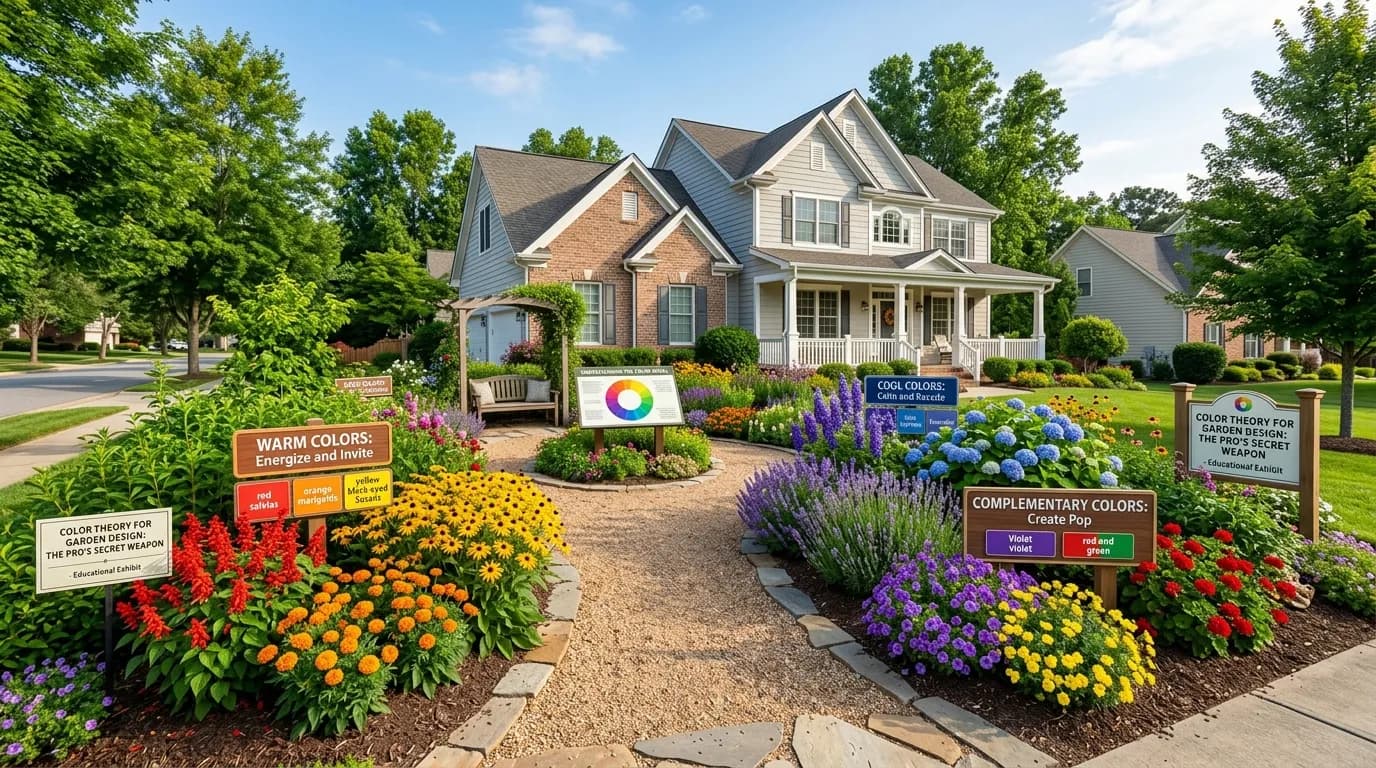
The difference between a garden that feels "designed" and one that feels like a random plant collection usually comes down to one thing: color theory. Professional landscape designers spend years learning this. You can learn it in 10 minutes.
The Color Wheel in the Garden
The color wheel works the same in the garden as it does in art:
Primary colors: Red, Yellow, Blue
Secondary colors: Orange (red+yellow), Green (blue+yellow), Purple (blue+red)
Tertiary colors: Yellow-orange, red-orange, red-purple, blue-purple, blue-green, yellow-green
These colors have specific emotional and visual effects that pros exploit deliberately.
The 4 Professional Color Schemes
1. Complementary (Maximum Drama)
Colors opposite each other on the wheel: purple + yellow, blue + orange, red + green.
Effect: High energy, maximum contrast, eye-catching. Best for entertainment areas, front yard focal points, and anywhere you want visual excitement.
Example: Purple coneflower (Echinacea) + black-eyed Susan (Rudbeckia) — the classic prairie combination. Purple lavender + yellow coreopsis. Blue salvia + orange marigolds.
Pro tip: Use a 70/30 ratio. 70% of one color, 30% of its complement. Equal proportions compete — one must dominate.
2. Analogous (Harmonious Flow)
3-5 colors adjacent on the wheel: purple + blue + violet, or red + orange + yellow.
Effect: Calm, cohesive, sophisticated. Best for relaxation areas, meditation gardens, long border plantings that flow like a river of color.
Example warm: Red knockout roses → coral dahlias → orange daylilies → golden rudbeckia → yellow coreopsis. Each plant's color flows into the next.
Example cool: Blue salvia → lavender catmint → purple alliums → violet clematis. A gradient from blue to purple creates depth and sophistication.
3. Monochromatic (Elegant Simplicity)
One color in different shades, tints, and tones. An all-white garden, all-pink garden, or all-blue garden.
Effect: Elegant, serene, sophisticated. Best for small spaces, formal gardens, moonlight gardens (white), and creating a sense of luxury.
Example (white moonlight garden): White hydrangeas + white roses + white astilbe + silver dusty miller + white tulips (spring) + white impatiens (shade). Glows in the evening.
Example (blue border): Delphinium → salvia → agapanthus → catmint → blue star creeper groundcover. Five shades of blue, all harmonious.
4. Triadic (Balanced Energy)
Three colors equally spaced on the wheel: red + yellow + blue, or orange + purple + green.
Effect: Vibrant and balanced. Feels joyful without being chaotic. Best for cottage gardens and cutting gardens.
Example: Red bee balm + yellow coneflower + blue veronica. Three bold colors that work because they're evenly distributed around the wheel.
Color Principles in the Garden
Warm Colors Advance
Red, orange, and yellow flowers appear closer than they are. Plant warm colors:
- Near the house or patio for visual energy
- In entertainment areas for social stimulation
- At the front of borders for immediate impact
- In large yards where you want to make distant areas feel closer
Cool Colors Recede
Blue, purple, and white flowers appear farther than they are. Plant cool colors:
- At the far end of the garden to create depth
- Along property boundaries to make the yard feel larger
- In relaxation areas for calming effect
- In shade (cool colors glow in shade; warm colors disappear)
Green Is a Color
Most gardeners forget that green foliage comes in dozens of shades:
- Chartreuse (sweet potato vine, 'Gold Mound' spiraea): Bright, energetic, electric
- Emerald (boxwood, holly): Rich, formal, classic
- Blue-green (blue hostas, blue spruce): Cool, sophisticated
- Silver-green (lamb's ear, artemisia, dusty miller): Elegant, links warm and cool colors
- Burgundy (purple smoke bush, 'Crimson Pygmy' barberry): Dramatic, moody
An all-foliage garden with great green variety + texture is more sophisticated than a flower explosion.
Common Color Mistakes
- 1Too many colors: Limit to 3-4 flower colors maximum. More than that feels chaotic. Use green foliage to connect them.
- 2Ignoring foliage color: Flowers last 2-4 weeks. Foliage lasts 6-8 months. Design for foliage first, flowers second.
- 3Random rainbow: One of everything in every color = a garden center display, not a design. Pick a scheme and commit.
- 4Ignoring bloom timing: That "complementary" pair only works if they bloom at the same time. Check bloom seasons.
- 5Forgetting bark and berries: Crape myrtle bark, winterberry holly, beautyberry — these provide color when nothing is blooming.
Seasonal Color Planning
A professional garden has color in every season:
Spring: Bulbs (tulips, daffodils, alliums), flowering trees (redbud, dogwood, cherry)
Summer: Perennials (coneflower, daylily, hydrangea, black-eyed Susan)
Fall: Foliage color (Japanese maple, oakleaf hydrangea), ornamental grasses, asters
Winter: Bark (crape myrtle, river birch), berries (winterberry, beautyberry), evergreen foliage, dried grass plumes
Your Yardcast design applies named color schemes automatically — complementary, analogous warm, or analogous cool — to every design variant, so you can see which approach works best for your space.