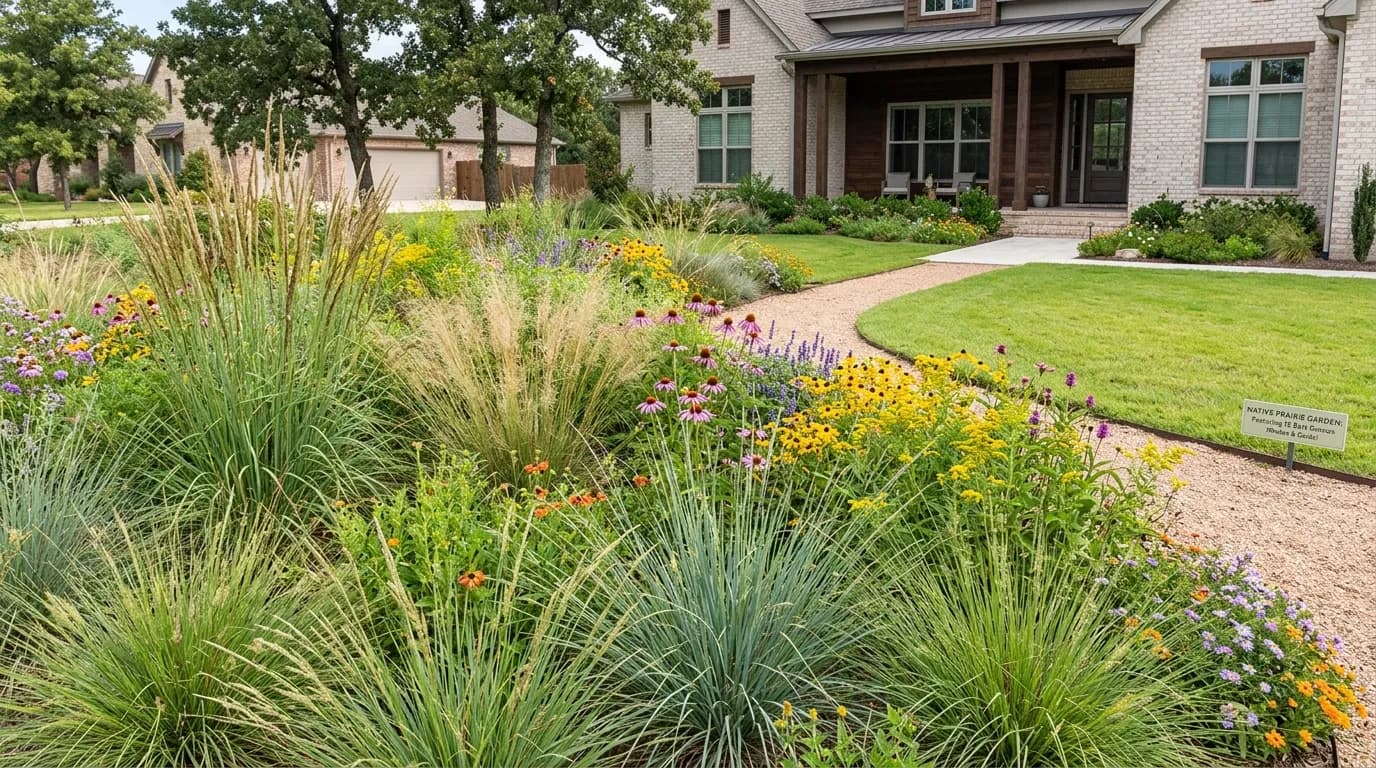
Native grasses are the structural backbone of every prairie. They provide year-round visual interest, deep root systems for erosion control and carbon storage, and critical habitat for wildlife. Here are the 15 best species organized by height and region.
Tall Grasses (4-8 feet)
1. Big Bluestem (Andropogon gerardii)
The king of the tallgrass prairie. Grows 4-8 feet tall with distinctive three-pronged seed heads resembling a turkey foot.
- Zones: 3-9
- Sun: Full sun
- Soil: Adaptable — clay, loam, sand
- Water: Drought tolerant once established
- Fall color: Copper to burgundy
- Best regions: Upper Midwest, Great Plains, Northeast, Southeast
- Landscape use: Back of borders, screening, prairie restoration, naturalized areas
- Root depth: Up to 10 feet — the deepest roots in North American grassland
Big Bluestem is the signature species of the tallgrass prairie that once covered 170 million acres of North America. Its deep roots make it unmatched for carbon sequestration and erosion control.
2. Indian Grass (Sorghastrum nutans)
Golden plumes above blue-green foliage make this one of the most ornamental native grasses.
- Zones: 3-9
- Sun: Full sun
- Soil: Adaptable
- Water: Drought tolerant
- Fall color: Orange-gold
- Best regions: All regions east of the Rockies
- Landscape use: Specimen or mass planting, mixed borders, naturalized areas
3. Switchgrass (Panicum virgatum)
The most versatile native grass — dozens of cultivars from 3-8 feet in every color from green to blue to burgundy.
- Zones: 3-9
- Sun: Full sun to light shade
- Soil: Extremely adaptable — wet or dry
- Water: Tolerates both drought and flooding
- Fall color: Gold to burgundy (variety dependent)
- Best regions: All US regions
- Top cultivars: 'Shenandoah' (burgundy by midsummer), 'Northwind' (upright blue-green), 'Heavy Metal' (steel blue, stiffly upright)
- Landscape use: Foundation planting, screening, mass planting, rain gardens, shoreline stabilization
Switchgrass is the single best native grass for beginners. It grows almost anywhere, looks good in every season, and provides excellent wildlife habitat.
Medium Grasses (2-4 feet)
4. Little Bluestem (Schizachyrium scoparium)
The most beautiful native grass in America. Blue-green in summer, turning copper-red in fall with fluffy silver seed heads that catch winter light.
- Zones: 3-10
- Sun: Full sun
- Soil: Prefers lean, well-drained soil (actually looks BETTER in poor soil)
- Water: Extremely drought tolerant
- Fall color: Copper, mahogany, rust
- Best regions: All US regions
- Landscape use: Foundation plantings, mass planting, mixed borders, hell strips, anywhere you need beauty with zero maintenance
Little Bluestem was named the 2022 Perennial Plant of the Year. In poor soil, it stays compact and colorful. Rich soil makes it floppy. This is a grass that rewards neglect.
5. Prairie Dropseed (Sporobolus heterolepis)
Fine-textured, fountain-shaped, and it smells like buttered popcorn when it blooms. Not a joke.
- Zones: 3-8
- Sun: Full sun
- Soil: Well-drained, lean
- Water: Very drought tolerant
- Fall color: Orange to gold
- Best regions: Upper Midwest, Great Plains, Northeast
- Landscape use: Edging, mass planting, groundcover alternative, the most refined native grass available
If you want native grass that looks like it belongs in a high-end landscape design, Prairie Dropseed is your answer. It's the ornamental grass of choice for landscape architects working with native palettes.
6. Side-Oats Grama (Bouteloua curtipendula)
Small oat-like seeds hang from one side of the stem — unique and charming.
- Zones: 3-10
- Sun: Full sun
- Soil: Lean, dry, well-drained
- Water: Extremely drought tolerant
- Fall color: Amber
- Best regions: Great Plains, Mountain West, Southwest
- Landscape use: Low borders, mass planting, lawn alternative
Short Grasses (Under 2 feet)
7. Blue Grama (Bouteloua gracilis)
Distinctive eyelash-shaped seed heads on tiny 12-18 inch plants.
- Zones: 3-10
- Sun: Full sun
- Soil: Lean, dry
- Water: Extremely drought tolerant — survives on 7 inches of rainfall per year
- Fall color: Straw gold
- Best regions: Great Plains, Mountain West, Southwest
- Landscape use: Lawn alternative (can be mowed to 3-4 inches), edging, rock gardens
8. Buffalo Grass (Buchloe dactyloides)
The original lawn — Native Americans and settlers built sod houses from it.
- Zones: 3-9
- Sun: Full sun
- Soil: Clay to loam
- Water: The most drought-tolerant lawn grass in existence
- Best regions: Great Plains (not ideal for humid Southeast or Pacific NW)
- Landscape use: Lawn replacement — mow to 3-4 inches for a traditional lawn look, or leave unmowed for a natural meadow. Uses 75% less water than Kentucky Bluegrass.
9. Blue Fescue (Festuca glauca)
Tight blue-silver mounds 8-12 inches tall.
- Zones: 4-8
- Sun: Full sun
- Soil: Lean, well-drained
- Water: Drought tolerant
- Best regions: All (most popular in modern/minimalist designs)
- Landscape use: Edging, mass planting in grids, container gardens, rock gardens
Regional Specialists
10. Muhly Grass (Muhlenbergia capillaris)
Pink cotton candy clouds in fall — possibly the most Instagram-worthy native grass.
- Zones: 6-10
- Sun: Full sun
- Soil: Adaptable, prefers sandy
- Water: Drought tolerant
- Fall display: Electric pink plumes September-November
- Best regions: Southeast, Southwest, southern Great Plains
- Landscape use: Mass planting for fall impact, borders, coastal gardens
11. Karl Foerster Grass (Calamagrostis × acutiflora 'Karl Foerster')
Strictly upright wheat-gold columns. The most widely planted ornamental grass in North America.
- Zones: 4-8
- Sun: Full sun to partial shade
- Soil: Adaptable, tolerates clay and wet conditions
- Water: Moderate — more tolerant of moisture than most native grasses
- Fall color: Golden wheat
- Landscape use: Vertical accent, screening, mass planting in rows, modern design
Note: Karl Foerster is technically a hybrid of European origin, but it's non-invasive and commonly included in prairie-style plantings.
12. Virginia Wild Rye (Elymus virginicus)
One of the few native grasses that thrives in shade.
- Zones: 3-8
- Sun: Partial shade to shade
- Soil: Moist, rich
- Water: Moderate moisture needs
- Best regions: Northeast, Southeast, Upper Midwest
- Landscape use: Shade meadows, woodland edges, rain gardens, erosion control on shaded slopes
13. Tufted Hairgrass (Deschampsia cespitosa)
Airy, delicate seed heads above dark green tufts.
- Zones: 3-8
- Sun: Full sun to partial shade
- Soil: Moist, tolerates clay
- Water: Moderate — prefers consistent moisture
- Best regions: Pacific Northwest, Northeast, Mountain West
- Landscape use: Rain gardens, stream banks, woodland edges, moist meadows
14. Eastern Gamagrass (Tripsacum dactyloides)
Massive clumps 5-8 feet tall with corn-like foliage.
- Zones: 4-9
- Sun: Full sun
- Soil: Moist to wet, tolerates clay
- Water: Tolerates wet conditions
- Best regions: Southeast, Lower Midwest
- Landscape use: Rain gardens, wet areas, screening, wildlife habitat
15. Idaho Fescue (Festuca idahoensis)
Blue-green bunches native to western mountains.
- Zones: 3-8
- Sun: Full sun
- Soil: Lean, well-drained
- Water: Very drought tolerant
- Best regions: Mountain West, Pacific Northwest
- Landscape use: Meadows, slopes, rock gardens, lawn alternative in dry western climates
How to Choose
For maximum drought tolerance: Blue Grama, Buffalo Grass, Little Bluestem, Side-Oats Grama
For wet/clay soil: Switchgrass, Eastern Gamagrass, Tufted Hairgrass
For shade: Virginia Wild Rye, Tufted Hairgrass
For modern/designed landscapes: Karl Foerster, Prairie Dropseed, Blue Fescue, Little Bluestem
For maximum wildlife habitat: Big Bluestem, Indian Grass, Switchgrass (support the most insect and bird species)
For fall color: Little Bluestem (copper), Muhly Grass (pink), Indian Grass (gold), Switchgrass 'Shenandoah' (burgundy)
Browse all native grasses (and 100+ more plants) in our Plant Encyclopedia, or design a prairie for your yard with AI.