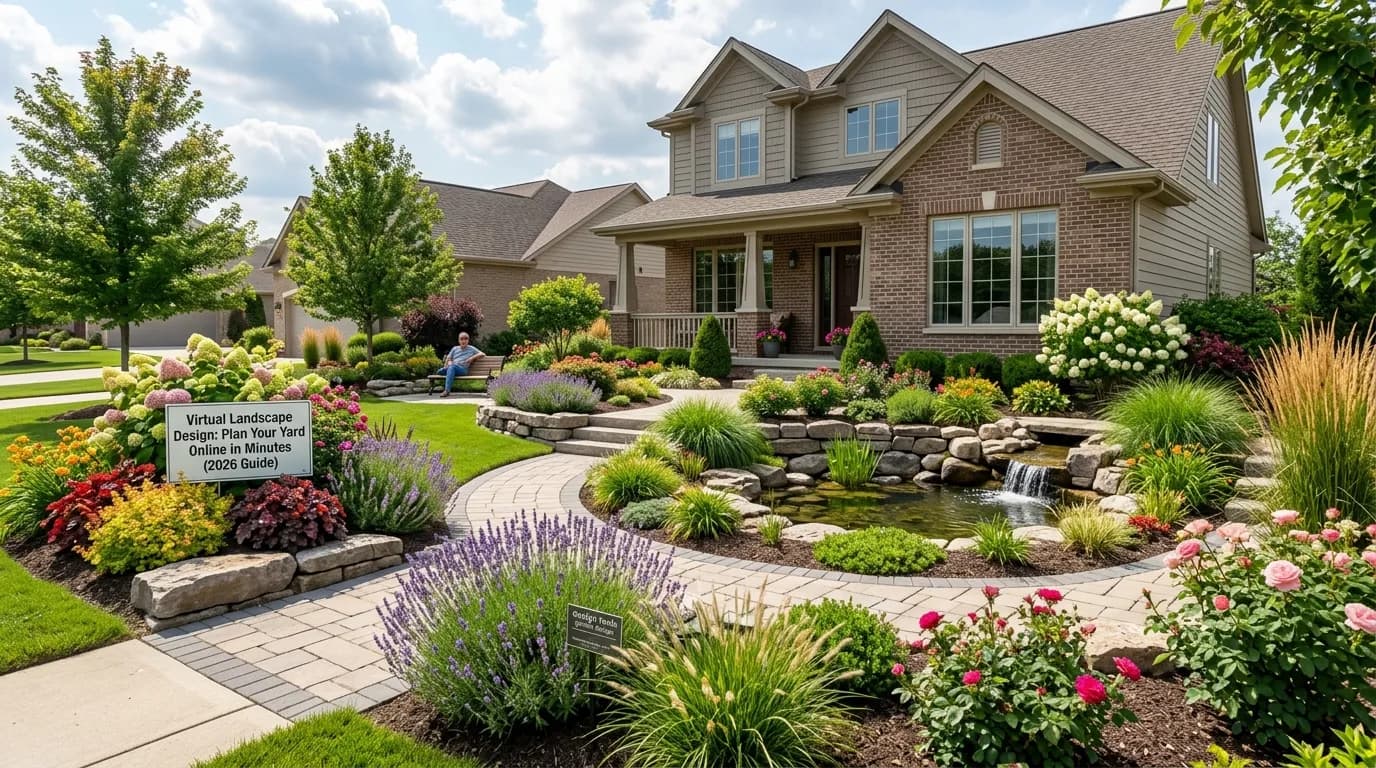
You don't need to hire a landscape architect and wait six weeks to see what your yard could look like. Virtual landscape design — using AI tools, online design platforms, or remote designer services — lets you plan your outdoor space from your phone or laptop and see photorealistic results in minutes.
This guide covers the full spectrum: free AI tools, affordable online design platforms, and premium remote landscape design services. By the end, you'll know exactly which option fits your project and how to get started today.
What Is Virtual Landscape Design?
Virtual landscape design refers to any landscape planning process that happens online rather than with an in-person designer visiting your property. It ranges from self-service AI tools to full-service remote design packages with human designers.
The three main types:
1. AI landscape design tools — You upload photos of your yard, answer a short questionnaire, and AI generates photorealistic design concepts in under a minute. Best for homeowners who want instant visualization at minimal cost.
2. Online design marketplaces — You submit a design brief and photos; a remote landscape designer creates a plan within 24–72 hours. Costs vary from $50 (basic plant list) to $500 (full design package). Human expertise, slower turnaround than AI.
3. Video consultation services — A licensed landscape designer walks your yard with you via video call, then delivers a design package. Costs $150–$400 for a consultation. Good middle ground between DIY and full-service.
Try AI landscape design for your yard — see 3 photorealistic concepts in 60 seconds →
AI Virtual Landscape Design: The Fastest Option
AI-powered virtual landscape design has improved dramatically in the past two years. Modern tools can take a photo of your house and yard and overlay a completely transformed landscape — with specific plants, hardscape materials, and design styles rendered directly onto your property photos.
The best AI tools do more than generate pretty pictures. They factor in:
- Climate zone and plant hardiness — suggesting plants that will actually survive in your region
- Sun exposure — positioning shade plants in shaded areas, sun-lovers in full-sun spots
- Maintenance level preferences — low-maintenance designs use drought-tolerant plants, groundcovers, and mulch beds; high-maintenance designs include lawn, perennials, and seasonal color
- Budget constraints — estimating costs and suggesting phased installation plans
- Home architectural style — matching hardscape materials and plant selections to your house's aesthetic
What AI virtual landscape design delivers:
- 3 distinct design concepts showing different style directions
- Photorealistic renders overlaid on your actual yard photos
- Plant lists with quantities, costs, and zone-specific selections
- Cost estimates by phase (immediate, year 3, year 5)
- Contractor-ready PDF documentation
Typical cost: $12–$40 for a complete design package. Most tools let you preview the designs for free before paying.
Turnaround: 30–90 seconds from uploading photos to seeing results.
Online Landscape Design Services: Human Expertise, Remote Delivery
If you want human judgment — especially for complex projects, unusual site conditions, or high-budget projects where you want professional accountability — online landscape design services provide designer expertise at a fraction of in-person rates.
How Online Design Services Work
- 1Submit your brief — You fill out a detailed questionnaire covering yard size, style preferences, budget, maintenance tolerance, and any specific requirements (privacy, drainage, kids' play area, etc.)
- 2Upload photos and measurements — Most services require multiple photos from different angles, rough measurements, and sometimes a satellite view from Google Maps
- 3Designer assignment — A landscape designer (usually with a degree and several years of experience) reviews your brief and creates your design
- 4Delivery and revisions — You receive your design package (typically a 2D plan, plant list, and notes) and can request one or two rounds of revisions
What Online Design Services Cost
| Service Level | What You Get | Typical Cost |
|---|---|---|
| Plant consultation | Plant recommendations only, no layout | $25–$75 |
| Basic design | 2D layout + plant list | $75–$150 |
| Standard package | 2D layout + 3D rendering + plant list + cost estimate | $200–$400 |
| Premium package | Full design documentation + material specs + contractor notes | $400–$800 |
Major platforms offering these services include Houzz Pro, Yardzen, and several Etsy-based landscape design shops.
Turnaround: 3–7 days for most services; rush delivery available at a premium.
> Try it free: Yardcast generates 3 photorealistic AI landscape designs for your yard in under 60 seconds. You see all 3 designs before paying anything. Start your free design preview →
3D Virtual Landscape Design: Seeing Your Yard in Three Dimensions
True 3D virtual landscape design — where you can orbit a three-dimensional model of your yard and view it from any angle — was previously only available through professional landscape design software costing thousands of dollars per year.
AI has changed this. While most AI landscape tools generate 2D photorealistic images rather than true 3D models, the photorealism of the output is often sufficient for homeowners to make confident decisions. The renders look like photographs of real yards because they're generated by the same AI image models used in professional photography and film production.
For true 3D interactive models, a few options exist:
iScape — an iOS/Android app that lets you drag and drop plants and hardscape elements onto an aerial view of your yard. Good for spatial planning; the rendering quality is lower than AI photo-generation tools.
PRO Landscape Home — desktop software with a 3D viewer. Best for homeowners who want to spend significant time planning their landscape themselves.
SketchUp with landscape plugins — professional tool; significant learning curve but very powerful for complex projects.
For most homeowners, AI-generated photorealistic 2D concepts provide more actionable value than interactive 3D models — because you're planning a real project on a specific budget, not playing a design video game.
Video Consultation: The Best of Both Worlds
A video landscape design consultation combines the personal attention of a real designer with the convenience of an online service. You schedule a 60–90 minute video call with a landscape professional; they walk your yard with you virtually, ask questions, take notes, and then deliver a design package within a few days.
Best for: Homeowners with complex sites (steep slopes, drainage issues, unusual soil, heritage trees to work around), or those starting a project over $25,000 where professional accountability matters.
Typical cost: $150–$400 for consultation plus design package.
How to find consultants: Landscape Architecture Foundation's directory, local ASLA chapter, or Houzz Pro.
Choosing the Right Virtual Landscape Design Option
| Your Situation | Best Option |
|---|---|
| Want to see ideas quickly, project under $15K | AI design tool (Yardcast) |
| Want human curation, project $15–$50K | Online design service |
| Complex site conditions (drainage, slope, etc.) | Video consultation + professional follow-up |
| Project over $50K with custom construction | In-person landscape architect |
| HOA submission or permit required | AI design (often sufficient) or video consultation |
| Contractor communication aid | AI design — share the renders directly |
How to Get the Most From Virtual Landscape Design
Regardless of which service you use, these steps dramatically improve your results:
Take Better Photos
The single biggest factor in virtual landscape design quality is photo quality. For AI tools:
- Take photos in overcast daylight (no harsh shadows)
- Capture from the corners and center of the space
- Include the full vertical range — don't cut off the roofline or the ground
- Take a photo from a second-story window if possible (overhead angle helps with spatial planning)
- Remove cars, clutter, and lawn furniture from the frame if possible
Be Specific About What You Don't Want
Most tools ask what you want. Be equally specific about what you don't want: "No lawn," "No grass — we travel too much," "No palm trees," "No color — all green and white," "Nothing that requires watering more than once a week." Negative constraints often produce better results than positive ones.
Use the Output for Contractor Conversations
Virtual landscape designs — whether AI or human-created — are conversation tools. Print them out or display them on your phone when meeting with landscapers. Ask contractors "what would it cost to build something like this?" rather than asking for open-ended bids. You'll get more accurate quotes, less scope creep, and better results.
Start your virtual landscape design — free preview, no credit card required →
Virtual Landscape Design for Specific Project Types
Front yard: AI virtual design excels here — front yards are typically visible from one angle, making photorealistic AI renders extremely useful for visualizing the transformation.
Backyard: Works well for defined spaces. For complex backyards with multiple zones (patio, garden, play area), generate multiple separate designs for each zone.
Small space or urban courtyard: AI design is ideal — small spaces are fully visible in photos and AI handles tight constraints well.
Large property or acreage: For properties over 2 acres or complex estates, human professional services are more appropriate — the spatial complexity exceeds what AI tools handle optimally.
How Virtual Landscape Design Compares to In-Person Services
The fundamental advantage of virtual landscape design is speed and cost. A traditional in-person landscape architect charges $75–$150 per hour and requires multiple site visits, consultations, and revisions before producing a final plan. The total cost for a residential design package is typically $1,500–$7,500 — before a single plant is purchased.
Virtual AI design costs $12–$40 and delivers results in under a minute. Online human design services cost $200–$500 and deliver in 3–7 days.
The traditional landscape architect is worth it for complex, expensive, or regulated projects. For the vast majority of residential landscaping — front yard makeovers, backyard transformations, patio additions, privacy plantings — virtual design is fully adequate.
FAQ: Virtual Landscape Design
Q: Is virtual landscape design accurate?
A: AI-generated designs are accurate visualizations of what a design concept could look like in your yard. They're not construction documents — plants may be slightly larger or smaller than shown, and exact spacing will need to be confirmed with a local nursery. Treat them as high-fidelity concept renders rather than engineering drawings.
Q: Can I use a virtual landscape design for an HOA submission?
A: Yes, in most cases. HOA submissions typically require a plant list, a rough layout diagram, and a description of proposed changes. AI-generated designs provide all of this. Some HOAs specifically require a licensed landscape architect for formal approval, but most accept photorealistic renders for initial review.
Q: How many photos should I take for virtual landscape design?
A: For AI tools like Yardcast, 2–4 photos from different angles provide the best results. Cover the main angle, both corners, and a secondary angle showing any features you want to preserve or change. More photos from different perspectives help the AI understand the 3D space.
Q: Do I need measurements for virtual landscape design?
A: For AI tools, you don't need precise measurements — the AI estimates scale from the photos. For online human design services, rough measurements (estimated width and depth of the yard, plus location of the house on the lot) are typically sufficient. Only detailed construction documentation requires precise survey-grade measurements.
Q: Can virtual landscape design handle complex drainage problems?
A: AI tools can generate designs that incorporate drainage solutions (dry creek beds, rain gardens, French drain paths, swales) but can't diagnose your specific drainage issue or specify the correct engineering solution. For serious drainage problems, a site visit from a landscape professional or civil engineer is still necessary.
Q: What's the difference between virtual landscape design and landscape design software?
A: Landscape design software (like iScape, Home Outside, or PRO Landscape) requires you to do the design work yourself — you drag and drop plants and elements. Virtual landscape design services — especially AI tools — do the design work for you based on your preferences and photos. The output quality is typically much higher with AI tools.