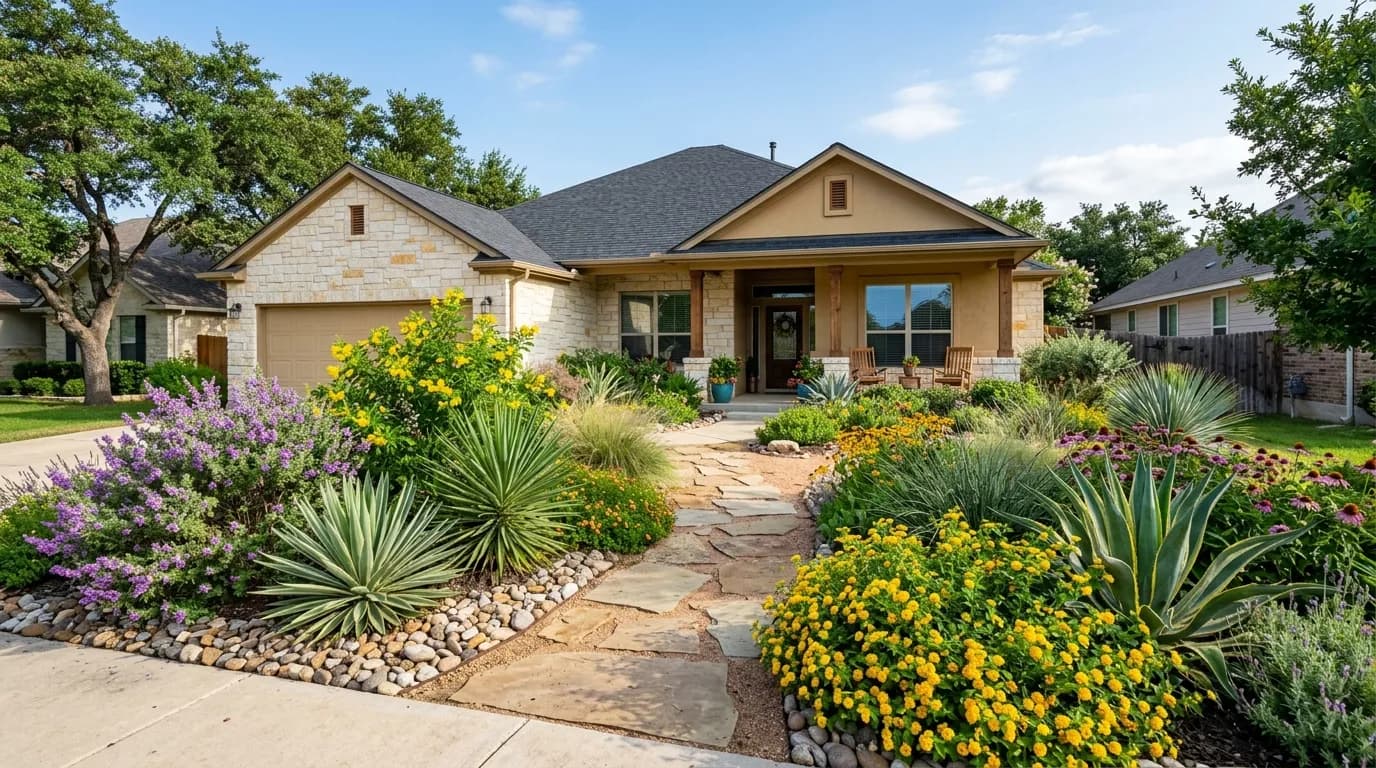
Landscaping in Texas requires a mindset shift: instead of choosing what looks beautiful and then hoping it survives, you start with what thrives in Texas conditions and design beauty from there. The plants that look stunning in a garden magazine from the Pacific Northwest will struggle, sulk, or die in Dallas. But the plants adapted to Texas extremes — summer highs above 100°F, occasional hard freezes, alkaline soil, clay that cracks in drought — are extraordinarily tough and often extraordinarily beautiful.
Texas spans 9 USDA hardiness zones and multiple distinct ecoregions: the humid Gulf Coast, the piney East Texas woods, the blackland prairie of Central Texas, the Hill Country with its limestone and cedar, the arid West Texas desert, and the subtropical Rio Grande Valley. Smart Texas landscaping works with your specific ecoregion's conditions.
Texas by the Numbers
Before the design ideas: understanding Texas's landscape conditions.
Climate extremes: Most of Texas experiences 100°F+ summer temperatures annually. Central Texas (Austin/San Antonio) averages 90+ days above 90°F. Houston sees high humidity along with heat. West Texas is arid with low humidity. Winter ranges from Zone 6 hard freezes in the Panhandle to essentially frost-free Zone 9 in the Valley.
Soil: North and Central Texas have heavy black clay (blackland prairie) that cracks in drought and floods in rain. Hill Country has thin, rocky limestone soil. East Texas has sandy, acidic loam. Coastal areas have sandy or silty soil.
Water: Texas averages 10 inches/year in El Paso to 56 inches/year in East Texas — a 5x range across one state. Droughts are common across all regions; Stage 2 water restrictions in urban areas limit irrigation. Designing for drought tolerance is non-negotiable in most of Texas.
30 Texas Landscaping Ideas
The Texas Native Plant Foundation
1. Build around Texas sage (Leucophyllum frutescens). Texas sage — the "barometer bush" — is the most reliable flowering shrub in the state. Purple or white flowers burst open after summer rains in a spectacular display that lasts weeks. Extremely drought-tolerant, full sun, caliche and clay tolerant. Grows 4–5 feet; can be sheared into formal hedges. Zones 7–10.
2. Plant the Texas triumvirate of toughness. Three plants survive almost anywhere in Texas without irrigation: Texas lantana (low-growing, orange-yellow flowers, butterfly magnet), mealy cup sage (Salvia farinacea, blue spikes, hummingbirds), and cedar sage (Salvia roemeriana, red, shade-tolerant). Together they provide color from April through frost.
3. Use Texas mountain laurel as a specimen shrub. Sophora secundiflora produces clusters of purple flowers in February–March with an intense grape Kool-Aid fragrance before anything else blooms. Evergreen, drought-tolerant, limestone-adapted. Slow growing (less than 1 foot/year) but worth the wait. Zones 7–10.
4. Install Gulf muhly grass (Muhlenbergia capillaris) for fall impact. Pink-purple flowering plumes from October through November stop traffic. One of the most dramatic fall displays of any plant in the Texas landscape. Once established, needs zero care — no water, no fertilizer, no pruning except one cut in late winter. Full sun to part shade. Zones 5–10.
5. Plant Mexican feather grass for low-water elegance. Nassella tenuissima produces cascading, flowing stems that move in the slightest breeze — like green hair or mist. In Texas heat and drought, it stays attractive when most other plants collapse. Pairs beautifully with bold-textured cactus and succulents. Zones 6–10.
Heat-Tolerant Color
6. Embrace crepe myrtle as the Texas summer tree. No plant defines Texas summer landscapes more than the crepe myrtle — 3 months of bloom in intense heat while everything else wilts. 'Natchez' (white, large tree), 'Dynamite' (red, medium), 'Tuscarora' (coral pink, medium) are top performers. Never top-cut: the natural branching structure is the tree's beauty.
7. Grow Esperanza (Tacoma stans) for tropical color. Butter-yellow trumpet flowers from June until frost, continuous in heat that stops most plants. Semi-woody perennial in Zone 8+, annual in Zone 7. 4–6 feet tall. Hummingbirds love it. Full sun, excellent drainage. One of Texas's most reliable summer color plants.
8. Plant rock rose (Pavonia lasiopetala) for shade. Texas-native perennial shrub with pink flowers almost year-round, adapted to the Hill Country's thin limestone soil. Remarkably shade-tolerant — one of few flowering plants that bloom in dappled shade in Texas. Dies back after freeze, returns from roots. Zones 7–10.
9. Use black-eyed Susans and coneflowers for prairie style. Texas natives, both are extraordinarily tough. Plant in fall for spring bloom; they naturalize and self-seed to spread over years. Black-eyed Susan (Rudbeckia hirta) and purple coneflower (Echinacea purpurea) attract monarch butterflies during fall migration through Texas.
10. Add flame acanthus (Anisacanthus quadrifidus) for hummingbirds. Tubular orange-red flowers from summer through fall, in heat and drought that would stop most plants. Native to Texas Hill Country. Grows 3–4 feet, full sun to light shade, thin rocky soil is fine. Hummingbirds use it as a nectar source during migration. Zones 7–11.
Drought-Tolerant Landscape Design
11. Design for xeriscape from the start. Texas droughts (like the 2011 disaster and the 2022–2023 events) have pushed water restrictions in every major Texas city. Xeriscape (drought-efficient landscape design) isn't just trendy — it's often required. Replace 50%+ of lawn with mulched planting beds of adapted plants, and supplement with drip irrigation rather than spray heads.
12. Create a cactus and succulent garden. Texas has extraordinary native cacti and succulents: Texas prickly pear (Opuntia engelmannii) with yellow flowers and edible red fruits, claret cup (Echinocereus triglochidiatus) with brilliant red flowers, and agave species ranging from small 'Blue Glow' to massive century plant. Group them with granite gravel mulch for a sculptural, zero-maintenance area.
13. Plant yuccas as architectural focal points. Soft-leaf yucca (Yucca recurvifolia) and Spanish dagger (Yucca treculeana) are native to Texas and provide bold, year-round architectural form. Dramatic white flower spikes appear in early summer. Adapt to any Texas soil type, any level of neglect. Position where the spiny tips won't pose a hazard.
14. Install a dry creek bed for drainage in clay soil. Black clay soil creates puddles after Texas thunderstorms and cracks after 2 weeks without rain. A dry creek bed filled with 4–6 inch river rock channels water from problem areas across the landscape. It functions as stormwater management and looks like a designed landscape feature.
15. Mulch deeply (4–6 inches) to survive Texas summers. In Texas heat, evaporation from bare soil is enormous. A 4–6 inch layer of shredded hardwood mulch or cedar bark reduces water needs by 40–60%, keeps roots cool during 100°F days, and reduces the frequency of watering significantly. This is the single highest-return maintenance step for Texas landscapes.
> Want to see how these Texas-adapted plants would look in your specific yard? Yardcast AI generates 3 photorealistic landscape designs from your yard photos, with plant lists optimized for your Texas zone and style. Free to preview.
Lawn and Groundcover Strategies
16. Switch to Zoysia grass in North/Central Texas. Zoysia uses 30–40% less water than St. Augustine, produces a dense sod that resists weeds, and is more drought-dormant-and-recover friendly than Bermuda. 'Palisades Zoysia' is the best performer in Texas clay conditions. Requires full sun.
17. Plant buffalo grass for the most drought-tolerant Texas lawn. Buffalo grass (Bouteloua dactyloides) is truly native to the Texas blackland prairie and Great Plains — evolved for exactly these conditions. Once established, it survives Texas droughts on rainfall alone. Blue-green color, grows to 4–6 inches and stops. Almost zero maintenance. Best in areas with at least 20 inches annual rainfall.
18. Use decomposed granite instead of lawn in shade. Under Texas live oaks and cedar elms, grass often struggles with competition. Decomposed granite (DG) in a natural buff or gold color creates a clean, low-maintenance surface that allows water percolation into tree root zones. Edge with steel or stone for a finished look.
19. Try 'No Mow' fescue blends in North Texas shade. In zones 7–8, shaded North Texas areas can support fine fescue blends — slower growing, lower input than traditional turf, and able to go 3–4 weeks without mowing in shade. Not appropriate for sunny areas in Texas heat.
20. Mass-plant fragrant groundcovers along walkways. Creeping rosemary (Rosmarinus officinalis), ornamental oregano, and lavender (Zones 6–8 only) are all drought-tolerant, fragrant when touched, and beautiful cascading over stone edges. They release fragrance when brushed — a sensory experience that makes walkways feel designed.
Texas Trees
21. Plant Texas live oak for permanence. Quercus fusiformis, the escarpment live oak, is the quintessential Central Texas landscape tree — massive, wind-resistant, semi-evergreen, and essentially indestructible once established. Grows 1–2 feet/year for the first decade. Allow 30+ feet clearance from structures. The most valuable long-term investment in a Texas landscape.
22. Add a desert willow (Chilopsis linearis) for flower color. Orchid-like lavender and white flowers all summer with almost zero water needs. Fast-growing Texas native (6–8 feet in 3 years), multi-trunk form adds naturalistic character. Drops leaves in winter but the branching structure is attractive. Full sun, well-drained soil. Zones 6–10.
23. Choose the Texas redbud for spring bloom. Cercis canadensis var. texensis is the Texas ecotype of the Eastern redbud — more heat and drought tolerant than the standard species. Stunning magenta bloom in February–March before leaves emerge. Small tree (15–20 feet), perfect for suburban lots. 'Oklahoma' and 'Traveller' (weeping form) are popular cultivars.
24. Plant a Mexican plum for wildlife value. Prunus mexicana is a small Texas native tree (15–25 feet) that bursts into white flowers in late winter, attracting early pollinators, then produces edible plums in summer that wildlife — and people — love. Tolerates clay soil, drought, and alkaline conditions. One of the most wildlife-valuable trees for Central Texas.
Specific Texas Design Styles
25. Create a Hill Country inspired landscape. The Texas Hill Country aesthetic is limestone, native grasses, and wildflowers. Mimic it with: limestone boulders or dry-stack retaining walls, gravel paths of crushed granite, masses of Blackfoot daisy, mealy cup sage, and inland sea oats under live oak canopy. Natural, unfussy, and deeply Texas.
26. Design a Gulf Coast tropical garden. Houston and Corpus Christi's heat and humidity support tropical plants unavailable elsewhere in Texas: bougainvillea, tropical milkweed, giant elephant ears, cannas, and bird of paradise. Design with bold tropical foliage plants as a backdrop and colorful flowering tropicals in the foreground.
27. Build a low-water front yard focused on curb appeal. Replace 50%+ of front lawn with a layered design: 3-inch gravel mulch base, large decorative boulders as anchors, mass plantings of Texas sage and gulf muhly grass, fragrant rosemary along the walk. Costs less to install than traditional sod and requires no irrigation after establishment.
28. Add a rain garden for Central Texas clay. Central Texas clay famously floods, then cracks. A shallow rain garden (6–12 inches deep) lined with tolerant Texas natives — Turk's cap, inland sea oats, pickerelweed — captures runoff and infiltrates it slowly, turning a flooding problem into a design feature.
29. Install a front yard pollinator meadow. A mix of native Texas wildflowers — bluebonnet (spring), coreopsis (spring/fall), black-eyed Susan (summer), purple coneflower, and Maximilian sunflower (fall) — creates a dynamic, season-changing display that supports monarch migration and local pollinators. Requires annual seeding in fall and mowing after summer bloom for rejuvenation.
30. Separate from the HOA lawn norm with a no-mow front yard. Many Texas HOAs are updating rules to allow drought-tolerant plantings as water restrictions tighten. A properly designed front yard with decorative gravel, native shrubs, and groundcovers can look more polished than a struggling lawn — and be fully compliant with increasingly common Texas water ordinances.
Design Your Texas Yard Before You Plant
Texas's climate extremes make it especially important to get the plant selection and layout right before installation — the wrong plants fail fast in Texas heat. Yardcast's AI landscape design tool generates 3 photorealistic landscape designs from your yard photos, with recommendations appropriate for your specific Texas zone and design style.
Try it free at yardcast.ai/redesign — see your design before spending a dollar on plants.