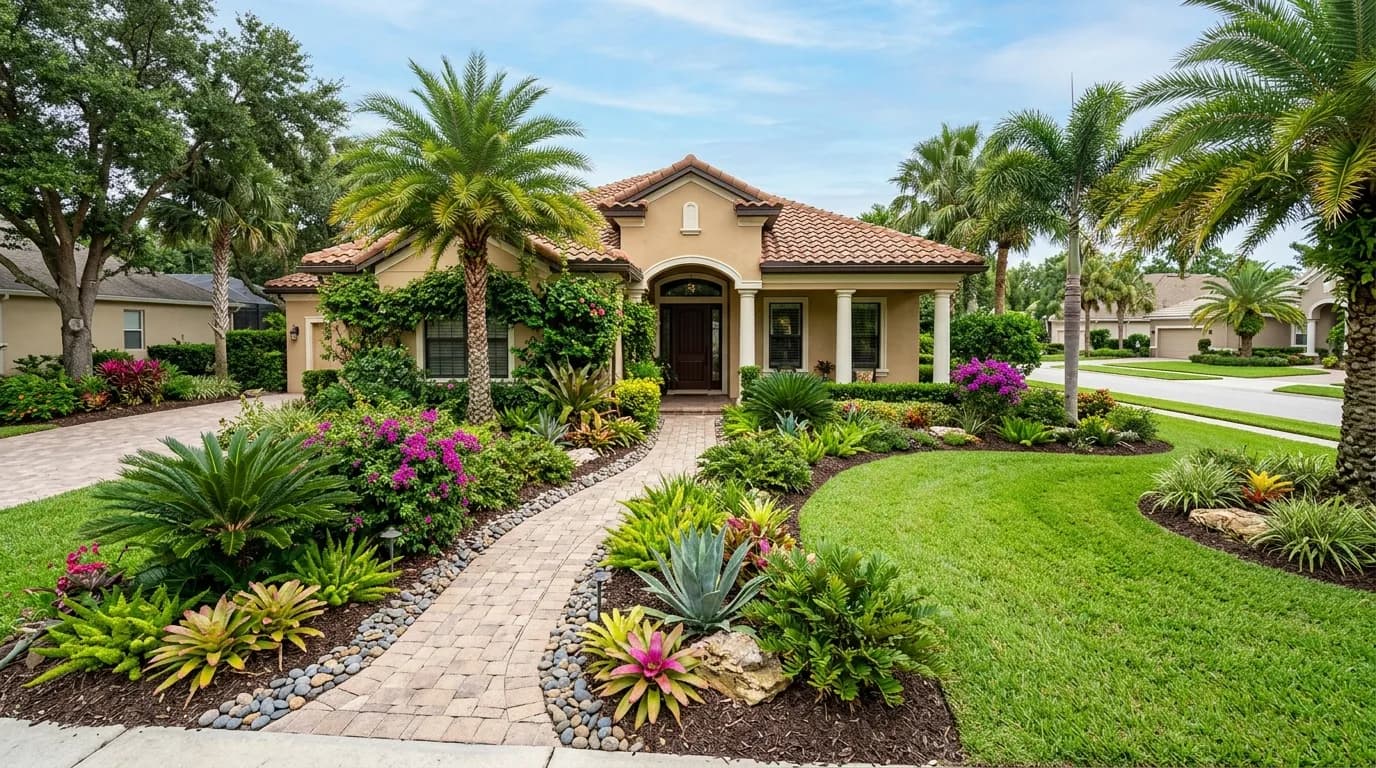
Florida is a gardener's paradise and a landscaper's puzzle. The year-round growing season means you can have color and life in your yard 12 months a year. But the intense summer heat, hurricane season, sandy soil with little water retention, and strict water restrictions across many counties mean that conventional landscaping advice — written for temperate climates — often leads Florida homeowners astray.
The plants that thrive in Ohio will struggle or die in Orlando. The watering schedule that works in North Carolina will violate water restrictions in Miami-Dade. And the ground cover that looks beautiful in spring can become invasive by summer in the subtropical south.
This guide is built specifically for Florida — with plant recommendations by region (North FL, Central FL, South FL), design strategies for the Florida climate, and ideas that look great while staying low-maintenance in intense heat and humidity.
Understanding Florida's Landscape Zones
Florida spans three distinct climate regions that require different approaches:
North Florida (Zones 8–9a): Jacksonville, Tallahassee, Gainesville. True winters with occasional frost. Can grow many traditional Southern plants — camellias, dogwoods, azaleas, crape myrtles. Summer heat and humidity intense. Sandy or clay soils.
Central Florida (Zones 9b–10a): Orlando, Tampa, Daytona Beach. Rare frost, intense summer heat and afternoon thunderstorms from June–September. Fast-draining sandy soil. Hurricane risk.
South Florida (Zones 10b–12): Miami, Fort Lauderdale, Naples, Key West. Tropical and subtropical. Year-round growing season, no frost. Extremely high humidity. Rocky limestone soil in Miami-Dade, rich muck in Everglades border areas.
Understanding your specific zone determines which plants will thrive, which irrigation approach you need, and how to plan for water management.
Florida-Friendly Design Principles
Before the plant list: the strategies that make Florida landscaping work.
Embrace Florida-Friendly Landscaping (FFL): Florida's extension service and water management districts developed the Florida-Friendly Landscaping program with 9 principles: right plant, right place; water efficiently; fertilize appropriately; mulch; attract wildlife; manage yard pests; recycle; reduce stormwater runoff; and protect the waterfront. Following these principles keeps you compliant with local ordinances and produces better results.
Design for drainage: Florida's sandy soils drain fast — sometimes too fast. Use compost and organic matter to build water-holding capacity in planting beds. In low-lying areas, grade for stormwater management or install a rain garden to capture runoff.
Plan for the dry season: Florida has distinct wet (June–September) and dry (October–May) seasons. Plants need irrigation through the dry season but can often survive on rainfall alone during summer. Design your irrigation system around this cycle.
Go vertical for privacy: Florida soil and climate produce exceptionally fast vertical growth. Clusia hedges grow 3–4 feet per year in South FL. Green Giant arborvitae adds 3–5 feet per year in North and Central FL. Use fast-growing screening plants to create privacy and wind protection quickly.
30 Florida Landscaping Ideas
Foundation and Structure Plants
1. Clusia hedge for South Florida privacy. Clusia rosea ('Autograph Tree') is the go-to South FL hedge — it grows 3–4 feet per year, tolerates salt spray and wind, and creates a dense, impenetrable green wall. Requires only 2-3 trimmings per year. No pest problems, drought-tolerant once established.
2. Green Giant arborvitae for North/Central FL screens. In zones 8–9b, Green Giant arborvitae grows 3–5 feet per year with zero maintenance once established. Plant 6 feet apart for a solid privacy screen in 2–3 years. Deer-resistant, cold-hardy, requires no pruning.
3. Simpson's stopper for native structure. A Florida native shrub (Myrcianthes fragrans) with white flowers, red-to-black berries loved by birds, and attractive peeling bark. Naturally grows 10–15 feet but can be pruned to any height. Full sun to partial shade. Excellent for wildlife habitat.
4. Firebush (Hamelia patens) for hummingbirds and color. Florida native with tubular orange-red flowers that hummingbirds and butterflies can't resist, from summer through fall. Grows fast to 5–8 feet, tolerates heat and drought. Evergreen in South FL, dies back and resprouts in North/Central.
5. Cocoplum for salt-tolerant coastal hedges. Chrysobalanus icaco is native to coastal South FL, handles salt spray beautifully, and produces edible plum-like fruits. Slow to moderate growing, can be maintained as a formal hedge or allowed to naturalize. Zones 10b–12.
Groundcovers and Lawn Alternatives
6. Replace St. Augustine with Empire zoysia. St. Augustine grass is Florida's most common turf but requires high water, fertilizer, and chinch bug management. Empire Zoysia uses 30% less water, tolerates drought, shades out weeds, and recovers from wear faster. It's slower to establish but dramatically lower maintenance long-term.
7. Plant bahiagrass for low-input lawns. Pensacola bahia is the most drought-tolerant, low-input lawn option for Florida. It goes dormant and brown in winter but is deep green through Florida's long warm season with minimal irrigation and fertilizer. Common along roadsides for a reason — it thrives on neglect.
8. Use coontie (Zamia integrifolia) as a native groundcover. Florida's only native cycad is a slow-growing, drought-tolerant, shade-tolerant groundcover that looks like a small feathery palm. It's the host plant for the endangered atala butterfly. Perfect under trees where grass fails. No maintenance once established. Zones 8–11.
9. Plant liriope or mondo grass in shade. Under Florida oaks and pines where little else grows, liriope (monkey grass) and mondo grass create dark green, evergreen groundcover that needs mowing once a year. Both handle deep shade, dry soil under tree canopies, and compete with surface roots.
10. Try Sunshine mimosa (Mimosa strigillosa) as a turf replacement. This Florida native groundcover spreads aggressively to form a dense, pink-flowering carpet that tolerates foot traffic, mowing, and drought. Attracts butterflies. Excellent for slopes, roadsides, and areas where grass struggles.
Color and Flowering Plants
11. Bougainvillea for spectacular color. In Zones 9b+, bougainvillea produces its spectacular paper-thin bracts (the colorful "flowers") almost year-round in full sun with minimal water. Once established, drought stress actually encourages more flowering. It needs support (fence, trellis, pergola) but the payoff is extraordinary color that photographs beautifully.
12. Plumbago for year-round blue blooms. Plumbago auriculata is a Florida workhorse — sky blue flowers almost year-round in full sun, drought and heat tolerant, grows to 3–4 feet, butterflies love it. One of the most reliable flowering shrubs for Central and South FL.
13. Pentas for butterfly gardens. Pentas lanceolata (Star Flower) is a must for Central and South FL butterfly gardens. Red, pink, white, or lavender star-shaped flowers blooming continuously in summer heat. Monarchs, swallowtails, and hummingbirds flock to it. Plant in full sun.
14. Ixora for South FL color. Classic South Florida shrub with clusters of orange, red, yellow, or pink flowers. Grows well in South FL's acidic soil, tolerates salt spray, and blooms spring through fall. 'Super King' grows 4–6 feet; 'Nora Grant' stays compact at 3–4 feet.
15. Blanket flower (Gaillardia) for drought-tolerant summer color. Native to Florida, blanket flowers bloom all summer in intense heat and sandy soil with minimal water. The red-and-yellow bi-color flowers look like fireworks. Excellent for coastal landscapes and xeric gardens. Short-lived perennial — reseeds freely to naturalize.
16. Porterweed (Stachytarpheta jamaicensis) as a pollinator plant. Blue and purple porterweed is covered in butterflies and hummingbirds all season. Sprawling habit (2–3 feet tall, wider) makes it excellent for naturalized beds or edges. Native, drought tolerant, full sun to part shade.
> Want to see what these Florida-friendly plants would look like in your actual yard? Yardcast generates 3 photorealistic AI landscape designs from your yard photos — designed for your specific zone, style, and budget. Free to preview.
Trees for the Florida Landscape
17. Live oak (Quercus virginiana) as the Florida shade tree. The quintessential Florida native tree — massive, wind-resistant, hurricane-tough, and long-lived. Provides dense shade that reduces cooling costs. Spanish moss drapes naturally. Allow at least 30 feet clearance from structures. Zones 8–10.
18. Crape myrtle for summer bloom color. The South's summer tree blooms for 3+ months in intense heat — something few trees do in Florida. Choose mildew-resistant varieties: 'Natchez' (white), 'Tuscarora' (coral pink), 'Muskogee' (lavender). Multi-trunk form is most graceful. Do NOT top-cut (topping ruins the natural form).
19. Sabal palm (Cabbage palm) as the Florida state tree. The most hurricane-resistant tree in Florida — flexible enough to bend dramatically without snapping. Extremely drought-tolerant once established. Slow growing, but a mature specimen (15–25 feet) is a statement tree. Zones 8–11.
20. Gumbo limbo (Bursera simaruba) for tropical character. One of South Florida's most distinctive native trees — the "tourist tree" named for its peeling red bark that looks like a sunburned tourist. Extraordinarily hurricane resistant (falls over, roots itself again). Fast growing, tropical appearance. Zones 10–12.
21. Southern magnolia for North Florida elegance. The classic Southern tree with enormous fragrant white flowers and glossy evergreen leaves. 'Little Gem' is a compact cultivar (15–20 feet) perfect for suburban lots. Zones 7–10.
22. Foxtail palm for tropical drama. In Zones 10+, the foxtail palm (Wodyetia bifurcata) is a popular choice for tropical landscape design — fast-growing (2+ feet per year), full, lush appearance, and more cold-tolerant than royal palms. Single trunk, dramatic proportions.
Water Features and Rain Gardens
23. Install a Florida rain garden. Florida's afternoon summer thunderstorms deliver 2–3 inches of rain at once — often too fast for soil to absorb. A rain garden (shallow depression planted with native water-tolerant plants) captures stormwater runoff, reduces flooding, and filters pollutants before they reach waterways. Required or incentivized by many Florida water management districts.
24. Add a native pond or bog garden. Florida has an extraordinary native aquatic plant palette: pickerelweed (Pontederia cordata), blue flag iris, duck potato, and native water lilies. A small backyard pond with native marginal plants attracts frogs, dragonflies, and native birds — and makes stormwater management beautiful.
25. Use a dry riverbed for drainage management. A constructed dry creek bed with river rock channels water from downspouts and low spots across the yard to a collection area or swale. Functional and attractive — it reads as a landscape feature even when dry.
Sustainability and Florida-Friendly Practices
26. Create a butterfly garden with Florida's native milkweed. Tropical milkweed (Asclepias curassavica) blooms year-round in South FL and is the host plant for monarch butterflies. Plant in full sun with pentas, porterweed, and firebush for a complete butterfly habitat. Important: cut tropical milkweed back in winter to reduce OE parasite buildup.
27. Install drip irrigation with a Florida ET-based controller. Florida water management districts mandate efficient irrigation. Smart controllers from Rachio and RainBird use local evapotranspiration (ET) data to skip watering cycles when soil is already saturated. A drip system with ET controller can reduce irrigation water use by 40–60% and keeps you compliant with district watering restrictions.
28. Use pine straw mulch instead of wood chips. Florida's native pine forests produce pine straw naturally, and bagged pine straw is widely available and inexpensive. It acidifies soil (good for Florida's naturally sandy, slightly acidic soil), decomposes slowly, and repels some pests. Apply at 3–4 inch depth over beds.
29. Build a Florida-friendly fertilizer schedule. Florida environmental laws restrict fertilizer use from June–September in most counties (the rainy season), when excess nitrogen flushes into waterways and causes algae blooms. Use slow-release, low-phosphorus fertilizers in spring and fall only. A well-mulched native planting needs almost no supplemental fertilizer.
30. Design for the Florida room view. Florida homes often have glass-enclosed Florida rooms, lanais, or pool enclosures that face the backyard. Design the garden bed visible from this primary interior vantage point with the most color, texture, and interest — it's your year-round garden view even during summer heat or afternoon storms.
Visualize Your Florida Landscape Before You Plant
Florida's climate allows for extraordinary landscaping — but the wrong plant in the wrong place fails fast in subtropical heat and sand. Yardcast's AI landscape design tool generates 3 photorealistic designs from your yard photos, optimized for your specific Florida zone and style preferences. See how your yard could look with the right plants before making a single purchase.
Preview 3 professional designs free at yardcast.ai/redesign — takes 60 seconds. No account needed.