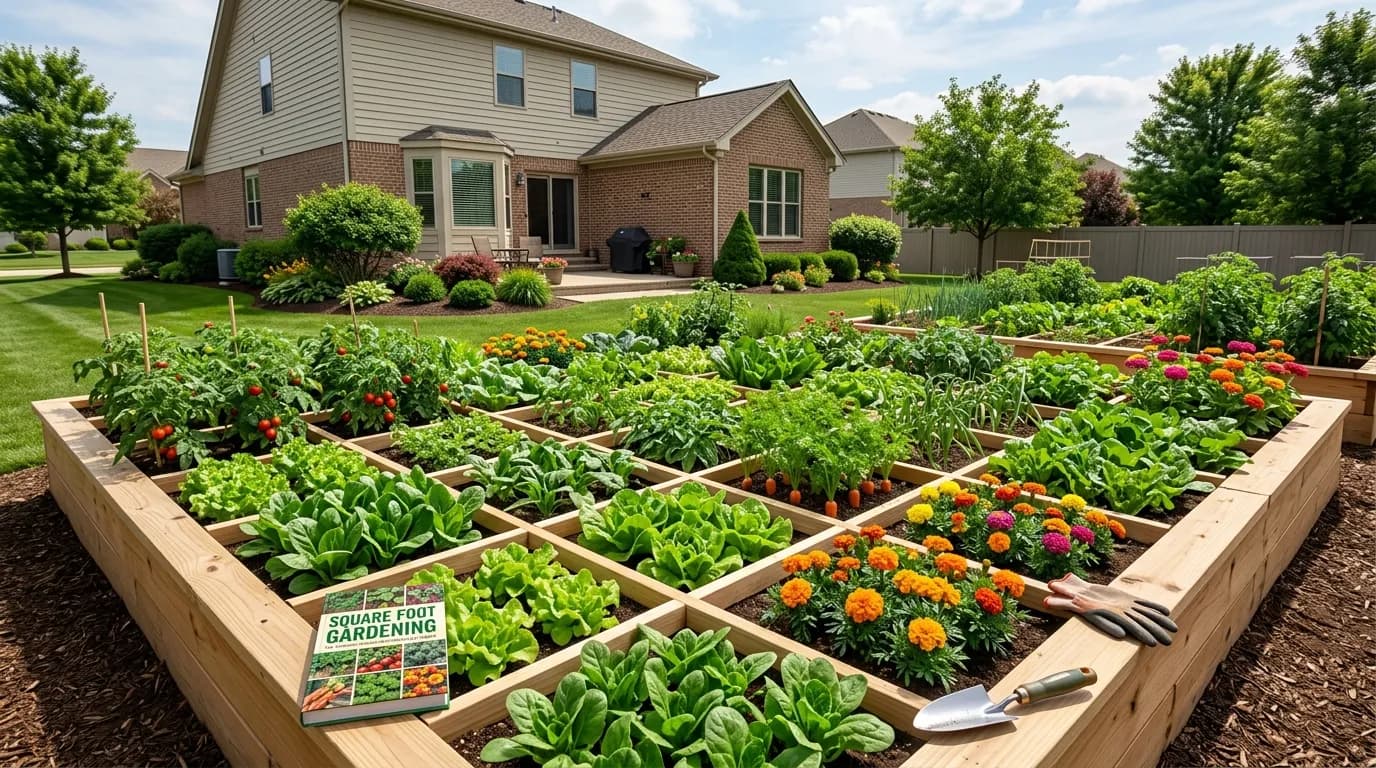
Square foot gardening is one of the most efficient ways to grow food at home — and it's perfectly suited for small backyards, raised beds, and even patios. Developed by Mel Bartholomew in the 1980s, the method divides your growing space into a grid of 1-foot squares, each planted with a specific number of crops based on their size. The result: up to 5 times more yield in 20% of the space of a traditional row garden, with a fraction of the water, weeding, and effort.
Whether you have a 4×4 raised bed or a sprawling backyard, square foot gardening can transform how you grow food. This complete guide covers everything — from building your first bed to spacing charts, soil mix, companion planting, and seasonal planning.
What Is Square Foot Gardening?
Square foot gardening (SFG) is a method of intensive planting in which every square foot of growing space is allocated to a specific plant or group of plants. Instead of planting in long rows with wide paths between (which wastes most of your growing space), SFG uses every inch productively.
The key principles:
- Raised beds: 4 feet wide (so you can reach the center from either side without stepping in)
- Grid system: Every bed is divided into 1-foot squares using a physical grid (string, wood lath, etc.)
- Custom spacing: Each square holds 1, 2, 4, 9, or 16 plants depending on mature size
- Mel's Mix soil: A specific blend — 1/3 compost, 1/3 peat moss or coco coir, 1/3 coarse vermiculite
- No tilling: Once the bed is built, you never till — just add compost on top each season
The result is dense, productive planting that suppresses weeds naturally (plants shade the soil), retains moisture, and produces enormous amounts of food in small spaces.
How Many Plants Per Square Foot?
This is the foundation of square foot gardening. Plant spacing per square foot is based on mature plant size:
| Plants per Square | Crop Examples |
|---|---|
| 1 plant | Tomato, pepper, broccoli, cabbage, cauliflower, eggplant, melon, squash |
| 2 plants | Cucumber (trained vertical), small cabbage, fennel |
| 4 plants | Lettuce (large head), Swiss chard, basil, parsley, dwarf kale |
| 9 plants | Spinach, bush beans, beets, turnips, garlic, peas (trained), kohlrabi |
| 16 plants | Radish, carrots, onions, scallions, small herbs (thyme, chives), beets (baby) |
Pro tip: Tall plants (tomatoes, pole beans, trellised cucumbers) go on the north side of your bed so they don't shade smaller crops. Compact plants (herbs, radishes, lettuces) fill the sunny southern squares.
Building Your First Square Foot Garden Bed
Step 1: Choose Your Location
SFG beds need at least 6 hours of direct sunlight daily. Most vegetables need full sun — exceptions include lettuce, spinach, and herbs, which tolerate partial shade (4–5 hours). Avoid low spots that hold water. Near a water source is ideal.
A standard starter bed is 4×4 feet (16 squares). This gives you enough space to grow a meaningful variety without being overwhelming. Once you're comfortable, add a second 4×8 bed (32 squares).
Step 2: Build or Buy a Raised Bed
Frame options (all work well):
- Cedar: Naturally rot-resistant, lasts 15–20+ years, looks great — best long-term choice
- Douglas fir: Affordable, lasts 7–10 years, widely available
- Pine: Cheapest, lasts 3–5 years — acceptable for beginners
- Composite lumber: Rot-proof, low-maintenance, expensive upfront
- Galvanized metal: Modern look, extremely durable, heats up soil (good in cool climates)
Bed depth: 6 inches minimum for lettuce and herbs; 12 inches ideal for most vegetables; 18 inches for deep-rooted crops (carrots, parsnips, potatoes).
Thinking about your full outdoor layout — not just the garden? Yardcast's AI landscape design tool generates photorealistic plans for your whole yard, including garden placement, pathways, and outdoor living zones — in under 60 seconds.
Step 3: Mix Your Soil (Mel's Mix)
Regular garden soil is too dense for raised beds — roots can't penetrate efficiently and drainage suffers. Mel's Mix is:
- 1/3 blended compost (ideally 5+ sources: mushroom, vermicompost, cow manure, leaf mold, etc.)
- 1/3 peat moss (or coconut coir — more sustainable)
- 1/3 coarse vermiculite (NOT perlite — vermiculite holds moisture and air better)
For a 4×4×0.5 ft bed, you'll need approximately 8 cubic feet of mix total. Bags from garden centers:
- 4 cu ft compost (~$15–25 per bag, need 2–3 bags)
- 3.8 cu ft peat/coir bale (~$12–20)
- 4 cu ft vermiculite (~$20–35)
Total soil cost for a 4×4 bed: approximately $60–$90. This mix lasts for years — you only add 1 inch of fresh compost on top each spring.
Step 4: Create Your Grid
The physical grid is what makes SFG work. Without it, you'll inevitably over-plant or under-plant. Options:
- Wood lath strips screwed to the frame edges (classic, permanent)
- String or twine tied to screws in the frame (easy, flexible)
- PVC pipe cut to length (durable, lightweight)
Lay the grid flush with the top of the bed. Label your squares with plant markers or draw a simple plan on graph paper first.
Step 5: Plan Your Planting Grid
Before planting, sketch your layout on paper. Think about:
- Sun direction: Tall crops north, short crops south
- Succession planting: After lettuce bolts in June, replant that square with bush beans
- Companion planting: Some plants help each other; others compete
- Vertical growing: Trellises on the north edge for cucumbers, pole beans, and peas let you grow 4–6 additional crops in the same footprint
Best Square Foot Gardening Layouts
Beginner 4×4 Layout (16 Squares)
Perfect for a first garden with a mix of easy crops:
| Square | Crop | Plants |
|---|---|---|
| 1 | Cherry tomato | 1 |
| 2 | Bell pepper | 1 |
| 3 | Basil | 4 |
| 4 | Lettuce (head) | 4 |
| 5 | Spinach | 9 |
| 6 | Radishes | 16 |
| 7 | Carrots | 16 |
| 8 | Garlic | 9 |
| 9 | Bush beans | 9 |
| 10 | Scallions | 16 |
| 11 | Kale | 4 |
| 12 | Cucumber (trellised) | 2 |
| 13 | Parsley | 4 |
| 14 | Beets | 9 |
| 15 | Marigolds (pest deterrent) | 4 |
| 16 | Swiss chard | 4 |
4×8 Salad-Focused Layout (32 Squares)
For maximizing fresh greens all season long — great for a family of 4:
- Rows 1–2: 6 squares of mixed lettuce (cut-and-come-again varieties)
- Rows 3–4: 4 squares spinach, 4 squares arugula, 2 squares mesclun mix
- Center band: Tomatoes (2), cucumber (trellised, 1), kale (2)
- Edge squares: Radishes (4×16=64 radishes), scallions (2×9=18), chives, dill
Companion Planting in Square Foot Gardens
Companion planting boosts yield and reduces pest pressure. The best square foot garden companions:
Three Sisters (Corn + Beans + Squash)
Works in larger SFG setups (need 4+ squares). Corn provides a pole for beans; beans fix nitrogen; squash shades the soil, keeping it cool and weed-free.
Tomatoes + Basil: Basil repels aphids and whiteflies; may improve tomato flavor. Plant 4 basil plants in the square directly adjacent to each tomato.
Carrots + Onions: Onion scent repels carrot fly; carrot scent repels onion fly. Interplant in alternating squares.
Marigolds as borders: French marigolds (Tagetes patula) repel nematodes, aphids, and whiteflies. Plant in border squares around the bed.
Avoid together: Fennel is allelopathic — it inhibits growth of most vegetables. Keep it in its own isolated bed. Also keep onion family away from beans and peas.
Watering and Maintenance
Square foot gardening reduces water use by up to 80% compared to row gardening because:
- Dense planting shades the soil (reduces evaporation)
- Mel's Mix retains moisture well
- No pathways between plants means zero wasted water
Watering: Drip irrigation or soaker hose laid under the grid is ideal. Hand watering works fine — water at soil level, not overhead (reduces fungal issues). A 4×4 bed typically needs 1 inch of water per week — roughly 2.5 gallons.
Weeding: Minimal with SFG. Once plants fill in their squares, very few weeds can germinate. Pull any that emerge immediately while they're tiny.
Fertilizing: Mel's Mix has enough nutrients for 1 season. Each spring, add 1 inch of fresh compost on top and lightly mix it into the surface inch. That's it.
Seasonal Succession Planting
The real power of square foot gardening is continuous harvest through succession planting — as soon as one crop finishes, replant that square with the next seasonal crop.
| Season | Cool-Season Crops | Warm-Season Crops |
|---|---|---|
| Spring (Mar–May) | Lettuce, spinach, peas, radishes, carrots, kale | — |
| Early Summer (Jun) | — | Tomatoes, peppers, cucumbers, beans |
| Midsummer (Jul–Aug) | — | Squash, eggplant, sweet corn |
| Fall (Sep–Oct) | Lettuce (again), kale, spinach, arugula, broccoli | — |
| Winter (Nov–Feb) | Garlic (plant in Nov, harvest July), overwintered kale | — |
Example succession sequence for one square:
- 1March: 16 radishes (harvest in 28 days)
- 2April: 9 spinach plants (harvest in 45–50 days, cut-and-come-again)
- 3June: 1 cherry tomato (harvest until frost)
- 4October: 9 spinach plants again
Common Square Foot Gardening Mistakes
Skipping the grid: Without a physical grid, you'll eyeball it wrong. The grid enforces discipline and keeps spacing consistent.
Using regular garden soil: Too compacted. Roots can't penetrate, drainage fails, plants underperform. Always use Mel's Mix or equivalent.
Planting too many slow crops: A beginner mistake is filling every square with tomatoes and peppers (1 per square) and ending up with only 16 plants. Mix in fast crops (radishes, lettuce) that you'll harvest and replant 3× in the same season.
No trellis: You're leaving 30–50% of your growing potential on the table if you're not growing vertical crops on a north-side trellis.
Overwatering: Dense planting = retained moisture. Feel the soil 2 inches deep before watering. Soggy Mel's Mix can cause root rot.
How to Design Your Entire Outdoor Space Around Your Garden
Your vegetable garden is part of a larger outdoor system — pathways, seating, tool storage, compost areas, and aesthetics all matter. Use Yardcast's AI landscape design tool to generate a photorealistic plan of your entire yard, including where your raised beds fit within a larger landscape vision. Upload photos of your space and get 3 full design concepts in under 60 seconds.
FAQ: Square Foot Gardening
Q: How many square foot garden beds do I need to feed a family of 4?
A: For a significant share of your vegetable needs (salads, herbs, some main-course vegetables), aim for 100–200 square feet of SFG space — about 6–8 standard 4×4 beds. That's a lot! Start with 1–2 beds and expand as you learn what your family eats most.
Q: Can I do square foot gardening without raised beds?
A: Technically yes — you can create a grid in the ground. However, raised beds are strongly recommended because they provide better drainage, warmer soil, perfect soil control (no clay, compaction, or rocks), and easier access. The investment is worth it.
Q: What's the best soil mix for square foot gardening?
A: Mel's Mix: equal parts blended compost, peat moss (or coco coir), and coarse vermiculite. Do not use native garden soil in a raised SFG bed — it's too dense.
Q: Can I do square foot gardening in containers?
A: Absolutely. A 24×24-inch container is 4 squares. Use the same Mel's Mix and plant accordingly. Works great on patios, balconies, and decks.
Q: How do I deal with pests in a square foot garden?
A: Row cover (floating fabric) protects against insects. Companion plants (marigolds, nasturtiums, aromatic herbs) deter many pests. Hand-pick caterpillars and slugs in the morning. Neem oil spray handles aphids and fungal issues without harsh chemicals.
Q: When should I replant a square after harvesting?
A: Immediately — or within a day or two. Every day an empty square sits is wasted productivity. Keep succession seeds on hand: radish seeds germinate in 3–5 days, lettuce in 7–10 days. Always have the next crop ready to go.
Q: Does square foot gardening really work?
A: Yes, with caveats. SFG dramatically improves yield per square foot compared to row gardening. However, productivity depends on: good sunlight (6+ hours), quality soil (Mel's Mix), consistent watering, succession planting, and vertical growing for eligible crops. The method underperforms when soil is poor or sunlight is limited.
Q: What are the best crops for beginners doing square foot gardening?
A: Start with lettuce (fast, easy, rewarding), radishes (28-day harvest — instant gratification), cherry tomatoes (prolific, forgiving), basil (complements tomatoes, very productive), and green beans (bush variety, easy, heavy yield). These all perform well in Mel's Mix and teach you the basics of planting, spacing, and succession.