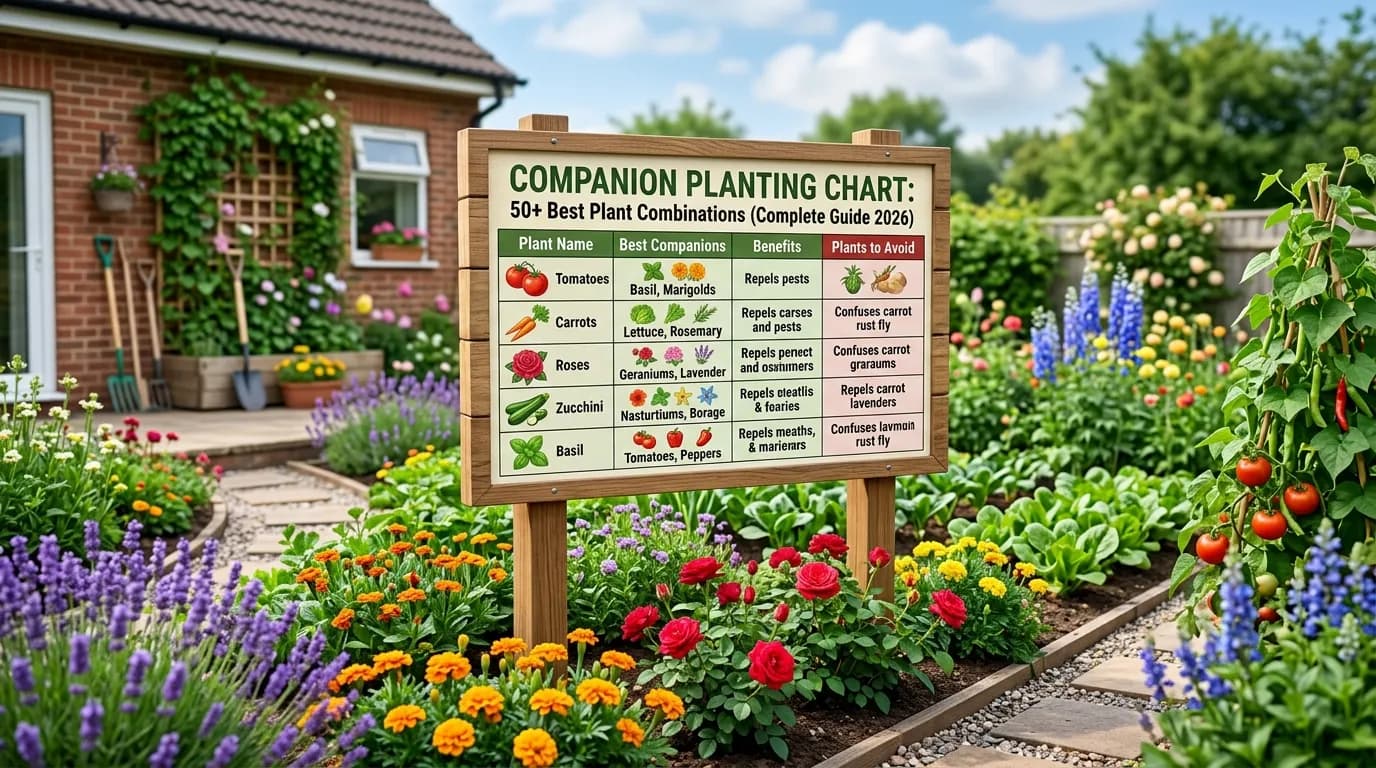
Companion planting is the art of placing plants together so they help each other — not just coexist. The right plant pairs can slash pest damage without pesticides, fix nitrogen that feeds your heavy feeders, improve flavor, maximize space in small gardens, and attract the beneficial insects that keep your whole garden healthy.
This guide covers the 50+ most valuable companion planting combinations, organized by vegetable, herb, and flower — plus a master chart you can print and take to the nursery.
Why Companion Planting Works: The Science
Some companion planting relationships are ancient wisdom; others are confirmed by university research. Here's what actually drives the benefit:
Chemical pest deterrence. Many plants release volatile compounds through their roots and leaves that repel specific insects. Marigold roots produce thiophenes that nematodes avoid. Basil leaves emit linalool and eugenol that deter thrips and aphids. Alliums (garlic, onions, chives) release sulfur compounds that confuse fungal gnats and aphids.
Insectary planting. Certain flowering plants attract beneficial insects (ladybugs, lacewings, parasitic wasps, hoverflies) that prey on garden pests. Dill, fennel, yarrow, and members of the carrot family (Apiaceae) are the most powerful insectary plants.
Nitrogen fixation. Legumes (beans, peas, clover, vetch) host rhizobium bacteria on their roots that pull nitrogen from the air and fix it in the soil. Plants grown near legumes absorb this nitrogen through root exudates and soil decomposition.
Physical benefits. Tall plants create shade for heat-sensitive companions. Sprawling plants (squash, nasturtium) suppress weeds and conserve moisture. Trellised crops (beans, cucumbers) make efficient use of vertical space that ground crops don't need.
Trap cropping. Sacrificial plants are placed to attract pests away from the main crop. Blue Hubbard squash, for example, is so attractive to squash vine borers and cucumber beetles that it draws them away from valuable summer squash and zucchini.
The Three Sisters: The Original Companion Planting System
The most famous companion planting combination in the world was developed by Indigenous farmers across North America — corn, beans, and squash, grown together in a mutually beneficial polyculture that produces more food per acre than any of the three grown separately.
Corn: provides a living trellis for bean vines to climb, giving them vertical growing space without stakes. Corn is a heavy nitrogen feeder.
Beans: fix atmospheric nitrogen through root nodules, replenishing what corn takes out. They twine around corn stalks without damaging them.
Squash: its large, rough-surfaced leaves shade the soil, preventing moisture evaporation and suppressing weed germination. Squash leaves also deter raccoons and other animals with their prickly texture.
The Three Sisters work together so effectively that Indigenous communities could grow the same plot for decades without rotating crops or adding external fertilizer.
How to plant Three Sisters: Mound soil 12–18 inches high, 3 feet wide. Plant 4–6 corn seeds per mound. When corn is 4–6 inches tall, plant 4–6 bean seeds around it. One week later, plant 2–3 squash seeds at the mound's edge.
Want to design a garden or yard that incorporates companion planting from the start?
Get a free AI landscape design preview — 60 seconds →
Master Companion Planting Chart: Vegetables
Tomatoes
| Plant With | Benefit | Avoid |
|---|---|---|
| Basil | Deters aphids, thrips; may enhance flavor | Fennel |
| Marigolds (French) | Deters soil nematodes, whiteflies | Brassicas |
| Borage | Deters tomato hornworm; attracts pollinators | Corn |
| Parsley | Attracts predatory insects | Potatoes |
| Carrots | Loosens soil around roots | |
| Garlic | Repels spider mites | |
| Asparagus | Mutual pest benefit |
Basil is the non-negotiable tomato companion. Plant it 12–18 inches from tomato stems. Some growers swear it improves fruit flavor — the mechanism isn't fully understood, but it may relate to volatile compounds shared through root exudates.
Peppers
| Plant With | Benefit | Avoid |
|---|---|---|
| Basil | Deters aphids and spider mites | Fennel |
| Carrots | Loosens soil | Brassicas |
| Marigolds | Root nematode control | |
| Buckwheat | Attracts hoverflies | |
| Geraniums | Deters Japanese beetles and leafhoppers |
Cucumbers
| Plant With | Benefit | Avoid |
|---|---|---|
| Nasturtiums | Trap crop for aphids; edible flowers | Potatoes |
| Dill | Attracts predatory wasps | Fennel |
| Radishes | Deters cucumber beetles | Sage |
| Sunflowers | Trellis + shade for soil | |
| Bush beans | Nitrogen fixation |
Nasturtiums are the most versatile companion plant in the garden. They attract aphids as a trap crop (drawing them away from vegetables), produce edible flowers, fix nitrogen as a groundcover, and deter whiteflies from cucumbers and squash with their peppery scent.
Squash and Zucchini
| Plant With | Benefit | Avoid |
|---|---|---|
| Corn | Three Sisters system | Potatoes |
| Beans | Nitrogen fixation | |
| Nasturtiums | Deters squash beetles | |
| Borage | Deters squash vine borers | |
| Blue Hubbard squash | Trap crop for vine borers | |
| Radishes | Deters squash bugs |
Beans and Peas
| Plant With | Benefit | Avoid |
|---|---|---|
| Corn | Three Sisters; beans fix nitrogen for corn | Alliums (onions, garlic, leeks) |
| Squash | Three Sisters | Fennel |
| Carrots | Loosen soil; beans shade carrot seedlings | |
| Potatoes | Deters Colorado potato beetle (beans) | |
| Marigolds | Nematode control |
Critical warning: Alliums (onions, garlic, chives, leeks) stunt bean growth. Keep beans and peas at least 3 feet from any allium family plant.
Carrots
| Plant With | Benefit | Avoid |
|---|---|---|
| Tomatoes | Tomato roots produce chemical that deters carrot flies | Dill (once bolted) |
| Beans | Nitrogen from beans feeds carrots | |
| Chives | Scent confuses carrot fly | |
| Rosemary | Repels carrot fly | |
| Leeks | Mutual protection — carrot fly vs. leek moth | |
| Lettuce | Uses shallow soil while carrots go deep |
The carrot + leek combination is famous in European organic gardening: carrot flies avoid leeks, and leek moths avoid carrots. Interplanting them cuts pest pressure on both.
Brassicas (Cabbage, Broccoli, Kale, Brussels Sprouts)
| Plant With | Benefit | Avoid |
|---|---|---|
| Dill | Attracts parasitic wasps that eat cabbage worms | Tomatoes |
| Nasturtiums | Trap crop for aphids | Strawberries |
| Celery | Deters white cabbage butterfly | Fennel |
| Chamomile | Calcium accumulator; improves soil | Potatoes |
| Thyme | Repels cabbage worms | |
| Hyssop | Deters cabbage moths |
Cabbage worms (Pieris rapae) are the #1 Brassica pest. Dill, thyme, and hyssop all interfere with the cabbage white butterfly's ability to detect host plants. Plant one herb for every 3–4 Brassica plants.
Herb Companion Planting
Basil
Pairs with: tomatoes, peppers, asparagus, oregano
Avoid: sage (inhibits basil's growth when planted in close contact)
Benefit: volatile oils repel aphids, whiteflies, spider mites, and tomato hornworm
Dill
Pairs with: brassicas, cucumbers, lettuce, onions
Avoid: fennel (they cross-pollinate and produce inferior seed for both), tomatoes (once dill bolts, it inhibits tomato growth)
Benefit: insectary powerhouse — attracts lacewings, ladybugs, parasitic wasps, and hoverflies
Garlic
Pairs with: roses, fruit trees, carrots, tomatoes, most vegetables
Avoid: beans, peas (stunts legume growth significantly)
Benefit: sulfur compounds repel aphids, spider mites, Japanese beetles, and fungal diseases
Mint
Pairs with: brassicas, tomatoes, peas
Avoid: plant in containers — mint spreads aggressively and will take over beds
Benefit: intense scent confuses aphids, flea beetles, and ants
Rosemary
Pairs with: beans, carrots, cabbage, sage
Avoid: cucumber (allelopathic effect in some conditions)
Benefit: repels cabbage fly, bean beetles, carrot fly
Flowers as Companion Plants
Marigolds (French — Tagetes patula)
The gold standard of companion planting flowers. French marigolds produce thiophenes from their roots — scientifically proven to repel root-knot nematodes. Their scent also deters whiteflies, aphids, and rabbit browsing.
How to use: Plant in dense groups throughout the vegetable garden — 1 marigold per every 3–4 plants. Interplanted marigolds are more effective than border plantings.
Nasturtiums
Edible, beautiful, and one of the most versatile companion plants available. Use as: trap crop for aphids (sacrifice it to save tomatoes), groundcover (suppresses weeds), nitrogen fixer, pollinator attractor, and cucumber beetle deterrent.
Borage
One of the best companion plants for tomatoes and squash. Its star-shaped blue flowers attract pollinators in enormous numbers. It's also a dynamic accumulator — its leaves decompose to release calcium and potassium into the soil.
Phacelia
Not well known outside of commercial organic farming, but phacelia is one of the most powerful insectary plants in existence. It attracts more beneficial insects per plant than almost any other flower, including many parasitic wasp species that prey on caterpillars and aphids.
Zinnias
Attract hummingbirds, butterflies, and parasitic wasps. Their dense flowering provides habitat for beneficial insects between vegetable rows.
Bad Companion Planting Combinations to Avoid
| Avoid Pairing | Reason |
|---|---|
| Fennel + anything | Allelopathic — inhibits most vegetables, especially tomatoes and peppers |
| Beans + alliums | Garlic, onion, leeks significantly stunt bean growth |
| Potatoes + tomatoes | Share blight (P. infestans); concentrate disease pressure |
| Potatoes + cucumbers | Increase blight spread |
| Sunflowers + potatoes | Sunflower roots are allelopathic to potatoes |
| Cabbage + strawberries | Compete for same soil nutrients |
| Dill (bolted) + tomatoes | Bolted dill releases compounds that suppress tomato growth |
| Brassicas + tomatoes | Brassicas stunt tomato development |
| Roses + ornamental grass | Grass root competition weakens roses |
How to Design a Companion Planting Garden
Step 1: Identify your heavy feeders. Tomatoes, corn, squash, and Brassicas need the most nitrogen. Pair each with a nitrogen fixer.
Step 2: Map your pest problems. If you have aphids every year, prioritize nasturtiums and marigolds. If nematodes are an issue, plant French marigolds heavily.
Step 3: Add insectary flowers throughout. Don't clump them in one corner — scatter dill, fennel (in its own isolated spot), phacelia, borage, and zinnias throughout the garden to ensure beneficial insects patrol every row.
Step 4: Think vertically. Use taller companions (corn, sunflowers, trellised crops) to create microclimates of shade for heat-sensitive plants like lettuce and cilantro.
Step 5: Rotate annually. Companion planting relationships don't override the need for crop rotation. Move plant families to different beds each year to prevent disease buildup.
A well-designed companion planting garden requires intentional spatial planning — which is exactly where AI-assisted garden design shines.
Design your garden layout with AI — free preview →
Get a photorealistic design of your garden or yard with plant placement built in. Upload your yard photos, set your preferences, and see exactly where everything should go — down to specific companion plant pairings for your climate zone.
Frequently Asked Questions
See the FAQ section above for the most common companion planting questions.
Does companion planting really work?
The honest answer: some combinations have strong scientific support (marigolds + nematodes, legumes + nitrogen, allelopathic effects of fennel and black walnut). Others are based on generations of observation without controlled studies. In practice, most experienced organic gardeners find that companion planting measurably reduces pest pressure and soil amendment costs — even if the exact mechanism isn't fully understood for every pairing.
Can you do companion planting in raised beds?
Yes — raised beds are actually ideal for companion planting because you control the layout precisely. The Three Sisters work beautifully in a 4×8 raised bed. Interplanting marigolds and basil throughout a raised bed vegetable garden is one of the simplest and most effective companion planting strategies available to any gardener.