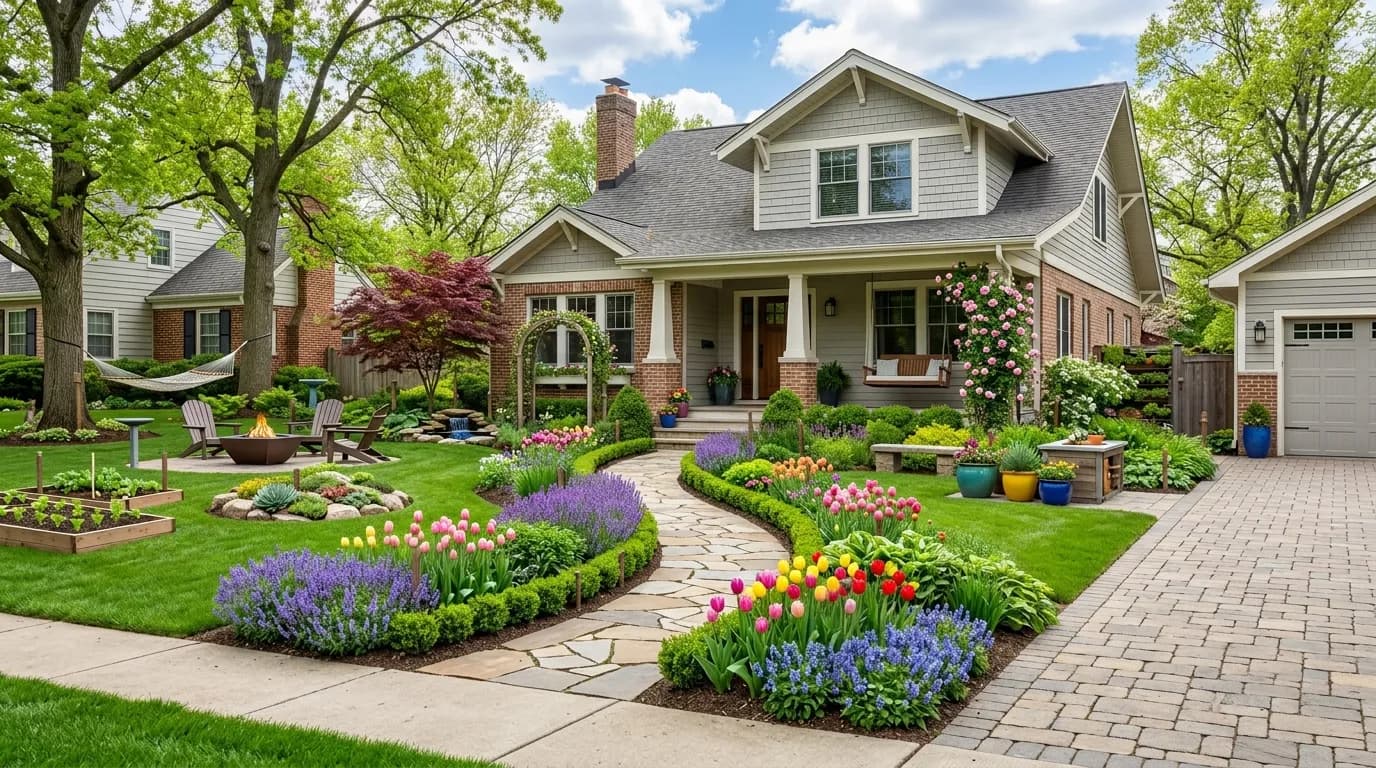
Spring is the most high-impact season for landscaping. Plants are actively growing, soil is workable, temperatures are ideal for establishment, and every improvement is magnified by the season's natural energy. Here are 25 spring landscaping ideas — from free weekend projects to complete yard transformations.
Why Spring Is the Best Time to Landscape
Spring offers a unique combination of conditions that makes it far more forgiving than any other season:
- Mild temperatures mean new plantings establish before summer heat stress
- Consistent rainfall reduces irrigation needs during the critical first weeks
- Active root growth lets plants anchor in fast
- Long growing season ahead — plants have all summer to establish
The catch: spring is short. In most of the country, you have a 6–10 week window between when the ground thaws and when summer heat arrives. The ideas here are organized from fastest to most involved so you can pick based on how much time you have.
Week 1: Free and Fast Spring Wins
1. Spring Cleanup First
Before any new plants or projects, complete a full cleanup. Remove all winter debris: dead stems left from fall (if not cut back), fallen branches, matted leaves, and winter mulch pushed against plant crowns. This takes 2–4 hours for most yards and immediately improves the look without spending a dollar.
What to cut back:
- Ornamental grasses: cut to 3–4 inches before new growth emerges
- Perennial stems: cut to the ground while you can still see last year's stubs
- Rose canes: cut dead canes back to green, healthy wood
2. Re-Edge All Garden Beds
A sharp, clean edge between lawn and garden beds is the single fastest visual upgrade available. Use a half-moon edger or flat spade to cut a vertical edge 3–4 inches deep. A crisp edge makes even an average landscape look professionally maintained. Do this before mulching for the cleanest result.
3. Apply Fresh Mulch
Mulching in spring is the most cost-effective maintenance task in landscaping. A 2–3 inch layer of fresh wood chip mulch:
- Suppresses weeds (reducing summer weeding by 80%+)
- Retains soil moisture (cutting irrigation needs significantly)
- Regulates soil temperature as summer heat arrives
- Gives beds a finished, professional appearance
Cost: $25–$45 per cubic yard for bulk delivery. A typical suburban yard needs 3–5 yards. Total cost: $75–$225 — a major visual upgrade for a small investment.
4. Plant Cool-Season Annuals Immediately
Cool-season annuals thrive in spring temperatures that would kill summer flowers. Plant now for instant color:
- Pansies: Bloom from near-freezing through 50s°F, come in hundreds of colors
- Violas: Smaller than pansies, even more cold-hardy
- Snapdragons: Excellent cut flower, reseeds prolifically
- Sweet alyssum: White carpet, intensely fragrant, fills gaps beautifully
- Calibrachoa: Trailing habit, perfect for containers
- Lobularia, stock, nemesia: All perform best in cool weather
These plants will start declining as temperatures rise above 75°F, but they provide 6–10 weeks of peak color in the critical spring window.
Project 1: Refresh Your Foundation Planting
5. Remove Overgrown Foundation Shrubs
Most homes have original builder-grade foundation plantings that were installed 10–30 years ago and have long since outgrown their space. Shrubs covering windows, blocking the front door, or hiding the house's architecture actually hurt curb appeal rather than helping it.
Spring is the best time to remove shrubs — roots are easier to cut before summer heat and you can see the full extent of what needs to go. Rent a stump grinder for $150–$200/day, or hire a landscaper to remove and chip for $200–$400.
6. Replace with Right-Sized Plants
After removing oversized shrubs, replace with varieties that fit their permanent space:
| Location | Plant | Mature Size | Notes |
|---|---|---|---|
| Corner of house | Dwarf hinoki cypress | 4–6 ft | Slow-growing, architectural |
| Under windows | Dwarf spirea | 2–3 ft | Flowering, easy care |
| Entry accent | Little Lime hydrangea | 3–5 ft | Reblooming, compact |
| Foundation bed | Drift roses | 1.5–2 ft | Disease-resistant, continuous bloom |
| Shady foundation | Oakleaf hydrangea | 6–8 ft | Native, four-season interest |
7. Add Structure with Dwarf Conifers
Dwarf conifers — small-growing evergreens — provide year-round backbone to mixed beds. Spring is the ideal planting window. Good options: 'Blue Star' juniper (18 inches, blue foliage), 'Nana' mugo pine (3 feet, globe form), 'Fireworks' gold thread cypress (4 feet, weeping gold).
Project 2: Create or Expand a Flower Bed
8. Smother New Bed Areas with Cardboard
To create a new garden bed without tilling (which brings up weed seeds), lay flattened cardboard boxes directly on grass, overlap edges 6 inches, and cover with 6 inches of compost/topsoil mix. The cardboard smothers the grass, decomposes over 6 months, and adds organic matter. This "sheet mulching" or "lasagna bed" method is the easiest way to expand bed space.
9. Plant in Odd Numbers and Sweeps
Design principle: plant in groups of 3, 5, or 7 of the same species, arranged in drifts (elongated diagonal groups) rather than rows. Drifts look naturalistic and intentional. A single specimen of anything rarely reads well from a distance; repetition of a few species creates coherence.
10. Layer by Height
Classic layering — tall in back, medium in middle, low in front — is a principle that applies to every bed, every style:
- Back: 4–6 ft shrubs or tall perennials (ornamental grass, Russian sage, Joe-Pye weed)
- Middle: 18–36 inch flowering perennials (salvia, echinacea, catmint, peonies)
- Front: 6–18 inch edging plants (creeping phlox, agapanthus, dwarf aster, sedum)
11. Plant Spring Bulbs for Fall
It seems counterintuitive, but spring is an excellent time to buy and plant summer-blooming bulbs (not spring bulbs — those go in fall):
- Dahlias: Spectacular from July through frost, divide and store annually in cold climates
- Cannas: Tropical foliage effect, red/yellow/orange flowers
- Gladiolus: Traditional cut flower, stagger plantings for succession bloom
- Caladiums: Foliage only, outstanding tropical color for shade
Project 3: Hardscape Upgrades
12. Install a Dry Creek Bed
A dry creek bed solves two problems simultaneously: it manages storm runoff in low areas and adds a naturalistic design element. The materials cost $200–$600 for a typical 20–30 foot creek:
- Large boulders ($5–$15 each) for the edge
- River rock (2–3 inch) for the streambed
- Perennials along the bank (native sedges, iris, Joe-Pye weed)
13. Lay a Stepping Stone Path
A stepping stone path from driveway to front door, or through a side yard, adds function and charm. Spring is ideal because you can see exactly where feet naturally travel before the vegetation fills in.
Installation: Lay stones on a 4-inch bed of compacted sand. Space them 18–24 inches on center (natural stride length). Offset them slightly from a straight line for a more natural look.
14. Add a Border Edge to Your Driveway
The transition between driveway and lawn is often one of the most neglected areas. A simple treatment:
- Install metal landscape edging along both sides of the driveway
- Plant one species of low, spreading groundcover (creeping thyme, sedum, or perennial geranium)
- Mulch the 18-inch strip behind the edging
This takes a half-day and costs $150–$300 but dramatically changes the entry experience.
15. Build a Simple Fire Pit Seating Area
A fire pit with simple seating — 4 Adirondack chairs on a gravel pad — is the most popular backyard project in America for good reason: it extends outdoor living by months and becomes the social center of the property.
Budget DIY version: $200–$400 for a 12x12-foot gravel pad plus a cast-iron fire pit bowl. The gravel pad alone transforms the feel of a backyard — it creates a destination.
Project 4: Lawn Renovation
16. Core Aerate Compacted Areas
If you have areas with compaction (paths, parking overflow, play areas), core aerate before overseeding. Rent a core aerator for $75–$100/half day. Run it over compacted areas 2–3 times in different directions for best penetration.
17. Overseed Thin Spots
After aerating, overseed thin or bare areas. In spring, use grass varieties that establish quickly in cool conditions — perennial ryegrass germinates in 5–7 days and establishes in 3–4 weeks. For lawns transitioning to fine fescue or bluegrass blends, spring overseeding works with consistent watering.
18. Apply Pre-Emergent Weed Control
Apply a pre-emergent herbicide when soil temperature reaches 50°F at 2-inch depth (typically when forsythias bloom). This prevents crabgrass and other summer annual weeds from germinating. Important: don't apply pre-emergent in areas where you're overseeding — it prevents all seed germination.
19. Top-Dress with Compost
Spreading ¼–½ inch of compost over the entire lawn in spring is one of the best things you can do for long-term soil health. It improves drainage in clay soils, adds water retention in sandy soils, feeds soil biology, and contributes slow-release nutrients. A yard spreader makes this easy. Budget: $50–$100 for a typical lawn.
Project 5: Trees and Shrubs
20. Plant Trees in Spring
Spring is the second-best time to plant trees (fall is technically optimal, but spring-planted trees establish well with proper watering). The key: water every 3–5 days for the first summer, even drought-tolerant species. Trees transplanted without adequate first-year water fail at a high rate regardless of species.
Best spring-planted trees:
- Serviceberry (Amelanchier): Native, white spring flowers, edible berries, brilliant fall color
- Redbud (Cercis): Magenta flowers on bare branches in early spring — stunning
- River birch: Fast-growing, multi-stem, peeling bark, native
- Japanese maple: Slow but spectacular; plant now for years of enjoyment
21. Prune Spring-Blooming Shrubs After Bloom
Forsythia, lilac, azalea, rhododendron, and other spring-blooming shrubs set their flower buds in fall. Pruning before they bloom removes this year's flowers. The correct time to prune: within 6 weeks after bloom. Prune after the flowers fade, before the plant sets next year's buds.
22. Feed Established Trees and Shrubs
Established trees and shrubs benefit from a single annual feeding in spring as growth resumes. Use a slow-release granular fertilizer (10-10-10 or similar) broadcast under the entire canopy drip line, not just at the base. Avoid high-nitrogen fertilizers on flowering shrubs — they promote leafy growth at the expense of flowers.
Project 6: Water Features and Accents
23. Install a Rain Garden
A rain garden is a shallow depression planted with water-tolerant native plants that collects and filters storm runoff. It solves drainage problems while creating a habitat feature. Typical cost for a DIY rain garden: $200–$600 in plants and soil amendment. Position downhill from a downspout or driveway runoff point.
24. Add a Container Vignette to the Entry
A well-designed container grouping at the front entry is the fastest way to add "designed" appeal. Spring formula: a tall thriller (ornamental grass, canna, spike), a mounding filler (petunia, verbena, marigold), and a trailing spiller (sweet potato vine, bacopa, trailing petunia). Use odd numbers of containers — 3 is ideal — and match container colors to your home's exterior palette.
25. Design the Whole Yard Before You Plant
The most expensive landscaping mistake is planting reactively — buying what looks good at the nursery without a plan and ending up with an incoherent mix of plants that don't work together.
Before your next nursery run, use Yardcast's free AI landscape design tool to generate 3 complete design concepts for your specific yard. Each design includes a full plant list tailored to your climate zone, style preferences, and budget. Takes 60 seconds and it's free to preview. Know exactly what you want before spending a dollar.
Spring Landscaping Cost Guide
| Project | DIY Cost | Professional Cost | Time |
|---|---|---|---|
| Full spring cleanup | $0–$50 (bags, tools) | $200–$500 | Half day |
| Mulching (3 yards) | $75–$135 | $200–$350 | 3–4 hours |
| Foundation replanting | $200–$600 | $800–$2,000 | 1–2 days |
| New flower bed (200 sq ft) | $150–$400 | $500–$1,200 | 1 day |
| Stepping stone path (20 ft) | $80–$200 | $300–$600 | Half day |
| Core aeration + overseed | $150–$300 | $300–$700 | 3–4 hours |
| Dry creek bed (20 ft) | $200–$500 | $600–$1,500 | 1 day |
| New tree installation | $75–$400 | $300–$800 | 2–3 hours |
Spring Planting Calendar by Region
| Region | Last Frost | Start Cool Annuals | Start Warm Season | Overseed Window |
|---|---|---|---|---|
| Zone 9–10 (CA, FL, TX south) | Jan–Feb | January | March | January–February |
| Zone 7–8 (Mid-Atlantic, PNW) | Mar–Apr | Early March | Mid-April | March–April |
| Zone 6 (Midwest, NE) | Apr–May | Late March | Mid-May | April–May |
| Zone 5 (Great Lakes, New England) | May | Early April | Late May | April–May |
| Zone 4 (Upper Midwest, Mountain West) | May–June | Late April | Early June | May |
| Zone 3 (Northern Plains, Alaska) | June | May | June | May |
FAQ: Spring Landscaping Questions Answered
<script type="application/ld+json">
{
"@context": "https://schema.org",
"@type": "FAQPage",
"mainEntity": [
{
"@type": "Question",
"name": "What landscaping should I do in spring?",
"acceptedAnswer": {
"@type": "Answer",
"text": "Priority spring landscaping tasks: (1) Complete spring cleanup — cut back perennials, remove debris, rake leaves. (2) Apply fresh mulch to all beds (2–3 inches). (3) Re-edge garden beds. (4) Plant cool-season annuals for immediate color. (5) Core aerate and overseed thin lawn areas. (6) Apply pre-emergent weed control when soil hits 50°F. (7) Plant trees and shrubs before summer heat. (8) Prune spring-blooming shrubs after they flower."
}
},
{
"@type": "Question",
"name": "What plants should I plant in spring?",
"acceptedAnswer": {
"@type": "Answer",
"text": "Spring is ideal for planting almost everything. Cool-season annuals (pansies, snapdragons, sweet alyssum) can go in immediately. Perennials, trees, and shrubs should go in as soon as the ground is workable. Summer bulbs (dahlias, cannas, gladiolus) go in after your last frost date. Warm-season annuals (petunias, marigolds, impatiens) go in after soil warms above 60°F."
}
},
{
"@type": "Question",
"name": "When should I start landscaping in spring?",
"acceptedAnswer": {
"@type": "Answer",
"text": "Start as soon as the ground thaws and soil is workable — typically 4–6 weeks before your last frost date. You can clean up beds, plant cool-season annuals, and apply mulch while nighttime temperatures are still near freezing. Wait until after your last frost date to plant frost-sensitive annuals and warm-season plants."
}
},
{
"@type": "Question",
"name": "How do I freshen up my yard in spring?",
"acceptedAnswer": {
"@type": "Answer",
"text": "The fastest spring yard refresh: (1) Cut back all perennial stems from winter. (2) Apply 2–3 inches of fresh mulch to all beds ($75–$200 for most yards). (3) Re-edge between lawn and beds with a sharp spade. (4) Plant one flat of pansies or other cool-season annuals at the entry. These four tasks take one Saturday and transform the appearance of almost any yard."
}
},
{
"@type": "Question",
"name": "What is the cheapest spring landscaping idea?",
"acceptedAnswer": {
"@type": "Answer",
"text": "The cheapest and highest-impact spring landscaping tasks are all free or near-free: (1) Spring cleanup — just labor. (2) Re-edging beds — a $15 edger delivers major visual impact. (3) Dividing existing perennials to fill bare spots — free plants from what you already have. (4) Grasscycling (leaving mower clippings on the lawn) — reduces fertilizer costs. (5) Sheet mulching new bed areas with free cardboard from appliance stores."
}
},
{
"@type": "Question",
"name": "When should I apply mulch in spring?",
"acceptedAnswer": {
"@type": "Answer",
"text": "Apply spring mulch after the soil has warmed slightly but before weed seeds germinate — typically late March to mid-May depending on your zone. If you mulch too early over frozen ground, you insulate the soil and delay warming. If you wait too long, weeds get a head start. Also: re-edge your beds and cut back perennials before mulching for the cleanest result."
}
},
{
"@type": "Question",
"name": "Should I fertilize my landscaping in spring?",
"acceptedAnswer": {
"@type": "Answer",
"text": "A light spring fertilization benefits most landscape plants. Use a slow-release balanced fertilizer (10-10-10 or similar) broadcast under the drip line of trees and shrubs. For perennial beds, a 1-inch top-dressing of compost provides slow-release nutrition without the risk of over-fertilizing. Avoid high-nitrogen fertilizers on spring-blooming shrubs — they suppress flowering."
}
},
{
"@type": "Question",
"name": "What is the best way to landscape on a budget in spring?",
"acceptedAnswer": {
"@type": "Answer",
"text": "Budget spring landscaping: divide existing perennials and redistribute them to fill gaps (free), get free plants at spring plant swaps or from neighbors, buy nursery stock in 4-inch pots rather than gallon containers (3–4x cheaper, establish just as well), use bulk mulch instead of bagged (75% cheaper for large areas), use sheet mulching with free cardboard to create new beds without buying topsoil, and start plants from seed for $2–$4 per packet instead of $8–$15 per plant."
}
}
]
}
</script>