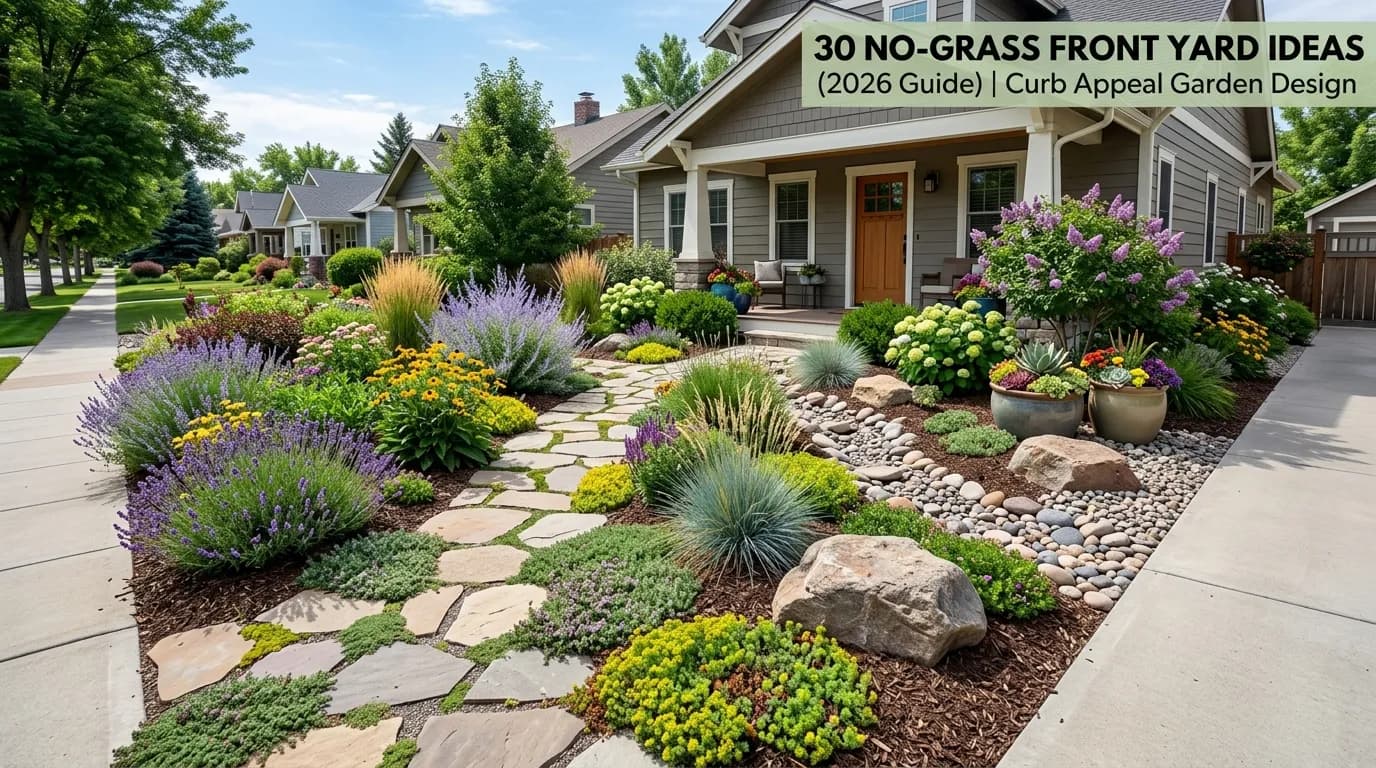
Across the US, millions of homeowners are ripping out their front lawns — and not replacing them with new sod. Water bills, drought restrictions, rising fertilizer costs, and the simple reality that grass requires constant effort are driving one of the biggest shifts in American landscaping.
The good news: a grass-free front yard almost always looks better than a traditional lawn. The options range from lush groundcover carpets to dramatic desert hardscapes, Japanese-inspired gravel gardens to meadow-style native plantings. Whatever your climate, style, or budget, there's a no-grass design that will transform your curb appeal.
Here are 30 ideas, organized by style — plus real cost data and a climate-by-climate groundcover guide.
Why Homeowners Are Ditching Grass: The Real Numbers
Before the ideas, consider what you're actually getting rid of:
- Average lawn water use: 1 inch per week = 620 gallons per 1,000 sq ft per watering. A 2,000 sq ft front lawn uses 1,240 gallons every week in summer.
- Annual fertilizer cost: $150–$400 per year for a standard front lawn
- Lawn maintenance cost: $1,200–$2,500/year if you hire it out; 40–80 hours/year if you DIY
- Mowing season: 25–35 mowings per year in most US climates
- HOA fines for dead grass: Increasingly common in drought-restricted areas, with fines up to $500/month
Replacing grass with drought-tolerant alternatives typically cuts outdoor water use by 50–80% and eliminates mowing entirely. Many local water utilities offer rebates of $1–$3 per square foot removed through turf replacement programs.
30 No-Grass Front Yard Ideas
Groundcover Gardens
1. Creeping Thyme Lawn — The most popular grass alternative in moderate climates. Creeping thyme forms a dense, fragrant mat that handles light foot traffic, blooms lavender in summer, and needs zero mowing. Plant plugs 6 inches apart; full coverage in one season. Cost: $200–$500 for a typical front yard.
2. Clover Meadow — White Dutch clover is experiencing a massive comeback. It stays green through drought, fixes nitrogen (feeds itself), attracts pollinators, and costs a fraction of grass seed. Mix with low wildflowers for a meadow effect. Cost: $50–$100 in seed for a small front yard.
3. Sedum Patchwork — Mix 3–5 sedum varieties (Autumn Joy, Dragon's Blood, Blue Spruce) for a tapestry of colors and textures. Sedums are drought-tolerant, spread slowly, and look stunning year-round. Ideal for zones 3–9.
4. Mondo Grass Carpet — Despite the name, mondo grass isn't a true grass and never needs mowing. The fine-textured, dark-green blades create an elegant, Japanese-inspired look. Dwarf mondo grass stays under 4 inches tall. Excellent for shaded front yards.
5. Liriope Borders with Gravel Fill — Plant liriope (lily turf) in sweeping drifts around a central gravel or decomposed granite area. The contrast between the soft, arching foliage and the hard surface creates a clean, modern look.
6. Creeping Phlox Hillside — If your front yard slopes, creeping phlox is one of the best erosion-control solutions that also creates a spectacular spring display — a carpet of pink, purple, or white blooms that stops traffic.
Rock & Gravel Gardens
7. Decomposed Granite with Boulders — DG (decomposed granite) is the workhorse of grass-free yards in the Southwest. A 3-inch stabilized DG base with 3–5 large boulders and pockets of drought-tolerant plants creates a landscape that needs almost zero irrigation after establishment.
8. Japanese Gravel Garden — Raked pea gravel or white granite chips around carefully placed moss-covered stones creates a zen aesthetic that rewards the eye without demanding any maintenance. Add a single Japanese maple or dwarf pine for a focal point.
9. River Rock Dry Creek Bed — Replace lawn with a meandering dry creek bed of river rocks that doubles as drainage infrastructure. Plant ornamental grasses and low shrubs along the banks. Functional and beautiful.
10. Flagstone Patio + Groundcover Gaps — Large flagstones set in a pattern with creeping thyme or Irish moss filling the gaps creates a hybrid hardscape-softscape look. You get the permanence of stone with the organic softness of living plants.
11. Pea Gravel Courtyard — A defined area of fine pea gravel bordered by low stone edging, filled with container plants and a central focal point (bird bath, sculpture, or fire feature), transforms a front yard into an outdoor room.
12. Gravel Garden with Drifts — The "New Perennial" style: fine gravel mulch with naturalistic drifts of ornamental grasses, salvias, and rudbeckia. Inspired by designer Piet Oudolf. Looks intentional and lush, requires almost no irrigation.
Native Plant Designs
13. Prairie Front Yard — Replace lawn with native prairie grasses (little bluestem, sideoats grama) and wildflowers (coneflowers, black-eyed Susans). After establishment, a prairie front yard needs zero irrigation, zero fertilizer, and one annual cut in late winter. It also sequesters carbon and supports native pollinators.
14. California Native Garden — For zone 8–11 homeowners, a garden of California poppies, white sage, manzanita, and native bunch grasses is the ultimate low-water front yard. Many California cities offer rebates up to $5,000 for turf removal.
15. Mid-Atlantic Woodland Edge — In the Mid-Atlantic and Southeast, a native plant palette of Virginia sweetspire, wild ginger, native ferns, and spicebush creates a lush, green look without grass. Perfect for shaded front yards under mature trees.
16. Texas Tough Native Landscape — Salvia greggii, Texas lantana, Blackfoot daisy, and Gulf muhly grass create a heat-loving, drought-proof palette for Texas and the Gulf Coast. Colors from spring through first frost, no irrigation after year one.
17. Butterfly + Pollinator Garden — A designed habitat garden with native milkweed, coneflowers, goldenrod, and asters is both wildlife-friendly and strikingly beautiful. Add a simple sign explaining your pollinator habitat — neighbors inevitably become curious and inspired.
18. Eastern Native Meadow — For the Northeast and Midwest, a mix of native grasses (Karl Foerster, switchgrass) with self-seeding annuals (cosmos, rudbeckia) and perennials creates a meadow that evolves beautifully over the season.
Ready to see what a grass-free design would look like for your specific yard? Generate your free AI landscape preview at Yardcast → Answer 5 questions about your space, style, and climate — and get 3 professional-quality design concepts in under 60 seconds.
Mediterranean & Desert Styles
19. Agave and Gravel Desert Garden — A statement agave (Blue Agave, Artichoke Agave) centered in a bed of decomposed granite with smaller succulent satellites is one of the most dramatic front yard looks possible. Absolutely zero water after establishment. Zones 8+.
20. Lavender Fields — A front yard filled with rows or drifts of English lavender is profoundly beautiful, fragrant from spring through summer, and extremely drought-tolerant once established. Pairs beautifully with gravel mulch and stone edging.
21. Olive Tree + Gravel Mediterranean — A single multi-trunk olive tree (non-fruiting variety) as the centerpiece, with silver-leafed plants (artemisia, santolina, lavender cotton), terracotta edging, and pea gravel creates an instant Tuscan feel.
22. Rosemary Hedge + Flagstone — A low rosemary hedge along the front of the house, flagstone path to the door, and gravel fill is both culinary and beautiful. Rosemary is drought-tolerant, fragrant, and can be clipped to maintain shape.
23. Succulent Tapestry Garden — Lay out Echeveria, Sempervivum, Sedum, and Aeonium in a color-block pattern like a living mosaic. Plant in fast-draining soil or build a raised bed. Spectacular year-round and requires watering only every 2–3 weeks.
24. Cactus Garden with River Rock — For zones 9+, a curated cactus garden (Saguaro, Prickly Pear, Barrel, Cholla) in river rock mulch creates a low-maintenance yard that looks like it belongs on a design tour.
Modern & Hardscape-Forward Designs
25. Concrete + Ornamental Grass Grid — Architectural concrete pavers in a grid pattern with ornamental grass (Karl Foerster, Mexican feathergrass) planted in the gaps. Clean, modern, requires mowing of exactly zero square feet.
26. Permeable Paver Driveway Extended — Extend a permeable paver design from your driveway across the front yard, with planting strips for ornamental grasses and low shrubs. Handles heavy foot traffic and drainage while looking sophisticated.
27. Raised Planter Boxes with Gravel — Weathering steel (Corten) raised planters at varying heights, filled with a mix of herbs, ornamental grasses, and low perennials, create an architecturally interesting front yard with no lawn whatsoever.
28. Crushed Stone Zen Garden — White or grey crushed stone carefully raked around low-growing Mugo pines and boxwood spheres creates a minimalist, meditative front yard that stays immaculate with almost no effort.
29. Moss Garden — In the Pacific Northwest and other consistently moist climates, a moss garden is genuinely magical. Established moss needs no mowing, no fertilizing, and very little watering. Remove grass, amend with acidic soil, plant moss mats or inoculate with a blended moss slurry.
30. Mixed Hardscape Living Room — Combine a small seating area (gravel + pavers), a planting bed with specimen shrubs, a low stone wall, and strategic pathway lighting. Your front yard becomes an outdoor space that makes passersby stop and look.
How Much Does It Cost to Replace a Front Lawn?
| Approach | Material Cost | Labor Cost | Total Range |
|---|---|---|---|
| DIY groundcover planting | $100–$500 | $0 (DIY) | $100–$500 |
| Decomposed granite + plants | $300–$800 | $500–$1,500 | $800–$2,300 |
| Native plant meadow | $200–$600 | $400–$1,200 | $600–$1,800 |
| Flagstone + groundcover | $600–$1,500 | $800–$2,000 | $1,400–$3,500 |
| Full hardscape (pavers, walls) | $2,000–$8,000 | $2,000–$6,000 | $4,000–$14,000 |
Most homeowners who eliminate a 1,000 sq ft front lawn spend $800–$2,500 and recover the cost within 2–3 years in water and maintenance savings. Water utility turf replacement rebates (where available) can offset $500–$2,000 of that upfront cost.
Best Groundcovers to Replace Grass (By Climate)
- Pacific Northwest (Zones 7–9): Kinnikinnick, creeping Jenny, wild ginger, Pacific Coast iris, low-growing ferns, moss
- California / Southwest (Zones 9–11): Dymondia, gazania, ice plant, lantana, creeping rosemary, delosperma
- Texas / Gulf Coast (Zones 8–10): Asiatic jasmine, prairie verbena, frogfruit, dwarf ruellia
- Southeast (Zones 7–9): Liriope, asiatic jasmine, mondo grass, native sedges, vinca
- Mid-Atlantic / Northeast (Zones 5–7): Creeping thyme, sedum, clover, creeping phlox, pachysandra (for shade)
- Midwest / Great Plains (Zones 4–6): Prairie dropseed, buffalo grass (low-mow), native sedge, creeping thyme
- Mountain West (Zones 5–7): Woolly thyme, blue grama, buffalo grass, penstemon, low-growing asters
HOA Considerations: What to Know Before You Dig
The biggest concern homeowners have about going grass-free is their HOA. The landscape is changing rapidly:
- 1Check your CC&Rs — Many HOAs written before 2010 require "lawn" but don't define it precisely. Groundcovers may qualify.
- 2State drought protection laws — California, Nevada, Colorado, Arizona, Utah, and Texas all have state laws that prevent HOAs from requiring water-intensive landscaping. Your HOA cannot legally fine you for removing grass in California, for example.
- 3Get pre-approval — Submit design plans to your HOA before breaking ground. Most boards approve well-designed alternatives when presented professionally.
- 4Start with the side yard — If your HOA is conservative, start with a side yard or back yard transformation. Build a track record before tackling the front.
Even if your HOA rules are strict, there are almost always compliant grass-free options — groundcovers, native plants, and designed hardscape are increasingly accepted as the definition of a "well-maintained yard" evolves.
How Yardcast Helps
Going grass-free sounds simple in principle, but the actual design — what plants go where, how to handle drainage, what the finished space will look like — is where most projects stall.
Yardcast's AI landscape design tool takes your yard's dimensions, climate zone, sun exposure, and style preferences, then generates 3 professional-quality design concepts in about 60 seconds. See your specific front yard with groundcovers, native plants, or hardscape before you commit to anything. It's free to preview and $14.99 to download your full design package.
If you're ready to see what your lawn-free front yard could look like, start your free design here →