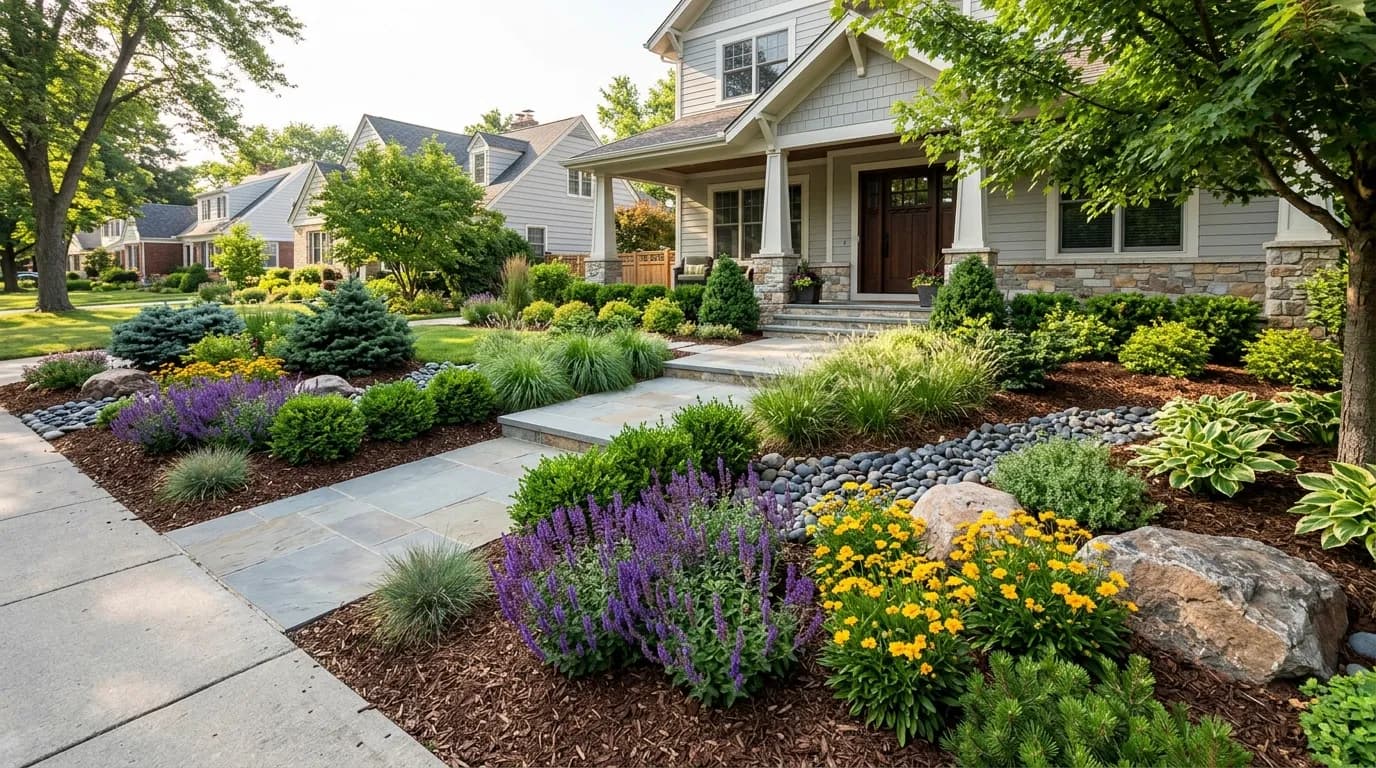
A stunning front yard doesn't have to mean every weekend on your knees pulling weeds and hauling hoses. The secret the professional landscapers know: design for low maintenance from the beginning. The right plant choices, the right layout, and the right materials create a front yard that looks incredible and practically takes care of itself.
These 21 ideas are ordered from simplest to most involved — pick the ones that match your budget, your style, and how much time you realistically want to spend.
Why Most Front Yards Are High-Maintenance (And How to Fix It)
The typical American front yard is a high-maintenance nightmare by design. A monoculture lawn that needs mowing 35+ times per year. Foundation plantings that overgrow and block windows every 3-5 years. Annual flower beds that require replanting every spring. A sprinkler system covering everything at the same frequency.
Low-maintenance front yards are designed differently from the start:
- Perennials over annuals — Plant once, enjoy for years
- Native and adapted plants — Evolved for your climate, need no babying
- Defined hardscaping — Reduces lawn area and creates clean edges that maintain themselves
- Drip irrigation — Waters only what needs water, reduces disease and weeds
- Mulch — The single highest-ROI maintenance-reducer in landscaping
1. Replace Your Lawn with Groundcover
Grass is the most labor-intensive surface in any landscape. A front yard converted to groundcover can eliminate 90% of your mowing time while looking greener and lusher than a stressed lawn.
Best groundcovers by region:
- Northeast/Midwest: Creeping thyme (fragrant when walked on), pachysandra (shade), vinca minor
- Southeast: Liriope muscari (monkey grass), Asian jasmine, dwarf mondo grass
- Southwest: Prairie zinnias, desert zinnia, trailing rosemary, lantana
- Pacific Northwest: Creeping Oregon grape, kinnikinnick, native strawberry
A groundcover transition takes 1-2 seasons to fill in but requires almost no maintenance afterward.
2. Mass-Plant One Shrub Species
Random assortments of shrubs look chaotic and require constant individual attention. Mass plantings of a single species create a cohesive, professional look — and since every plant needs the same care, maintenance becomes simple.
Low-maintenance shrubs for mass planting:
- Knock Out roses (Zones 4-9): Bloom May through November, disease-resistant, need only one annual cutback
- Little Lime hydrangea (Zones 3-9): Compact (4x4 ft), lime-white blooms, cut back once in late winter
- Karl Foerster grass (Zones 4-9): Upright, architectural, never flops, cut back once per year
- Autumn Fire sedum (Zones 3-9): Pink fall blooms, evergreen groundcover, zero maintenance
- Sky Pencil holly (Zones 5-9): Columnar evergreen, 8 ft tall × 2 ft wide, no pruning needed
3. Add a Defined Mulch Border
A 3-inch layer of quality mulch in your existing beds does more work than almost any other single change:
- Suppresses weeds for an entire season (fewer weeds = less maintenance)
- Retains moisture (reduces watering needs by 25-50%)
- Regulates soil temperature (plants establish faster and stress less)
- Looks like the yard was just professionally landscaped
Refresh mulch every 1-2 years instead of replanting annuals. The annual cost difference: $80 in mulch vs. $300+ in annuals.
4. Install Crisp Metal Edging
Nothing ages a front yard like blurry edges between lawn and beds. Metal landscape edging (steel or aluminum) creates a permanent, clean separation that lasts 20+ years and eliminates the need for frequent re-edging.
Cost: $2-4 per linear foot installed. A typical front yard needs 60-100 linear feet: $120-400 for clean edges that never need resetting.
Once installed, you mow right along the edge — no trimmer needed.
5. Plant a Specimen Tree
A single well-placed specimen tree can be the centerpiece that makes your entire front yard look designed. Choose a low-maintenance tree that doesn't drop messy fruit, doesn't have invasive roots, and doesn't need regular pruning.
Best low-maintenance specimen trees:
- Japanese maple (10-15 ft): Weeping or upright forms, stunning year-round, no pruning needed
- Serviceberry (15-25 ft): Spring flowers, summer berries for birds, brilliant fall color
- Crape myrtle (15-30 ft, Zones 6-10): Summer blooms for 90+ days, cinnamon bark in winter, drought-tolerant
- Native dogwood (15-25 ft): Spring flowers, fall color, wildlife habitat — no maintenance
- Eastern redbud (15-25 ft): Pink blooms on bare branches in early spring, heart-shaped leaves, fast growing
Plant the tree, water it the first summer, and then essentially ignore it forever.
6. Use Ornamental Grasses as Foundation Plants
Traditional foundation plantings (boxwood, yew, arborvitae) require shearing 2-4 times per year to maintain their shape. Ornamental grasses need exactly one maintenance event per year: cutting back in late February or March.
Best ornamental grasses for front yard foundations:
- Little Bluestem (3 ft, Zones 3-10): Blue-green summer, copper fall, minimal footprint
- Hameln fountain grass (2-3 ft, Zones 5-9): Classic cascading form, blooms August-September
- Blue oat grass (2 ft, Zones 4-9): Silver-blue, stays compact, semi-evergreen
- Prairie Dropseed (2 ft, Zones 3-8): Fine texture, fountain shape, popcorn-scented blooms
Replace one overgrown foundation shrub with a grass and cut your maintenance time by 50%.
Already picturing your new front yard? See what it looks like with AI → Upload a photo and get 3 custom designs in 60 seconds — free preview, no commitment.
7. Convert Strips to Decomposed Granite
Those narrow strips between the sidewalk and street — called hell strips, parkways, or curb strips — are the most maintenance-intensive square footage in any front yard. They're too narrow to mow efficiently, get walked on constantly, and rarely support healthy grass.
The fix: Convert to decomposed granite (DG) with low-growing drought-tolerant plants. DG is permeable, inexpensive, and extremely low maintenance.
Plant options for strips:
- Creeping thyme (handles foot traffic)
- Sedum varieties (heat and drought tolerant)
- Low-growing blue fescue (architectural grass)
- Native sedges (for shadier strips)
After installation, these strips need nothing but an occasional hand-weeding every few months.
8. Plant Lavender Masses
Lavender is the perfect low-maintenance front yard plant: drought-tolerant, deer-resistant, fragrant, evergreen (in mild climates), and covered in purple blooms for weeks. It's also extraordinarily difficult to kill once established.
Plant in groups of 5-7 along walkways, in border areas, or as a replacement for high-maintenance flowering shrubs. Cut back by 1/3 in late spring — that's the entire annual maintenance requirement.
Best varieties: 'Hidcote' (compact, intense purple), 'Munstead' (early bloomer, Zones 5-9), 'Phenomenal' (hardy to Zone 4, most cold-tolerant).
9. Add a Flagstone Path
A flagstone or stepping stone path through your front yard does double duty: it gives visitors a clear route to the door, and it breaks the lawn into smaller sections that are easier to manage. It also adds strong visual interest that makes the yard look intentional.
Irregular flagstone placed directly on the soil with low groundcover growing between stones virtually maintains itself — the groundcover prevents weeds naturally.
10. Install a Drip Irrigation System
Drip irrigation is the single best investment for reducing ongoing watering labor. It delivers water directly to plant roots, eliminating the need for hand-watering, reducing water use by 30-50%, and preventing the leaf disease that overhead sprinklers cause.
A professionally installed drip system costs $1,000-3,000. A DIY system can be done for $200-400 and installed in a weekend.
Once set on a smart timer (which adjusts automatically based on weather), drip irrigation is completely hands-off.
11. Plant Native Perennial Meadow Strips
Instead of a lawn all the way to the street, plant a native perennial strip along the front of your property. Native wildflowers bloom in succession from spring through fall, support pollinators, and need almost no care once established.
Easy-to-grow native perennials:
- Black-eyed Susan (Rudbeckia)
- Coneflower (Echinacea)
- Blazing star (Liatris)
- Wild bergamot (Monarda)
- Goldenrod (Solidago)
One annual cutback in late winter, and these plants do everything else themselves.
12. Choose Dwarf Evergreen Shrubs
If you want foundation plantings that maintain their shape without constant shearing, choose inherently dwarf varieties that grow slowly to their mature size and stop.
Dwarf evergreens that require minimal pruning:
- 'Green Velvet' boxwood (3x3 ft): Maintains a perfect globe naturally
- 'Tater Tot' arborvitae (3 ft round): Naturally globe-shaped, never needs pruning
- Dwarf mugo pine (3x5 ft): Stays compact for decades
- 'Tiny Tower' Italian cypress (6 ft, narrow): Formal look without shearing
13. Add Rock Mulch in Dry Zones
In areas that get intense heat — along south and west walls, in strips, or in desert climates — rock mulch (river rock, crushed granite, or lava rock) dramatically outperforms organic mulch. It doesn't decompose, doesn't wash away, doesn't float in heavy rain, and reflects heat upward (beneficial for heat-loving plants).
Cost: $80-150 per cubic yard. Lasts indefinitely — essentially a one-time purchase.
14. Simplify Your Color Palette to 2-3 Plants
The front yards that look best on low maintenance budgets tend to have just 2-3 plants repeated throughout the entire design. One specimen tree. One shrub repeated 5-7 times. One groundcover. That's it.
This approach:
- Creates a cohesive, designed look
- Means every maintenance task is the same (you only need to know how to care for 3 plants)
- Looks "on purpose" rather than "random assortment"
15. Use Boulders as Focal Points
A 2-3 large boulders (18-36 inches diameter) are maintenance-free focal points that anchor a planting design. They never grow, never need pruning, and add incredible texture and naturalism to any style — modern, cottage, or contemporary.
Pair boulders with low-growing succulents or ornamental grasses for a composition that requires almost zero care.
16. Install Landscape Lighting on Timers
Properly designed landscape lighting runs automatically — photocell sensors turn lights on at dusk, timers turn them off at midnight. Once installed, the only maintenance is an occasional bulb replacement (LED bulbs last 20-25 years).
Lighting dramatically improves curb appeal and is one of the highest-ROI front yard improvements for resale value.
17. Edge Beds to Prevent Grass Invasion
One of the most time-consuming front yard maintenance tasks is re-cutting grass that creeps into bed edges. Steel edging buried 4 inches deep eliminates this completely. Grass rhizomes can't penetrate a metal barrier.
One installation = permanent solution. No more re-edging ever.
18. Plant Rosemary as a Hedge
In Zones 7-11, rosemary makes an extraordinary low-maintenance hedge. It's woody, evergreen, fragrant, deer-resistant, and extremely drought-tolerant once established. Clip lightly after flowering (once a year) to keep it dense.
In colder zones, use lavender cotton (Santolina) or dwarf boxwood instead.
19. Remove Problem Trees
Sometimes the single highest-impact improvement is removing a tree that creates constant maintenance: dropping messy pods, sprouting invasive suckers, dropping branches, or casting so much shade that grass won't grow.
Removing one problem tree often eliminates 5-10 hours of annual cleanup and opens the yard to design possibilities that weren't there before.
20. Create a Dry Creek Bed
Instead of fighting drainage problems with pumps and maintenance-heavy solutions, a dry creek bed directs water naturally using river stone, plants, and grade change. It's decorative during dry weather and functional during rain.
Once installed, a dry creek bed requires no maintenance except removing the occasional leaf accumulation.
21. Hire a Designer First
The most expensive front yard mistake is installing plants without a plan and spending years fixing it. A professional design — or an AI-generated design like Yardcast produces — identifies the right plants for your specific microclimate, sun exposure, and style before you spend a dollar at the nursery.
A $29 AI design can save hundreds in plant replacement costs and hundreds of hours in maintenance by getting it right the first time.
The Low-Maintenance Front Yard Formula
The highest-impact, lowest-maintenance front yards all share these traits:
- 1Minimal lawn — 50% or less of the total front yard area
- 2Mass plantings — 3-5 of the same plant instead of one each of many
- 3Native and adapted plants — Suited to your climate, need no supplemental care
- 4Mulch, not bare soil — 3 inches suppresses weeds for a full season
- 5Defined edges — Metal edging prevents grass migration
- 6Drip irrigation — Fully automated, no hand-watering
- 7Simple palette — 3-5 plants total, repeated throughout the design
The most beautiful front yards on any block are almost always the lowest-maintenance ones — because their beauty comes from design thinking, not constant effort.