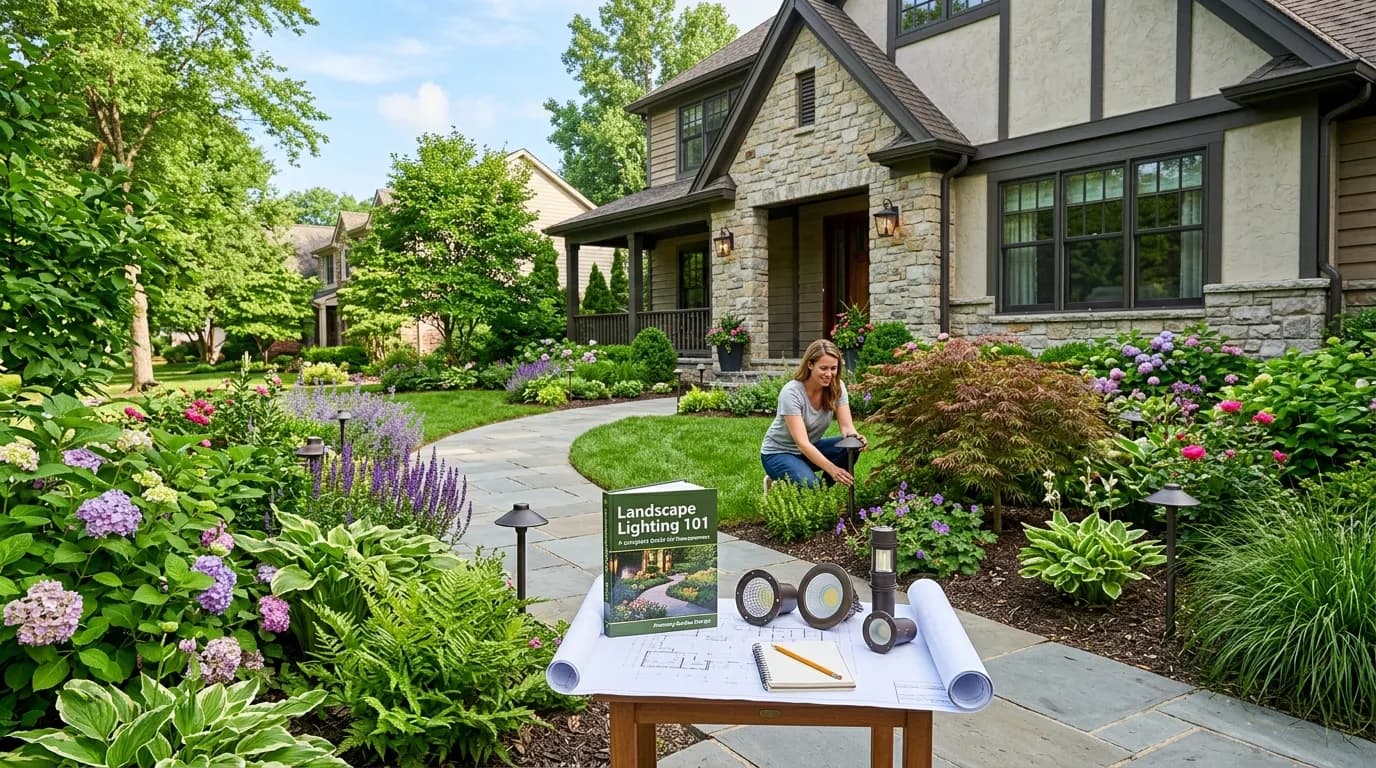
Landscape lighting is the most underrated upgrade in residential landscaping. Done right, it transforms your yard from a daytime-only space into an evening destination. It adds security, dramatically increases curb appeal (especially for home sales), and extends the usable hours of your outdoor living spaces.
Here's everything you need to know — from light types to installation, electrical planning, and design principles that professional lighting designers use.
Why Landscape Lighting Is Worth the Investment
The National Association of Realtors reports that landscape lighting is one of the top ten outdoor features that drives home buying decisions. Studies show it can add 1-3% to home sale price — $3,000-9,000 on a $300,000 home.
Beyond resale value, lighting solves real problems: dark pathways create safety hazards, unlit entrances feel unwelcoming, and an unlit backyard is effectively unusable after 7 PM for most of the year. The right lighting solves all three while making your landscape look dramatically more intentional and professional.
The 6 Core Types of Landscape Lights
1. Path Lights
The most common type, and the first thing most homeowners install. Path lights are low fixtures (14-24 inches tall) that mark walkways, garden borders, and driveway edges. They're designed to illuminate the path surface and cast a soft glow on surrounding plantings — not to light the whole yard.
Spacing tip: Place path lights 6-8 feet apart for even coverage without the "runway" look that happens when they're too close together. Alternate sides of the path for a more natural appearance.
Common mistake: Pointing them straight up (the default), which creates hot spots and glare. Angle them slightly toward the path.
2. Spotlights and Uplights
These are the workhorses of dramatic landscape lighting. Spotlights direct a focused beam at a specific feature — a mature tree, an architectural element, a sculpture, a statement shrub. Uplights are installed at ground level, casting light upward to create silhouettes and illuminate tree canopies from below.
Design principle: Use these sparingly. Three or four well-placed uplights on specimen trees are more powerful than 20 randomly placed lights.
Best candidates for uplighting: Large trees with interesting bark or branching structure, specimen shrubs (Japanese maples, ornamental hollies), stone or brick walls, arbors and pergolas.
3. Wash Lights
Wide-beam fixtures designed to illuminate broad areas evenly — facades, hedges, privacy walls, large plantings. They create soft, ambient illumination rather than dramatic focal points.
Use case: Install wash lights pointing toward your home's facade to make it glow warmly from the street at night. This is one of the most dramatic curb appeal moves possible.
4. Deck and Step Lights
Recessed or surface-mounted fixtures that mark elevation changes. These are safety features as much as aesthetic ones — unlit steps and deck edges are injury hazards. Most are LED and extremely low-wattage (1-3W per fixture).
Types: Recessed step lights, surface-mount deck board lights, stair riser lights, post cap lights.
5. In-Ground Lights
Buried flush with the surface, in-ground lights point straight up. They're perfect for illuminating trees from directly below (more dramatic uplighting than above-ground fixtures), marking the edge of a driveway, or highlighting a flagstone path.
Note: These must be rated for ground-level installation and need excellent drainage to prevent moisture damage.
6. String Lights (Overhead Lighting)
Technically outdoor string lights rather than "landscape lighting," but they're the fastest way to transform an outdoor dining or entertaining space. Strung overhead between posts, pergola rafters, or tree branches, they create ambient warmth that makes any space feel like a restaurant patio.
LED vs. Halogen: There's No Contest Anymore
Modern LED landscape lights have ended the LED vs. halogen debate definitively. LEDs:
- Last 25,000+ hours vs. 2,000 hours for halogen (12x longer)
- Use 75% less energy
- Produce minimal heat (safer around plants and mulch)
- Maintain color consistency over their lifespan
- Are available in warm, neutral, and cool white color temperatures
The upfront cost difference has largely disappeared — quality LED path lights start around $20-40 each, comparable to halogen. And the operational savings pay back any cost difference within 1-2 seasons.
Color temperature: For most residential landscape lighting, 2700K-3000K (warm white) is most flattering. Cool white (4000K+) looks clinical and unflattering on plants, stone, and skin.
Planning Your Landscape Lighting Layout
Step 1: Walk Your Property at Night
This sounds obvious, but most people plan landscape lighting in daylight. Do a nighttime walk and note: where do you trip or feel unsafe? Where are the interesting features that disappear into darkness? Where could you create a dramatic view from inside the house?
Step 2: Identify Your Goals
Different goals require different lighting strategies:
- Safety: Path lights on all walkways, step lights on all level changes
- Security: Bright motion-sensor floodlights at corners and entry points
- Aesthetics: Uplighting specimen trees, wash-lighting the facade
- Entertaining: String lights over patio, pathway lighting to dining area
Step 3: Design on Paper First
Sketch your property and mark: planned light positions, estimated wiring runs, transformer location, and existing electrical access. This step prevents expensive surprises during installation.
Step 4: Calculate Your Power Requirements
Add up the wattage of all planned fixtures. Your transformer should be rated for at least 25-50% more than your total wattage to allow for future expansion and to prevent running it at maximum capacity (which shortens transformer life).
Example: 8 path lights at 3W each + 4 uplights at 7W each + 2 step lights at 2W each = 24W + 28W + 4W = 56W total. Choose a 100W transformer minimum.
DIY Installation Guide
Low-voltage landscape lighting (12V) is genuinely DIY-friendly. You don't need an electrician. Here's the process:
- 1Choose your transformer location — near an outdoor GFCI outlet, ideally 12-15 ft from where your first lights will be installed
- 2Lay out your lights — place fixtures in their planned positions without connecting anything
- 3Run wire — use 12-gauge landscape wire; plan routes that minimize visible wire; wire loops are more reliable than daisy chains
- 4Connect fixtures — most modern fixtures use quick-connect piercers (no stripping required)
- 5Bury the wire — 6 inches deep minimum; use conduit in high-traffic areas
- 6Connect to transformer — most transformers accept standard landscape wire terminals
- 7Set the timer — program to turn on at dusk and off 4-6 hours later
- 8Test at night — adjust aim and position before backfilling
Smart Landscape Lighting
Modern smart systems (Lutron Caseta, Kichler, FX Luminaire) offer app control, scheduling, zone control, and integration with home automation systems. They're particularly useful for complex systems — you can easily adjust brightness, scheduling, and zones without physically moving anything.
Smart dimmers can also dramatically extend LED lifespan by running at 70-80% brightness instead of 100%.
Maintenance
Quality landscape lighting requires minimal maintenance:
- Replace bulbs as needed — LEDs last years, but it happens
- Clear debris — remove leaves and mulch from fixture heads monthly
- Adjust aim seasonally — plants grow and change, shifting what's being illuminated
- Check wire connections — after freeze-thaw cycles, connections can loosen
- Clean lenses — a soft cloth with mild soap restores brightness on dirty lenses
Design Your Landscape Lighting Plan
Yardcast's AI landscape design tool includes lighting recommendations as part of every design package. When you generate your designs, you'll see where professional designers would place lighting to maximize curb appeal and nighttime functionality for your specific yard.
[See your yard with professional lighting design →](/redesign)