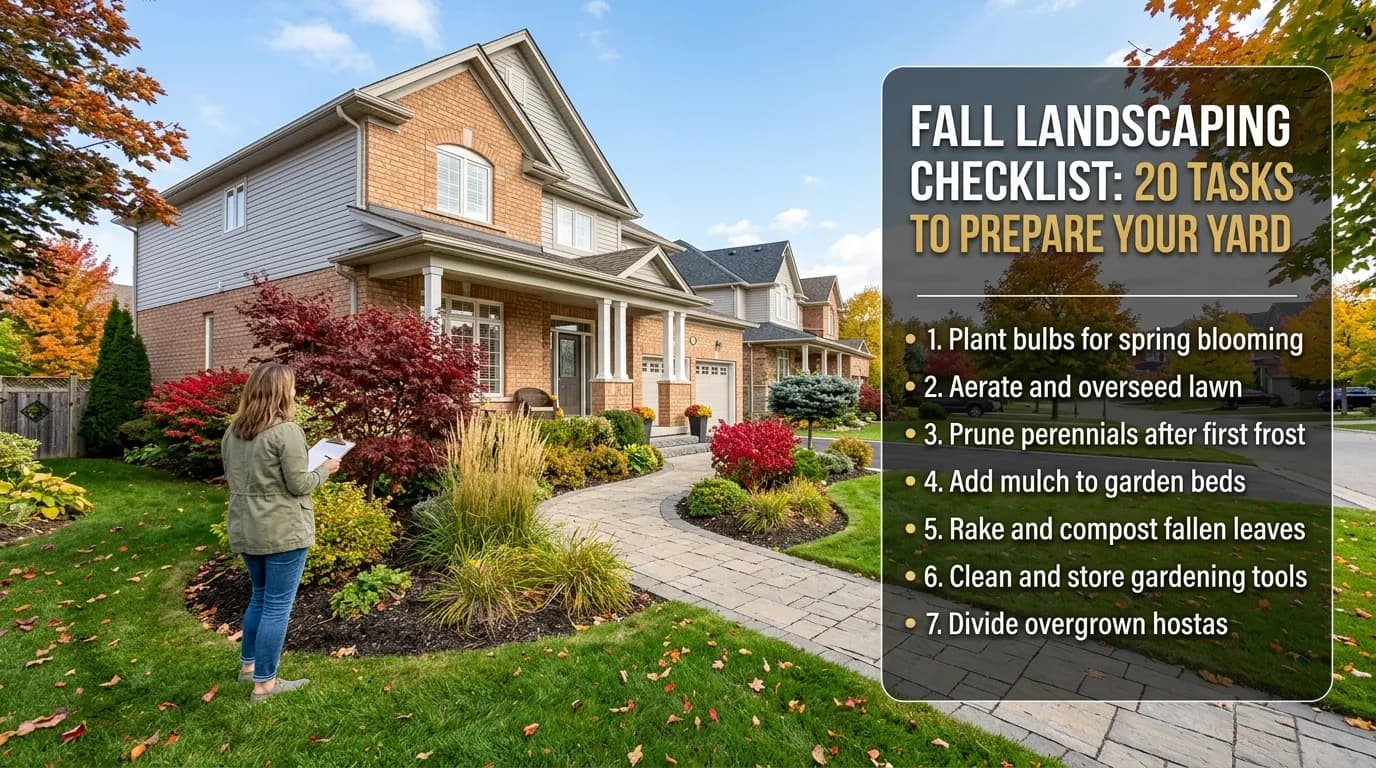
Fall is the most important season for your landscape. While spring gets all the glory, fall is when serious gardeners do their most impactful work — and the results show up the following year. What you do between Labor Day and the first hard frost determines how lush, healthy, and vigorous your yard is next spring.
Here's a comprehensive fall landscaping checklist, organized by category, with the reasoning behind each task so you understand why (not just what) to do.
Why Fall Is the Best Season for Landscaping
Three reasons fall beats spring for major landscaping work:
1. Plants establish roots, not tops. In fall, deciduous plants redirect their energy from foliage and flowers into root development. A tree or shrub planted in fall has an entire fall and winter to establish roots before the stress of summer heat. Fall-planted trees are typically 2-3x larger than spring-planted trees of the same size by the following August.
2. Soil is still warm, air is cool. The perfect combination for root growth. Plants can photosynthesize and build roots without the stress of extreme heat. Come spring, they explode into growth.
3. Pests and diseases are dormant. Fall planting avoids the peak pest and disease pressure of spring and summer. Fewer problems to deal with, better establishment.
Lawn Care (September–November)
Aerate — The Most Important Fall Lawn Task
Lawn aeration — poking small holes in the soil — is the most impactful single thing you can do for lawn health. It:
- Breaks up compaction (which prevents water and nutrients from reaching roots)
- Improves drainage
- Reduces thatch buildup
- Creates seed-to-soil contact for overseeding
When to aerate: In the North (cool-season grasses), aerate in September through early October. In the South (warm-season grasses), aerate in late summer (August-September).
How: Rent a core aerator from a hardware store ($60-90/day) or hire a lawn service ($50-150 for average yards). Core aeration (which removes small plugs of soil) is far more effective than spike aeration.
Overseed Thin Areas
Right after aerating is the best time to overseed. Grass seed falls into the aeration holes and has excellent soil contact for germination.
Germination time: Cool-season grasses (fescue, bluegrass, ryegrass) germinate in 7-14 days in fall temperatures. Keep seeded areas moist (light watering twice daily) until germination, then reduce frequency.
Seed selection tip: Use seed blends appropriate for your conditions — sunny areas, shady areas, and high-traffic areas all have different ideal mixes.
Apply Fall Fertilizer
Fall fertilizer is different from spring fertilizer. You want:
- High potassium (K) — promotes root growth and cold hardiness
- Lower nitrogen (N) than spring — you don't want to push tender top growth before winter
- Look for: Formulas labeled "fall fertilizer" or "winterizer" with NPK ratios like 24-0-10 or 10-0-20
Timing: Apply after the lawn has stopped active growth for the season but before the first hard freeze. In most of the country, this is late October to mid-November.
Continue Mowing
Keep mowing until the grass stops growing. Going into winter with very long grass creates problems: matting, snow mold, and vole damage. The ideal winter height:
- Cool-season grasses: 2.5-3 inches
- Warm-season grasses: 1.5-2 inches
Mulching vs. raking leaves: Research from Michigan State University shows that mulching leaves (chopping them up with a mower) instead of raking improves lawn density, reduces weeds, and adds organic matter. The caveat: thick layers of whole leaves (not mulched) can smother grass. Mow over light-to-moderate leaf cover; rake heavy deposits.
Planting (September–October)
Plant Trees and Shrubs Now
This is the most important fall planting message: plant woody plants NOW rather than waiting for spring. Nurseries often discount 30-50% in fall. Plants go in the ground while soil is warm, roots establish all fall and spring before summer heat arrives.
Best to plant in fall:
- All deciduous trees and shrubs
- Evergreen trees and shrubs (plant by early October in cold climates)
- Native grasses and perennials
- Groundcovers
Water requirements after planting: Water deeply (slowly) every 5-7 days through fall until the ground freezes hard. Even in rainy fall weather, check soil moisture — roots need consistent moisture to establish.
Plant Spring Bulbs
Spring bulbs require a cold dormancy period — they must be planted in fall to bloom in spring. Timing matters:
- When to plant: After nighttime temps are consistently below 50°F but before the ground freezes (typically October-November in most of the US)
- Depth: Most bulbs go 2-3x their diameter deep
- Key species: Tulips, daffodils, hyacinths, alliums, muscari, crocus
Squirrel and rodent protection: Many bulbs are targets for squirrels. Daffodils and alliums are toxic and rarely eaten. Tulips and crocus are highly attractive to squirrels — protect them by covering newly planted areas with wire mesh or planting with chicken wire.
Divide Overgrown Perennials
Every 3-5 years, clumping perennials get crowded and need dividing. Fall (or early spring) is the time to do it. Signs that division is needed: dead center in the clump, reduced flowering, reduced vigor, spreading into unwanted areas.
How to divide:
- 1Water the clump the day before
- 2Dig up the entire clump with a fork or spade
- 3Shake/wash off excess soil
- 4Divide into sections with a sharp spade, pruning saw, or fork
- 5Replant at the same depth immediately; water well
Good candidates for fall division: hostas, daylilies, black-eyed Susan, ornamental grasses (spring is better for grasses), rudbeckia, salvia.
Garden Cleanup (October–November)
Cut Back Perennials Strategically
Not everything should be cut back in fall — some plants provide critical winter wildlife value:
- Leave standing: ornamental grasses (shelters ground-nesting birds and provides visual winter interest), seed heads of coneflower, rudbeckia, black-eyed Susan (bird food through winter), native perennials with hollow stems (nesting habitat for native bees)
- Cut back: diseased foliage (remove and dispose, not compost), plants that look messy and have no wildlife value, tender plants that need a clean cut for winter protection
The "messy" approach to fall garden cleanup (leaving seed heads and stems) is increasingly recognized as ecologically valuable and requires less work. Win-win.
Remove Annual Flowers
Frost-killed annuals should be removed promptly — they can harbor disease and pest eggs over winter if left in place. Add to compost if healthy; bag and dispose if diseased.
Compost Healthy Plant Material
Fall generates enormous amounts of compostable material: leaves, plant debris, spent vegetables. Add all of it to a compost pile or bin. Alternate green (nitrogen-rich) and brown (carbon-rich) layers. A compost pile started in fall will produce finished compost by the following summer.
Leaves: If you have more leaves than your compost can handle, use them as free mulch. Shredded leaves (run over with a mower) applied 3-4 inches deep to garden beds is one of the best mulches available. It feeds soil biology, insulates roots, and suppresses spring weeds.
Winterizing
Drain and Store Garden Hoses
Forgotten hoses left outside will crack in freezing temperatures. Disconnect from hose bibs, drain fully, and coil in a garage or basement.
Winterize Your Irrigation System
Any water left in irrigation lines can freeze and crack pipes, fittings, and heads — an expensive repair. Options:
- Manual drain valves: Open the drain valves installed at low points in the system
- Blow-out method: Use an air compressor to blow all water from lines and heads. In very cold climates (zones 5 and colder), this is essential.
- Hire a professional: Many irrigation companies offer "winterization" blowouts for $50-100 — usually worth it for complex systems
Protect Tender Plants
Hardiness zone ratings are guidelines, not guarantees. If you've pushed your zone with a marginally hardy plant (one rated one zone warmer than yours), protect it:
- Mulch: Apply 4-6 inches of mulch around the base AFTER the ground freezes slightly. This isn't to keep it warm — it's to keep it consistently cold (preventing freeze-thaw cycles that damage roots).
- Burlap wrap: Wrap broadleaf evergreens (rhododendrons, hollies) with burlap in very cold or windy sites to prevent desiccation (winter burn). Don't wrap tightly — it needs airflow.
- Anti-desiccant spray: Products like Wilt-Stop or Cloud Cover applied to broadleaf evergreens coat the leaves and reduce moisture loss. Apply in late November when temperatures are above 40°F.
Drain Fountain and Water Feature Pumps
Water features must be winterized in zones 5 and colder:
- Remove the pump and store indoors in a bucket of water
- Drain all pipes and lines
- Add pond net to catch falling leaves if you have fish
- Some pond fish can overwinter in place if the pond is deep enough (18"+ in zone 6, 24"+ in zone 5)
Planning for Next Year
Fall is the ideal time to plan next year's garden improvements while the current year is still fresh in memory. Use these strategies:
Document Before Winter
Photograph every area of your garden in late summer/fall. Note: what worked beautifully, what needs editing, gaps in seasonal interest, problem spots that need addressing.
Order Now for Better Selection
Spring-planted bulbs, bare-root roses, and many specialty plants sell out if you wait until spring. Ordering in fall (for winter/spring delivery) gives you first pick of the best varieties.
Use Yardcast to Plan Changes
If you're considering significant changes — a new patio, a border redesign, a kitchen garden — fall is the perfect time to plan. Yardcast's AI design tool lets you visualize changes before you make them, so you start spring ready to execute a solid plan.
[Plan your spring landscape refresh →](/redesign)