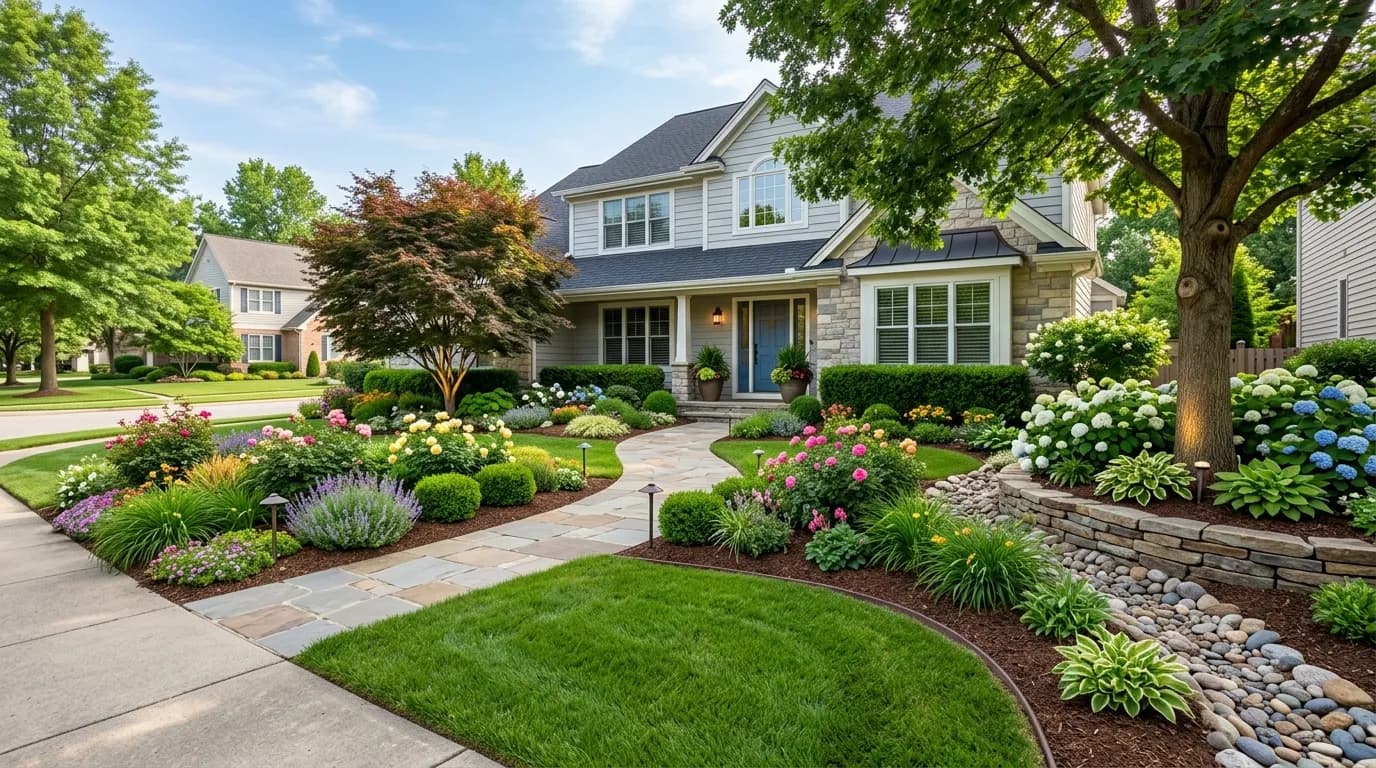
The front of your house tells your home's story before anyone steps inside. Real estate agents consistently cite curb appeal as one of the highest-ROI investments a homeowner can make — studies show strategic landscaping adds 10–15% to property value. But beyond resale, a beautiful front yard is something you see and appreciate every single day.
This guide covers 25 proven landscape ideas for the front of your house, organized by budget and impact — from quick weekend wins to complete front yard transformations.
Why Front of House Landscaping Matters
The front yard serves two distinct purposes: functional (access, drainage, utility lines) and aesthetic (first impressions, neighborhood context, personal expression). The best landscape designs for the front of a house balance both. They create a welcoming path to the front door, frame the architecture rather than hide it, and require maintenance proportional to what you're willing to give.
The most common front yard mistake is planting too much, too fast. Foundation shrubs that look perfect at year one become overgrown monsters blocking windows by year five. Good front yard landscaping plans for the spacing and eventual size of every plant.
Low-Cost Landscape Ideas for the Front of Your House (Under $500)
1. Mulch Your Beds Deeply
Fresh mulch at 3–4 inches is the single highest-ROI landscape improvement per dollar. It suppresses weeds, retains moisture, protects roots, and makes every plant look intentional. A full front yard mulching typically runs $150–$300 in materials. Dark hardwood mulch gives the cleanest look against green plants.
2. Define Bed Edges
Crisp edging between lawn and planting beds transforms the perceived quality of any front yard. Pound metal landscape edging along existing bed lines. The contrast between dark soil and green grass signals "maintained." Materials: $80–$150 for a typical front yard.
3. Plant Seasonal Color
Annual flowers in a few key spots — at the base of the mailbox, flanking the front door, or in a window box — add color without major investment. Marigolds, petunias, zinnias, and impatiens are reliable, affordable, and available everywhere. Budget: $40–$80 per season.
4. Paint or Replace the Mailbox
Surprisingly high-impact. A freshly painted or replaced mailbox ($30–$80) signals attention to detail. Add low ornamental grasses or a perennial on each side for a planted look.
5. Upgrade the Front Door Path
Sweep path edges of an existing concrete walkway with edge trim, or add a border of smooth river stones along either side of the path. This gives the entry sequence a finished look without replacing existing hardscape.
Mid-Range Front Yard Landscape Ideas ($500–$3,000)
6. Create a Foundation Planting Plan
Foundation plantings — shrubs and perennials planted along the base of the house — soften the transition between architecture and ground. Effective foundation plantings vary height (short perennials in front, taller shrubs behind), include some evergreens for year-round structure, and stay below windowsill height. Classic combinations: boxwood + ornamental grasses + ground cover; dwarf holly + muhly grass + creeping phlox.
7. Install a Curved Pathway
A straight concrete path is functional. A gently curved flagstone or paver path through a planted front yard is memorable. Curves slow down the eye, making a yard feel larger and more intentional. A 40-foot flagstone path through a planted bed runs $800–$2,400 professionally installed.
8. Add Layered Perennial Beds
Replace sparse foundation shrubs with layered perennial beds that provide color from spring through fall. A well-designed three-layer bed (tall background, medium mid-zone, low edging) gives maximum visual impact with moderate maintenance. Include black-eyed Susans, coneflowers, ornamental grasses, and creeping sedum for a low-care pollinator-friendly front yard.
9. Upgrade Outdoor Lighting
Low-voltage path lights along the front walk, uplights on specimen trees, and porch step lights transform a house at night. A basic 6-fixture path lighting kit runs $150–$400. Professional landscape lighting installation: $800–$3,000 for a full front yard. Smart solar options have improved dramatically — quality brands like BEAU JARDIN and Maggift give 8–10 hours of runtime.
> See what your front yard could look like before spending a dime. Generate a free AI landscape design at Yardcast → Upload your front yard photos, describe your style and budget, and get 3 photorealistic professional designs in under 60 seconds — complete with plant lists and cost estimates. Preview is 100% free.
10. Install a Statement Tree
A single well-placed ornamental tree transforms the scale of a front yard. Top choices: Japanese maple (4–12 feet, fiery fall color), dogwood (20 feet, spring flowers), crape myrtle (warm climates, summer color), or serviceberry (three-season interest, wildlife friendly). Plant trees at least 15 feet from the house foundation and 10 feet from utility lines.
11. Replace Lawn with Low-Maintenance Groundcover
Traditional turf in the front yard requires weekly mowing, fertilizing, and watering. Replacing a portion — or all — of front lawn with low-growing groundcover dramatically reduces maintenance while looking intentional and modern. Buffalo grass, creeping thyme, mazus reptans, and blue star creeper all work well. No-grass front yards are increasingly popular and HOA-friendly when neatly designed.
12. Add Window Boxes
Window boxes under front windows are among the most impactful front-of-house improvements per dollar. A well-planted window box overflowing with seasonal color draws the eye and complements architecture. Install structurally sound brackets, use a moisture-retaining potting mix, and plant in "thriller, filler, spiller" combinations (tall centerpiece + dense filler + trailing edge plant).
13. Create a Welcoming Entry Garden
Frame the front door with symmetrical plantings — two matching shrubs, two urns, or two raised planting beds on either side of the steps. Symmetry signals formality and care. Asymmetrical plantings work better for cottage or naturalistic homes.
Complete Front Yard Landscape Transformations ($3,000–$15,000+)
14. Replace Concrete with Paver Walkway
A new front walkway in brick, natural stone, or concrete pavers elevates the entire front yard design. The walkway is the spine of the front yard — invest here and everything else reads better. Cost: $8–$25 per square foot installed depending on material.
15. Install a Front Yard Garden with Hardscape Borders
A complete front yard redesign with defined hardscape borders, specimen plantings, and seasonal color layers creates maximum curb appeal. These projects involve removing existing turf, grading, installing irrigation, placing edging, planting a full palette of trees + shrubs + perennials + annuals, and mulching throughout. Budget $3,000–$15,000 depending on size.
16. Add a Pergola or Arbor Entry Feature
An arbor over the front gate or a pergola over the entry walk creates architectural weight and a destination feeling. Draped with climbing roses, wisteria, or clematis, an entry arbor becomes a signature front yard feature. Cost: $500–$4,000 for a quality structure.
17. Install a Front Yard Water Feature
A small bubbling fountain or recirculating urn at the front entry adds the sound of water, welcoming visitors and masking street noise. Keep it proportional to the house — a 24–30 inch urn fountain is usually appropriate for standard front yards.
Smart Plant Choices for Front of House Landscaping
Plant selection determines how much time you'll spend on maintenance. For the front yard, prioritize:
Low-maintenance perennials: Coneflower (Echinacea), black-eyed Susan, ornamental grasses, salvia, sedum, and daylilies. These return year after year with minimal care.
Reliable shrubs: Dwarf boxwood, knockout roses, spirea, weigela, viburnum, and nandina. Choose cultivars sized for your space at maturity — never count on shearing to solve a too-big shrub.
Statement trees: Japanese maple, serviceberry, flowering dogwood, crape myrtle, or redbud. A single well-chosen specimen tree defines a front yard.
Year-round structure: Include evergreens in your plan — 20–30% of the planting should be evergreen to prevent the yard from looking bare in winter.
Front Yard Landscape Design Mistakes to Avoid
Over-planting: The most common mistake. Plants need room to grow. Follow mature spacing guidelines, even when the bed looks sparse at planting.
Wrong scale: Small plants in front of a large house disappear. Scale plantings to architecture. A 2,500 sq ft house needs specimen trees, not just impatiens.
Ignoring existing conditions: Front yards often have challenging microclimates — reflected heat from the house, dry spots under overhangs, compacted soil from construction. Assess conditions before selecting plants.
No focal point: Every front yard needs a design anchor — specimen tree, statement planting at the entry, or an architectural feature. Without a focal point, the eye wanders.
Forgetting the view from inside: You see your front yard from your windows every day. Design it to look great from the street AND from the interior.
Front Yard Landscaping by House Style
Ranch/Traditional: Symmetrical foundation plantings, defined lawn areas, classic materials (brick edging, hardwood mulch). Foundation plants at 1/3 to 2/3 the height of the foundation wall.
Contemporary/Modern: Geometric beds, bold plant combinations, limited palette (3–4 species max), clean edging, ornamental grasses, and specimen trees. Less is more.
Craftsman/Bungalow: Cottage-style layered perennials, stone path materials, climbing roses or wisteria on porch columns, informal curved beds.
Mediterranean/Spanish: Drought-tolerant plants, gravel mulch, terracotta urns, lavender, rosemary, agave, and olive trees. Low water, high impact.
Colonial: Formal symmetry, boxwood hedges, traditional flowering trees (dogwood, magnolia), red brick or bluestone paths.
Transform Your Front Yard — Get Started Today
A beautiful front yard doesn't require a large budget — it requires a clear vision and smart plant choices. Whether you're investing $200 in fresh mulch and edge definition, or embarking on a complete front yard redesign, every dollar spent on front-of-house landscaping returns value in curb appeal, property value, and daily enjoyment.
Ready to see what your front yard could look like? Generate your free AI landscape design preview at Yardcast → Upload your front yard photos, describe your style and budget, and in 60 seconds you'll see 3 photorealistic professional designs rendered onto your actual property — with plant lists, cost breakdowns, and a phased installation plan you can hand to any contractor.