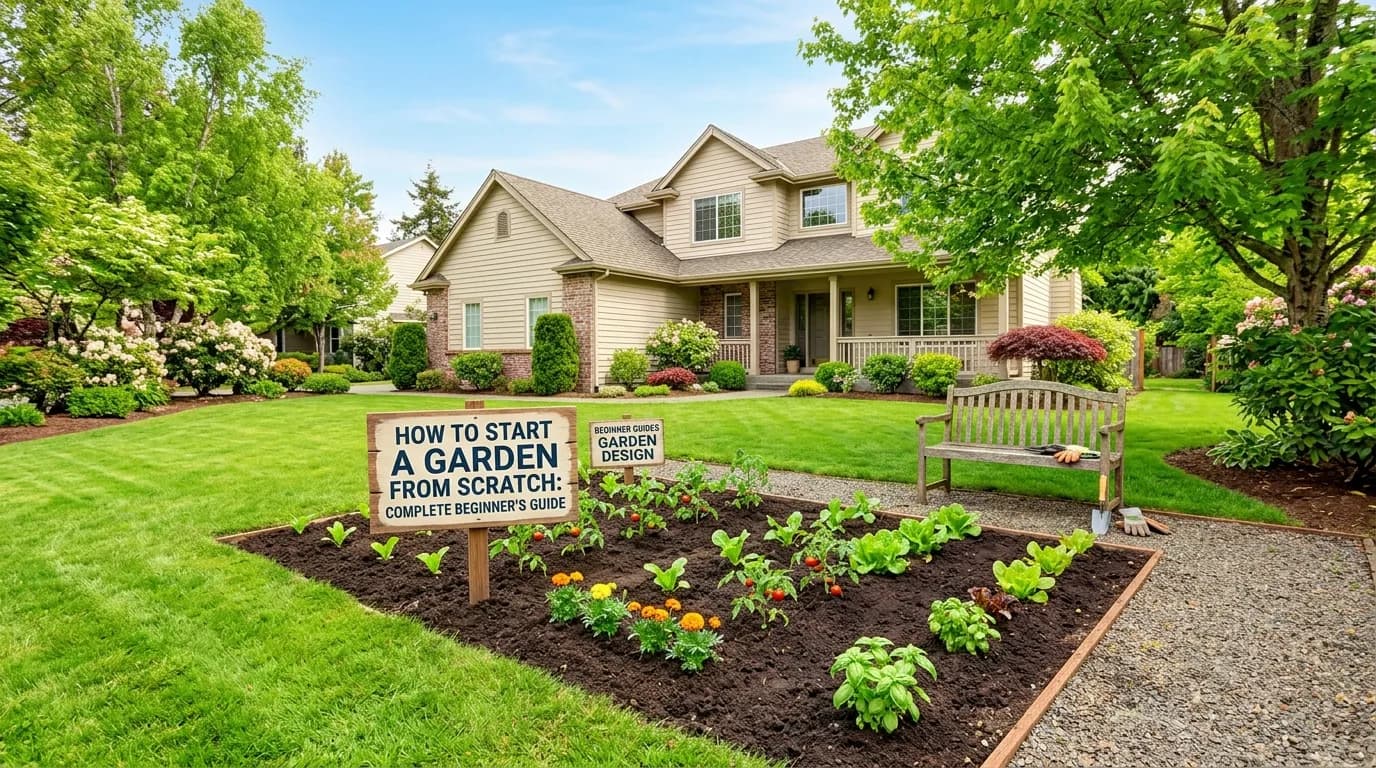
Starting a garden from scratch is one of the most rewarding things you can do as a homeowner — and one of the most overwhelming. Where do you begin? What plants survive? How do you not waste money on plants that die?
This guide covers everything in the right order. Follow these steps and you'll have a thriving garden in your first year.
Step 1: Choose Your Location (30 minutes)
The most important decision is where your garden goes, not what's in it. Walk your yard at three times of day: 8 AM, noon, and 4 PM. Note where shade falls and where sun hits.
Full sun: 6+ hours of direct sunlight. Vegetables, most flowering perennials, roses, ornamental grasses.
Partial sun/shade: 3–6 hours. Hydrangeas, hostas, ferns, many natives.
Full shade: Under 3 hours. Limited plant options but manageable.
Rule: Choose your location based on sun, then choose plants for that location. Never the reverse.
Step 2: Get Your Soil Tested (1 week, $15–$30)
Before buying a single plant, get a soil test from your local Cooperative Extension office. A $15–$30 test tells you:
- pH (most plants prefer 6.0–7.0)
- Nitrogen, phosphorus, and potassium levels
- Organic matter percentage
- Heavy metal levels if near old house paint
This prevents wasting money on plants that fail because of soil chemistry. Acidic soil? Add lime. Alkaline soil? Add sulfur. Low organic matter? Add compost.
Step 3: Define Your Bed Edges (2 hours)
Use a garden hose or spray paint to lay out your bed shape before you touch the soil. Organic curves look more natural; straight lines suit formal or contemporary yards.
Steel edging ($1–3 per linear foot) installed along the edge creates a clean separation between bed and lawn that requires only annual maintenance.
Step 4: Remove Existing Grass and Weeds
Three methods:
Sheet mulching (most sustainable): Lay cardboard directly over grass, overlap edges by 6 inches, cover with 4–6 inches of wood chip mulch or compost. Wait 3–6 months. The grass dies and begins composting into soil.
Solarization (fastest in summer): Cover with clear plastic for 4–6 weeks in summer. Heat kills grass and weed seeds. Then plant.
Manual removal or herbicide: Physical digging or targeted herbicide for immediate bed creation. Requires more work or chemical application.
Step 5: Amend Your Soil
For most first-time gardens, work 3–4 inches of compost into the top 8–10 inches of soil. This single step makes more difference than any other.
If your native soil is clay: add compost + perlite
If your native soil is sand: add compost + moisture-retaining mulch on top
If your native soil is rocky: consider raised beds with brought-in soil
Step 6: Choose Plants Wisely
Start with natives. Plants native to your region are adapted to your soil, rainfall, and climate. They're the closest thing to "plant it and forget it" gardening.
Check the label for: Mature size (the most common beginner mistake is underestimating this), sun requirements, water needs, zone hardiness.
Start small. A 10×10 bed done well is more satisfying than a 30×30 bed done poorly. Expand once you've learned your soil and light conditions.
Perennials over annuals. Perennials come back each year. They're more expensive upfront but cheaper over time. Build a framework of perennials, then add a few annuals for seasonal color.
Step 7: Plant Correctly
Dig the hole 2–3x wider than the root ball, same depth. Width, not depth, is what matters.
Don't bury the root flare. The flare where trunk meets roots should be at or slightly above soil level. Planting too deep is one of the top causes of landscape plant death.
Water immediately and deeply. New plants need water every 2–3 days for the first 2–3 weeks, then weekly for the first season.
Mulch 2–3 inches deep, away from stems. Pull mulch back from direct contact with stems to prevent rot.
Step 8: Water Right
Deep, infrequent watering beats frequent shallow watering. Shallow watering trains roots to stay at the surface. Deep watering pushes roots down, where the soil stays cooler and moister.
Morning watering is best. Evening watering leaves moisture on foliage overnight, promoting fungal disease.
Invest in a hose timer. A $25–$40 timer connected to a soaker hose is the single best investment for a beginning gardener.
Step 9: Maintain in the Right Order
Annual maintenance checklist (spring):
- 1Cut back ornamental grasses and perennials before new growth emerges
- 2Apply 1–2 inches of compost to all beds
- 3Top up mulch to 2–3 inches
- 4Edge all beds cleanly
- 5Assess what died over winter (replace or adjust)
Summer:
- Water during dry spells (1 inch per week from rain or irrigation)
- Deadhead spent flowers on annuals
- Weed as you see them (before they seed)
Fall:
- Plant spring bulbs
- Add final layer of mulch before frost
- Leave some seed heads standing for wildlife
Your First Garden Plan
The simplest effective first garden:
- 3 shrubs for structure (Knockout Rose, Inkberry Holly, or Smooth Hydrangea)
- 3 clumps of ornamental grass (Miscanthus or Hakonechloa)
- 12 perennials for color (6 Coneflower, 6 Black-Eyed Susan)
- 3 inches of mulch over everything
- Steel edging
Total cost: $200–$400. Looks professional. Almost impossible to kill.
Get Your Garden Designed First
Before you spend a dollar at the nursery, know what you're designing toward. Yardcast generates professional garden designs matched to your space, sun, and style — and shows you exactly what plants to buy and where to put them.