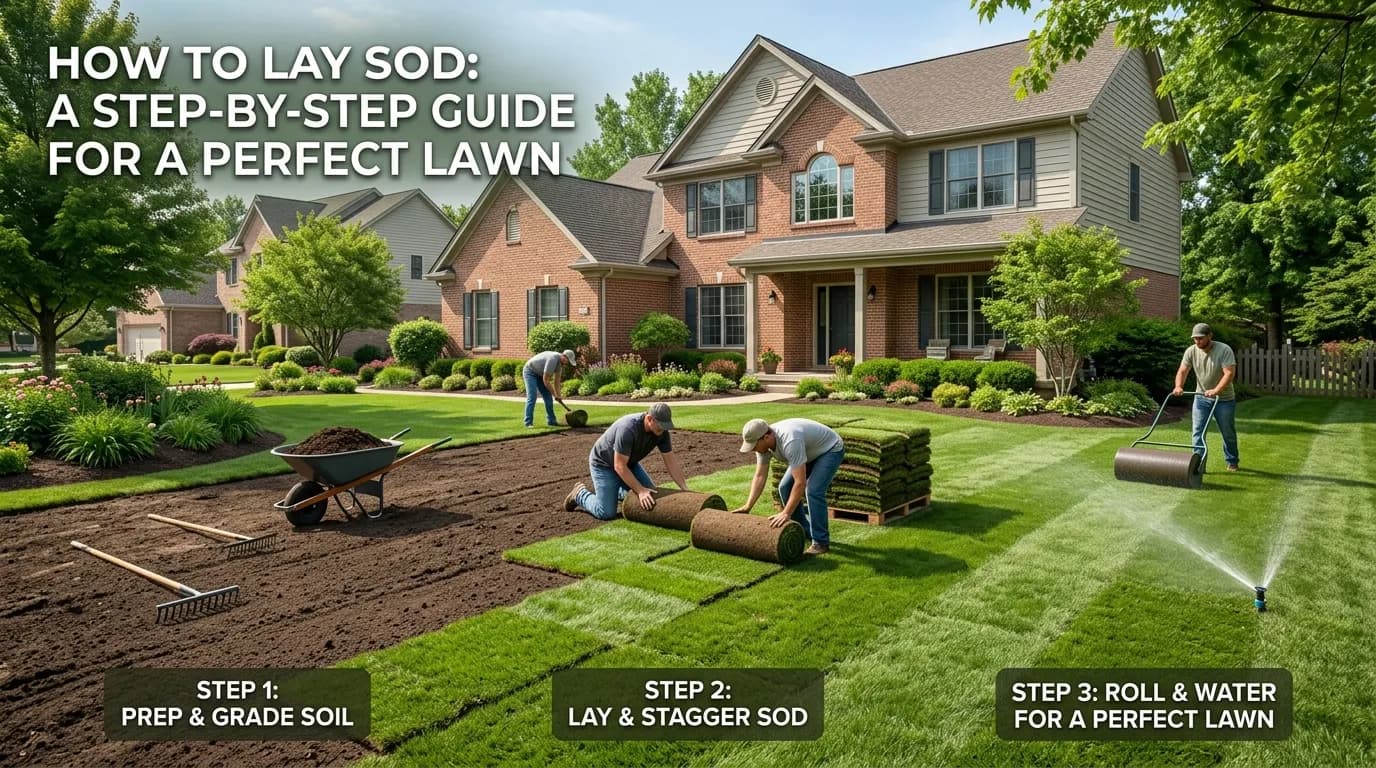
Laying sod is the fastest way to go from bare dirt (or dead lawn) to a lush, green lawn. Unlike seeding, which takes 6–12 weeks to show results, properly installed sod looks finished within days and establishes a functional lawn within 3–4 weeks. The process is labor-intensive but straightforward — and the result is dramatically better than most homeowners expect from a weekend project.
This guide walks through every step: soil testing, site preparation, sod selection, installation, and the watering schedule that determines whether your sod thrives or fails.
When to Lay Sod
Timing matters. Sod can be installed in any season, but it establishes best under specific conditions.
Cool-season grasses (Kentucky bluegrass, fescue, ryegrass — grown in northern states):
- Best time: late August through October (soil is warm, air cools down, less heat stress, fall rains help)
- Second best: March through May (spring establishment, but summer heat stress follows)
- Avoid: June–August (heat + drought stress before roots establish)
Warm-season grasses (Bermuda, Zoysia, St. Augustine, Centipede — southern states):
- Best time: May through August (warm soil, peak growing season, fastest root establishment)
- Avoid: October–March (dormant season, cold slows or prevents rooting)
For any region: the ideal soil temperature for sod establishment is 50–65°F for cool-season grasses and 70–85°F for warm-season grasses. Check soil temperature with an inexpensive soil thermometer — air temperature alone doesn't tell the full story.
How Much Sod Do You Need?
Calculate the square footage of your lawn area, then add 5–10% for waste (cuts, irregular edges, starter strips). Sod is sold by the square foot, pallet (typically 450–504 sq ft), or roll.
| Lawn Size | Pallets Needed | Approximate Cost |
|---|---|---|
| 500 sq ft | 1–2 pallets | $150–$500 |
| 1,000 sq ft | 2–3 pallets | $300–$900 |
| 2,500 sq ft | 5–6 pallets | $750–$2,000 |
| 5,000 sq ft | 10–12 pallets | $1,500–$4,000 |
| 10,000 sq ft | 20–22 pallets | $3,000–$8,000 |
Cost varies by sod type, region, and supplier. Add professional installation at $0.50–$1.50/sq ft if hiring out.
Tools and Materials You'll Need
Essential:
- Sod cutter (rental: $100–$200/day) — to remove old turf if present
- Tiller or rototiller (rental: $80–$150/day) — to loosen compacted soil
- Landscape rake — to smooth and level soil surface
- Garden hose + sprinkler or irrigation system
- Utility knife — to cut sod pieces
- Wheelbarrow — to move soil amendments
- Lawn roller (rental: $30–$60/day) — to press sod into soil after installation
Materials:
- Starter fertilizer (phosphorus-heavy: look for high middle number like 18-24-6)
- Topsoil or compost (if needed to level low spots or improve soil quality)
- Soil test kit (optional but recommended)
Step 1: Test and Prepare Your Soil
Sod rooting failure is almost always a soil preparation problem, not a sod quality problem. This step is where most homeowners shortchange themselves.
Soil test: Use a $15–$30 mail-in soil test (your state's Cooperative Extension office often offers them at low cost) or a quick garden center test kit. Target: pH 6.0–7.0 for most lawn grasses. If pH is too low (acidic), add lime. If too high (alkaline), add sulfur. Follow the test's application rates.
Remove old grass: If replacing a dead or weedy lawn, remove existing vegetation first. Options:
- Sod cutter: Most effective for large areas. A gas-powered sod cutter removes existing turf in strips. Dispose of the rolls (don't till dead grass under — it creates air pockets).
- Herbicide (glyphosate): Apply, wait 2 weeks for turf to die completely, then rake off dead material. Requires planning ahead.
- Manual removal: Practical for small areas under 500 sq ft.
Till the soil: Till to a depth of 4–6 inches to break up compaction. Compacted soil prevents sod roots from penetrating — they'll run shallow and the lawn will fail in its first drought.
Add amendments: Spread 2–3 inches of compost over the tilled area and till it in. If soil is very sandy or clay-heavy, adding topsoil at this stage improves drainage (sand) or aeration (clay). Rake smooth and level.
Add starter fertilizer: Apply a phosphorus-rich starter fertilizer (not a high-nitrogen lawn fertilizer — phosphorus drives root development). Work lightly into the top 1–2 inches of soil before laying sod.
Final grade: Rake the soil to a smooth, level surface. The finished sod surface should sit approximately 1 inch below the edges of adjacent sidewalks, driveways, and lawn borders — the sod adds that inch of height.
Step 2: Order and Pick Up Sod
Sod is perishable — it's a living plant and deteriorates rapidly once cut from the field. Follow these rules:
Order from a local sod farm when possible. Sod purchased from a local grower is fresher than sod shipped from a distribution center. Ask when it was cut — ideally less than 24 hours ago.
Schedule delivery for installation day. Sod should be laid within 24 hours of cutting. In hot weather (above 80°F), within 12 hours. Never let sod pallets sit in full sun for more than a few hours.
Store sod in shade if you can't install immediately. Keep pallets out of sun and mist lightly. Never stack rolls — they heat from the inside and the grass dies quickly.
Choose the right grass type for your region and conditions:
- Full sun, warm climate: Bermuda, Zoysia
- Shade, warm climate: St. Augustine, Centipede
- Full sun, cool climate: Kentucky Bluegrass, Tall Fescue
- Shade, cool climate: Fine Fescue blend
- High traffic: Tall Fescue (cool), Zoysia (warm)
- Low water/drought: Zoysia, Bermuda, Tall Fescue
> ### 🌿 See Your New Lawn Before You Install It
> Planning a full yard makeover around your new sod? Upload your yard photos to Yardcast's free AI design tool and get photorealistic landscape concepts — including what your new lawn could look like with beds, borders, paths, and plantings matched to your climate and style. Takes 60 seconds.
Step 3: Lay the Sod
This is the most physically demanding part — a 1,000 sq ft lawn takes most people 4–8 hours to lay. Work efficiently: sod needs to be down before it dries out.
Start at a straight edge. Begin at the longest straight edge (fence line, sidewalk, driveway). Lay the first row tight to this edge — it's your reference line for the entire installation.
Stagger seams like brickwork. Never align seams in adjacent rows. Offset each row by half a sod piece, the same way bricks are staggered. This prevents weak lines where multiple seams align and creates a more uniform appearance.
Butt seams tightly together. Sod pieces should touch firmly with no gaps. Gaps create drying channels — moisture escapes faster at seams, leading to browning and failed establishment in those areas. At the same time, don't stretch the sod — stretching causes it to shrink back as it roots, creating gaps.
Cut pieces with a sharp utility knife. For irregular edges, curves, and obstacles: roll the sod piece over the edge or obstacle, cut from the back (soil side) following the edge, then flip. A half-moon edger works well for curved cuts.
Avoid walking on freshly laid sod. Footprints compress the sod against the soil unevenly. If you need to walk on laid sod, use a board to distribute your weight.
Roll the entire area when complete. A lawn roller (filled with water, typically 100–200 lbs) pressed over the entire sod area after installation eliminates air pockets between the sod and soil. Air pockets are a primary cause of failed establishment — roots can't contact soil they can't reach.
Step 4: Water Immediately and Follow the Schedule
Watering is where sod installation succeeds or fails. The number one mistake is under-watering in the first two weeks.
Immediately after installation: Water deeply — until the sod is saturated and the soil beneath is wet to 4–6 inches. Lift a corner of a piece to check: you should see wet soil beneath.
| Week | Watering Frequency | Target Depth |
|---|---|---|
| Week 1–2 | 2–3x daily | Keep sod surface consistently moist |
| Week 3 | Once daily (morning) | Wet soil 4–6 inches deep |
| Week 4 | Every other day | Allow top inch to dry between waterings |
| Week 5+ | 1–2x per week | Deep, infrequent (promotes deep root growth) |
The tugging test: After 2 weeks, grab a corner of sod and tug gently. If it resists (roots have gripped the soil), you can reduce watering frequency. If it lifts easily, continue daily watering.
Don't mow for 3 weeks. New sod roots need time to anchor. Walking on it or mowing too soon pulls the sod up from the soil. When you do mow for the first time, raise your mower to its highest setting and remove no more than 1/3 of the grass blade height.
Common Sod Installation Mistakes
1. Skipping soil preparation. Shallow tilling (under 4 inches) and skipping compost addition are the most common causes of sod failure. Roots can't penetrate hard pan and will die in the first drought.
2. Letting sod sit before installing. Every hour of delay reduces sod viability. In summer heat, sod sitting on pallets can die within 6 hours. Have everything ready before the delivery arrives.
3. Watering too lightly or inconsistently. Light, frequent sprinkles wet the surface but don't penetrate to the root zone. Inconsistent watering lets the soil dry completely and the sod dies before rooting. Deep, consistent watering wins.
4. Installing over living weeds. If you lay sod over actively growing weeds without killing them first, the weeds push up through the sod within weeks. Kill all existing vegetation before installation.
5. Mismatching grass type to conditions. Bermuda planted in a shady yard fails. Bluegrass planted in Georgia fails. Match the grass variety to your sun exposure, climate, and intended use.
Sod vs. Seed: Which is Right for You?
| Factor | Sod | Seed |
|---|---|---|
| Upfront cost | $0.30–$0.80/sq ft (materials) | $0.03–$0.30/sq ft (materials) |
| Ready to use | 3–4 weeks | 6–12 weeks |
| Erosion risk | None — immediate ground cover | High until established |
| Best for | Immediate results, slopes, erosion control | Large areas, budget renovation |
| Weed control | Sod out-competes most weeds | Bare soil attracts weeds during establishment |
| Season flexibility | Can install spring, summer, or fall | Fall or spring only for best results |
For areas under 2,500 sq ft where you want immediate results, sod almost always wins. For large areas over 5,000 sq ft where budget is a limiting factor, seeding (or hydroseeding for slopes) is typically more economical.
A new sod lawn is one of the most satisfying outdoor projects — the transformation from bare soil to green lawn in a single weekend is dramatic. But the lawn is only the beginning. Once you have turf established, it's worth thinking about how the whole yard fits together.
See what your completed yard could look like with an AI landscape design from Yardcast. Upload your yard photos, describe your goals, and get 3 photorealistic designs showing how landscaping, garden beds, paths, and plantings could frame your new lawn — matching your home's style, your budget, and your climate. It takes about 60 seconds and it's free to preview.