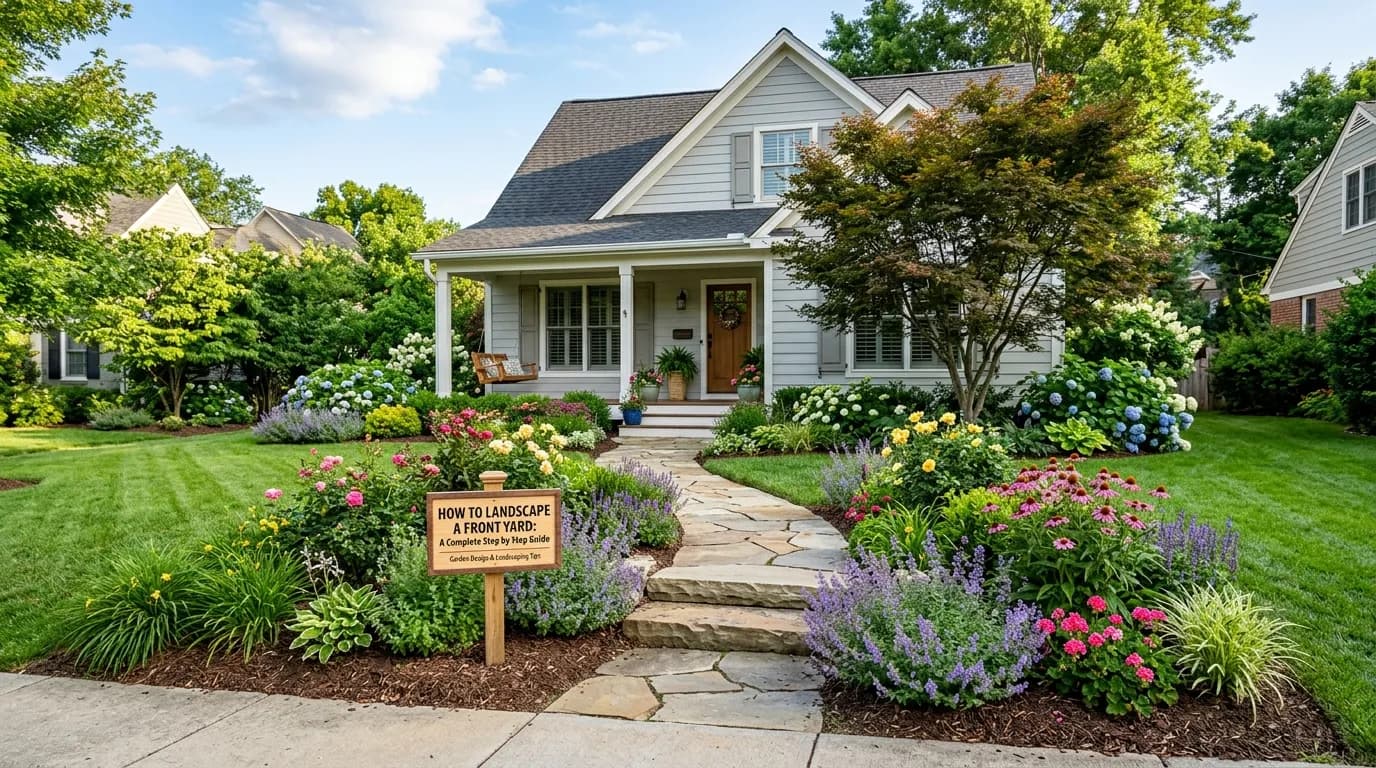
Landscaping a front yard is one of the highest-return home improvement projects you can do. Studies from Virginia Tech and the Appraisal Institute show that quality landscaping adds 5–15% to home value — on a $350,000 home, that's $17,500 to $52,500. And unlike a kitchen remodel, a well-designed front yard actually appreciates over time as plants mature.
This is your complete guide to landscaping a front yard — whether you're working with $500 or $5,000, whether you're a complete beginner or have done basic yard work before.
Before You Start: The Most Common Mistake
The #1 mistake homeowners make is buying plants at the nursery before they have a plan. This leads to overcrowding (plants look great at 1 foot, terrible at 6 feet), poor color sequencing, gaps in seasonal interest, and plants in the wrong conditions.
Before buying a single plant, you need a plan. This guide walks you through creating one.
Phase 1: Assess Your Current Yard (Week 1)
Step 1: Map Your Space
Measure your front yard and create a rough sketch. You don't need to be an architect — even a rough drawing to scale helps enormously. Note:
- Total square footage of all planted areas
- The footprint of your foundation (how far beds are from the house)
- Location of utilities (call 811 before digging)
- Existing trees, shrubs, and plants worth keeping
- Walkway location and width
Step 2: Document Sun Exposure
Walk your front yard at three times of day: 8 AM, noon, and 4 PM. Note which areas are in sun vs. shade at each time. This is non-negotiable — most plant failures come from putting sun-loving plants in shade (they get leggy and die) or shade-lovers in full sun (they scorch).
- Full sun: 6+ hours of direct sun
- Part sun/part shade: 3–6 hours
- Full shade: Under 3 hours
Step 3: Assess Your Soil
A basic soil test (available at any county extension office for $15–25, or online via Amazon for $20) tells you your soil's pH, nitrogen, phosphorus, and potassium levels. This determines what you need to add before planting.
Most front yards have compacted clay or sandy soil that needs amendment. The fix is the same regardless: 3–4 inches of compost tilled into the top 12 inches of soil before planting.
Step 4: Identify Problems to Solve
Walk your front yard as if you're seeing it for the first time. What bothers you?
- Bare patches of dirt or struggling lawn
- Foundation plantings that have outgrown their space
- No color or seasonal interest
- Poor drainage (water pooling after rain)
- No clear path to the front door
- Dated builder-grade plantings
Make a list. Your landscape plan should solve the top 3–5 problems.
Phase 2: Plan Your Design (Week 2)
This is where most homeowners skip steps — and pay for it later. Spend a full week on this phase.
Choose Your Design Style
Your home's architecture should drive your plant and hardscape choices.
| Home Style | Landscape Style | Key Characteristics |
|---|---|---|
| Traditional/Colonial | Formal English | Symmetrical, clipped hedges, seasonal beds, classic color palette |
| Craftsman/Bungalow | Cottage/naturalistic | Informal curves, mixed perennials, naturalistic planting |
| Modern/Contemporary | Minimalist | Bold masses of single species, gravel, ornamental grasses, strong geometry |
| Ranch/Suburban | Casual American | Mixed shrubs, lawn panel, simple beds, easy maintenance |
| Victorian | Ornate cottage | Complex mixed beds, roses, ornamental grasses, layered borders |
| Mediterranean | Drought-tolerant | Gravel, succulents, lavender, olive trees, tile accents |
Define Your Zones
Most front yards have 3 landscaping zones:
Zone 1 — Entry sequence: Everything the visitor passes from the street to the door. Should feel welcoming, have clear sight lines, be well-lit, and have year-round interest.
Zone 2 — Foundation beds: The beds directly against your house. Their primary job is to anchor the house to the ground visually and hide the foundation. Should have evergreen structure + seasonal interest.
Zone 3 — Border/perimeter: Beds along fences, property lines, or the street. Can carry bold color, height, and screening plants.
Create a Plant Palette
Choose 5–8 plants that will form the backbone of your design. Limit yourself — repeating the same plants throughout creates cohesion. More than 8 species typically looks chaotic.
Criteria for each plant:
- 1Hardy in your USDA zone (look it up at planthardiness.ars.usda.gov)
- 2Matched to your sun exposure
- 3Mature size that fits your space (plant for the future, not today)
- 4At least 2 plants that provide winter interest (evergreen, interesting bark, persistent seedheads)
Budget Your Project
Use this framework:
| Budget | What You Can Accomplish |
|---|---|
| $500–1,000 | Foundation bed refresh + mulch + entry planters |
| $1,000–2,500 | Full front yard redesign with quality plants |
| $2,500–5,000 | Complete landscaping with hardscape improvements (walkway, edging, lighting) |
| $5,000–10,000 | Professional-grade full installation |
| $10,000+ | Major hardscape + full planting + irrigation |
Phase 3: Hardscape First (Weeks 3–5)
The rule in professional landscaping: install hardscape before softscape. Walkways, edging, walls, and patios go in before any planting. Why? Because hardscape installation involves digging, grading, and heavy equipment that would destroy plants.
Walkway Evaluation
Your front walkway is the most-used hardscape element in the yard. Ask:
- Is it wide enough? (36 inches minimum, 48+ inches ideal for two people walking side by side)
- Is the surface in good condition?
- Does it take the most direct route to the door?
If your walkway needs replacement, do it first. Materials ranked by cost:
- 1Concrete (poured): $8–15/sq ft — most durable
- 2Brick pavers: $12–20/sq ft — classic, repairable
- 3Natural flagstone: $15–25/sq ft — beautiful, timeless
- 4Concrete pavers: $8–15/sq ft — uniform, affordable
- 5Gravel: $3–6/sq ft — lowest cost, casual feel
Install Bed Edging
Clean bed edges are one of the highest-ROI changes you can make. Steel edging (cor-ten steel or painted black steel) is the professional standard — it holds curves, lasts decades, and looks minimal/modern. Aluminum edging is less expensive. Concrete or stone edging is more formal.
Cost: $1.50–4.00 per linear foot installed (DIY: $0.75–1.50/ft)
Drainage Considerations
Before planting, solve any drainage problems. Water pooling near the foundation causes rot and foundation damage. Solutions:
- Regrade soil to slope 6 inches over 10 feet away from the house
- Install a French drain (perforated pipe in gravel trench)
- Create a rain garden to collect and infiltrate water
Phase 4: Soil Preparation (Week 6)
Never skip this step. Most landscape failures — plants that limp along, die, or never thrive — are soil problems, not plant problems.
Remove What's Not Staying
Remove sod, old plants, and weeds from all planned bed areas. For large areas, a sod cutter rental ($150–200/day) is worth every penny. For smaller areas, a flat spade works fine.
Till and Amend
- 1Till existing soil 10–12 inches deep (tiller rental: $80–120/day)
- 2Spread 3–4 inches of compost over the entire bed surface
- 3Till compost into the soil
- 4Rake smooth
- 5Let soil settle for 48–72 hours before planting
Compost to buy: 1 cubic yard covers ~100 sq ft at 3-inch depth. Cost: $30–60/yard.
pH Adjustment
- Acidic soil (pH below 6.0): Add lime at the rate recommended by your soil test
- Alkaline soil (pH above 7.5): Add sulfur or acidic compost (pine bark, peat moss)
- Most front yard plants prefer pH 6.0–7.0
Phase 5: Planting (Weeks 7–9)
Planting Order
- 1Trees (if any) — largest holes, most disruptive
- 2Large shrubs — structural anchors
- 3Small shrubs
- 4Perennials
- 5Annuals
- 6Groundcovers
- 7Bulbs (fall only, for spring bloom)
Spacing Rules
Plant for mature size, not current size. This is the second most common mistake after not planning.
- Check the plant tag for mature width
- Space plants so they'll just touch at maturity (not overlap)
- Fill gaps with annuals in year 1–2 while perennials establish
Planting Technique
For every plant:
- 1Dig a hole 2x as wide as the root ball, same depth
- 2Loosen the roots if circling (pot-bound plants need root pruning or scoring)
- 3Place plant so the root flare (where roots meet trunk) is at or just above soil level
- 4Backfill with the same soil (no need to add compost in the hole — it's already in the bed)
- 5Water thoroughly — fill the hole, let it drain, fill again
- 6Apply 3 inches of mulch in a 2-ft ring, keeping mulch away from stems/trunk
Best Time to Plant
- Spring (after last frost): Best for most perennials and warm-season annuals
- Fall (6 weeks before first frost): Best for trees, shrubs, and cool-season perennials
- Avoid planting in summer heat unless you can water daily
Phase 6: Mulch, Lighting, and Finishing Touches (Week 10)
Mulching
Apply 3 inches of organic mulch (shredded hardwood bark is the standard) over all bed surfaces after planting. Mulch:
- Suppresses weeds (eliminates 80–90% of first-year weeding)
- Retains moisture (reduces watering by 30–50%)
- Regulates soil temperature
- Improves soil as it decomposes
How much to buy: 1 cubic yard covers 100 sq ft at 3 inches deep. Most municipal utilities offer free wood chip mulch — check your city's website.
Landscape Lighting
Low-voltage LED path lighting is a high-ROI finish:
- Path lights along the walkway: $80–200 for 8–10 lights
- Uplighting for feature trees or shrubs: $40–80 per fixture
- Flood light for the house face: $50–100
All connect to a single low-voltage transformer ($40–80) plugged into any outdoor outlet.
Entry Planters
Two matching planters flanking the front door are the single highest-visual-impact finishing touch. Use identical plantings — symmetry reads as luxury. Best plants for entry planters:
- Full sun: Geranium + sweet potato vine + spike dracaena (thriller-filler-spiller formula)
- Part shade: Caladium + impatiens + creeping Jenny
- Evergreen year-round: Boxwood ball or clipped holly
Front Yard Landscaping Cost Guide
| Line Item | DIY Cost | Contractor Cost |
|---|---|---|
| Soil prep (compost, tilling) | $100–200 | $300–600 |
| Plants — shrubs | $150–400 | $300–800 |
| Plants — perennials | $100–300 | $200–600 |
| Plants — annuals | $30–80 | $80–150 |
| Mulch (3 yards) | $90–180 | $300–500 |
| Edging (50 linear ft) | $75–150 | $200–400 |
| Path lighting (10 lights) | $100–200 | $300–600 |
| Entry planters (2) | $100–200 | $200–400 |
| Total | $745–$1,710 | $1,880–$4,050 |
12-Week Front Yard Landscaping Timeline
| Week | Task |
|---|---|
| 1 | Site assessment: measure, document sun, photograph existing conditions |
| 2 | Design: create plant palette, define zones, finalize budget |
| 3–4 | Hardscape: walkway repair/replacement, install edging |
| 5 | Remove old plants and sod from new bed areas |
| 6 | Soil preparation: till, amend with compost, adjust pH |
| 7 | Purchase plants; let soil settle |
| 8 | Plant trees and large shrubs |
| 9 | Plant perennials, groundcovers, annuals |
| 10 | Apply mulch; install irrigation if planned |
| 11 | Install landscape lighting; add entry planters |
| 12 | Touch-up: tweak spacing, edge cleanup, photograph results |
Frequently Asked Questions
Q: How much does it cost to landscape a front yard?
A: DIY front yard landscaping typically costs $750–$2,000 for a standard suburban lot, including plants, mulch, edging, and basic lighting. Hiring a professional landscaper for the same scope runs $2,000–$6,000. A full redesign with new walkways, irrigation, and lighting runs $6,000–$15,000+ for a contractor.
Q: Can I landscape my front yard myself?
A: Yes — the majority of front yard landscaping is well within DIY ability. The most technically challenging tasks are: concrete/paver walkways (requires base prep and compaction), irrigation systems (requires basic plumbing knowledge), and grading/drainage (requires understanding of slope and water flow). Everything else — planting, mulching, edging, lighting — is straightforward with YouTube and patience.
Q: How long does it take to landscape a front yard?
A: Plan for 4–6 weekends for a full DIY redesign of a standard 1,500–3,000 sq ft front yard. The most time-intensive tasks are sod removal and soil preparation. If you hire a contractor for the hardscape and do planting yourself, you can compress this to 2–3 weekends.
Q: What are the best low-maintenance front yard landscaping plants?
A: The best low-maintenance front yard plants are: (1) Ornamental grasses — Karl Foerster, blue oat grass, switchgrass; (2) Native perennials — purple coneflower, black-eyed Susan, catmint; (3) Tough shrubs — Knock Out rose, spirea, viburnum, oakleaf hydrangea; (4) Groundcovers — creeping phlox, liriope, pachysandra. All are drought-tolerant once established and require minimal annual care.
Q: What should I plant in front of my house for curb appeal?
A: The highest-impact plants for front of house are: (1) Flowering shrub as anchor — oakleaf hydrangea, viburnum, spirea; (2) Ornamental grass for movement — Karl Foerster or blue oat grass; (3) Repeating perennial mass — lavender, salvia, or catmint; (4) Low front edge — creeping phlox, liriope, or alyssum. This 4-layer structure looks intentional and professional.
Q: How do I know what plants will survive in my yard?
A: Look up your USDA Hardiness Zone at planthardiness.ars.usda.gov (enter your ZIP code). Every plant sold at reputable nurseries has a zone range on the tag. Any plant rated for your zone or lower will survive your winters. Also check your sun exposure — most failures are from sun/shade mismatches, not climate.
Q: Do I need to hire a landscaper for my front yard?
A: You don't need to hire a landscaper for most front yard projects if you're comfortable with moderate physical labor. Where contractors add significant value: installing hardscape (pavers, concrete, retaining walls), installing irrigation systems, and removing large trees or stumps. For planting, mulching, and bed design, DIY is entirely achievable with proper planning.
Q: How do I design my front yard on a budget?
A: Budget-maximizing strategies: (1) Grow annuals from seed ($2–5/packet covers a 10-ft bed); (2) Divide neighbor's or your own established perennials (free); (3) Buy plants in late summer at 50–70% off; (4) Use free wood chip mulch from your municipality; (5) Use AI design tools to plan before buying — a bad plant purchase is the fastest way to waste money.
Want to see exactly what these ideas would look like applied to your specific house? Get 3 free AI landscape designs for your front yard — with a complete plant list, cost estimate, and phased installation plan →