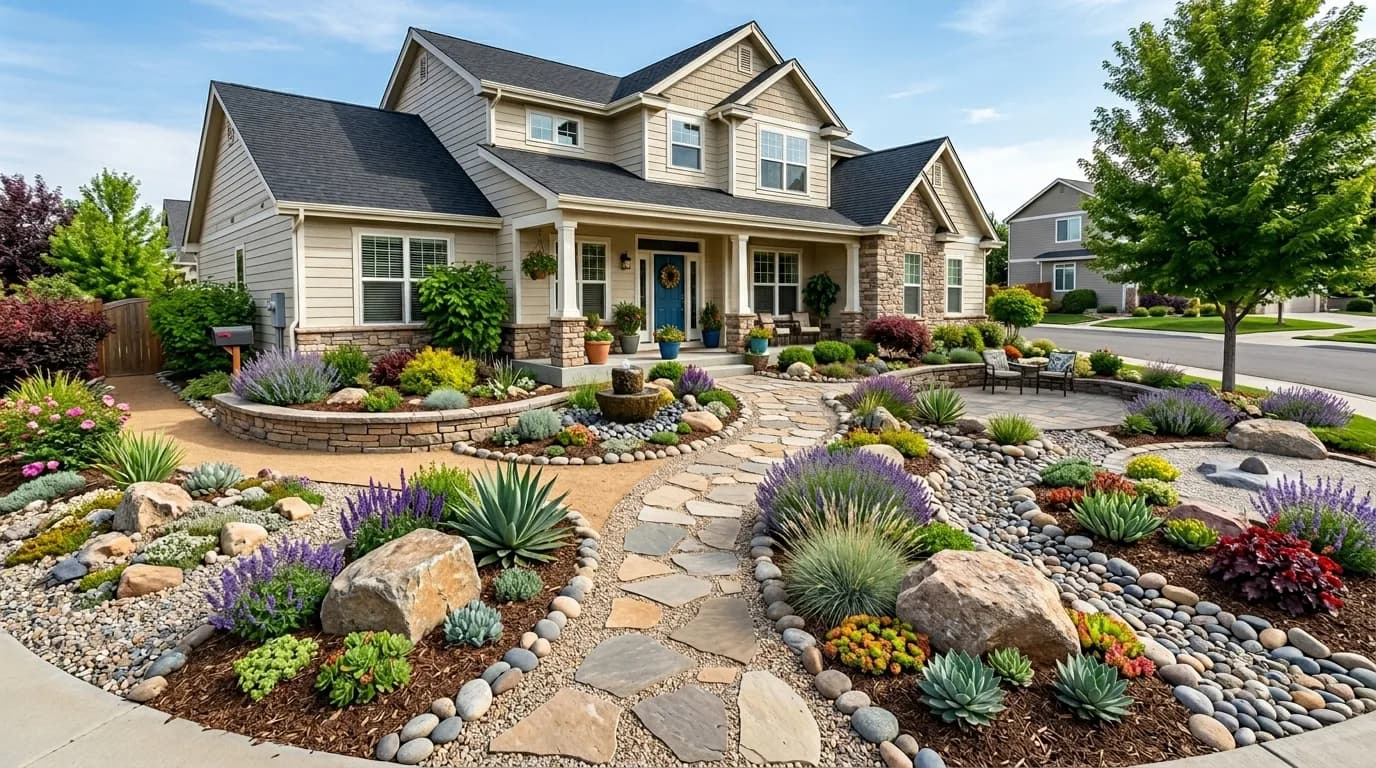
Rock-based front yard landscaping is one of the most searched landscaping topics in the US — and for good reason. With water bills rising, turf restrictions spreading, and HOA-safe alternatives in demand, rocks offer something rare: they look better than grass, cost less to maintain, and never need mowing.
A well-designed rock front yard can slash your water use by 50–70%, eliminate weekend lawn maintenance, and dramatically improve curb appeal. The catch? Most homeowners don't know how to design one that looks intentional rather than like a construction site.
This guide covers 28 rock landscaping ideas for front yards — from bold desert boulder designs to refined Japanese gravel courtyards — with real costs, plant pairings by climate zone, and a step-by-step installation plan.
Why Rock Works So Well in Front Yards
Rocks have three qualities that make them exceptional for front yard use:
Permanence. Unlike mulch (which needs annual replacement), decorative rock lasts indefinitely. The $800 you spend on river rock stays there for 20+ years. Over time, it's dramatically cheaper than mulch, sod, or traditional landscaping.
Water efficiency. A properly installed rock mulch layer suppresses evaporation and reduces irrigation needs dramatically. In hot climates, rock beds often need 70% less water than equivalent planted areas with soil exposed.
Visual impact. Rocks create texture, weight, and structure that looks good every month of the year — including the brown months when plants are dormant. A river rock border in January still looks designed and intentional.
28 Rock Front Yard Ideas by Style
Desert and Xeriscape Styles
1. Boulder focal point with ornamental grasses. Place one or three large boulders (2–4 ft) as anchors, surrounded by Mexican feathergrass, blue oat grass, or purple fountain grass. The grass softens the rock; the rock grounds the grass. Works in any climate.
2. Gravel garden with cactus and succulents. Lay decomposed granite or crushed limestone 3–4 inches deep across the entire front bed. Plant agave, prickly pear, and yucca for architectural structure. Add smaller aloe and echeveria at the border. Water: zero to once monthly.
3. River rock dry creek bed through lawn. Replace your lawn entirely with a sweeping dry creek bed — river rocks in two sizes (4–6 inch and 2–3 inch), meandering from one side of the yard to the other. Frame with ornamental grasses and low native shrubs. Cost: $2–$5 per sq ft.
4. Decomposed granite with native wildflowers. The Southwest classic: DG base (rust, buff, or gray tones), paved pathway, native wildflowers scattered in naturalistic clusters. California poppy, desert marigold, penstemon. Almost zero maintenance after establishment.
5. Gravel courtyard with potted agave. Replace the entire front lawn with a gravel courtyard. Use uniform ¾-inch gravel in a single color. Place large potted agave (15-gallon ceramic pots) as sculptural accents. Clean, modern, maintenance-free.
6. Red rock bed with desert sage. Crushed red granite with purple Texas sage, red yucca, and autumn sage. The warm tones of the rock pick up the warm tones in the plants — a cohesive palette that reads as intentional design from the street.
Pacific Northwest and Shade Garden Styles
7. Moss and stone Japanese pathway. A Japanese-inspired front entry uses flat stepping stones surrounded by moss, ferns, and Japanese forest grass. The stones create a pathway; the plants soften the edges. Works in zones 5–9 in cool, moist climates.
8. Basalt column fountain with river rock. A small basalt column fountain becomes the focal point, surrounded by smooth black river rock and hellebores, Japanese anemones, and shade hostas. The sound of water adds sensory dimension to the curb experience.
9. Shade rock garden with rhododendrons. For north-facing yards or those shaded by trees: large flat stones arranged in a naturalistic outcrop, underplanted with dwarf rhododendrons, pieris, and Epimedium groundcover. No lawn, minimal maintenance.
Traditional and Cottage Styles
10. Cobblestone border with cottage flowers. Edge your front beds with hand-set cobblestones or Belgian block. Fill with cottage flowers — roses, lavender, catmint, salvia — with crushed stone mulch between plants instead of wood mulch. The stone mulch suppresses weeds and reflects heat, extending the bloom season.
11. Fieldstone retaining wall with perennial border. If your front yard has any grade change, a dry-stack fieldstone retaining wall creates vertical interest, holds the slope, and creates a planting ledge. Fill the bed above the wall with coneflower, salvia, and black-eyed Susan for classic cottage appeal.
12. Limestone paver pathway with lavender borders. A clean limestone flagstone path from the street to your front door, with lavender planted directly in the crushed stone on either side. Lavender thrives in rocky, fast-draining soil and perfumes the entire entry from June through August.
13. Bluestone stepping stone through groundcover. Instead of lawn, a network of bluestone stepping stones through creeping thyme or stepable groundcover. The stones handle foot traffic; the groundcover handles the spaces in between. Blooms in spring; stays green all summer.
Ready to see how rocks could transform your specific front yard? [Get 3 free AI rock garden design previews at Yardcast](/redesign) — upload a photo and see your options in under 60 seconds.
Modern and Minimalist Styles
14. Crushed white granite with ornamental grasses. Pure white or pale gray crushed granite across the entire front bed, planted with three architectural grasses (feather reed, Karl Foerster is the classic). The monochrome palette reads as sophisticated and contemporary. Works especially well with stucco or cement-board siding.
15. Slate chip mulch with Japanese maple. Flat slate chips in dark gray or charcoal, with a single weeping Japanese maple as the centerpiece. The maple does all the seasonal work — spring red, summer burgundy, fall orange. The slate stays pristine year-round.
16. Gravel with ornamental boulders and steel edging. Brown or rust-colored pea gravel enclosed by clean steel edging, with 3–5 rounded granite boulders in varying sizes. Plant drought-tolerant grasses or yuccas in clusters. The steel edging keeps the look sharp and modern.
17. Black volcanic rock with white agave. Striking color contrast: black lava rock as the mulch layer, white-variegated agave (Agave americana 'Variegata') as the plant material. Extremely low maintenance. Thrives in zones 8–11.
18. Concrete stepping stones with fine gravel. Large concrete square stepping stones (2×2 ft) set in white or light gray fine gravel. Plant only at the perimeter with low ornamental grasses or echeveria. The result is architectural, like a modern Japanese garden.
Rocky Hillside and Slope Solutions
19. Rock terracing on a sloped front yard. For sloped front yards, dry-stack stone terraces solve two problems: erosion control and usable flat areas for planting. Stack local fieldstone or limestone in gentle terraces, fill with amended soil, and plant drought-tolerant perennials on each level.
20. Boulders as erosion control with groundcovers. Strategically placed large boulders anchor the slope and redirect water. Fill between boulders with spreading groundcovers — ice plant in warm climates, creeping phlox in cooler ones, or Bearberry (Arctostaphylos) for mountain zones.
21. Winding stone path down a slope. A winding path of steppers or stone pavers creates visual interest on a slope, provides safe access, and holds the grade. Plant the slope on either side with low-growing junipers, spreading cotoneaster, or native grasses for erosion control.
Regional Specialties
22. Pacific Northwest rain garden with cobbles. A bowl-shaped depression (6–12 inches deep) filled with large cobbles handles Seattle's winter rainfall naturally. Plant water-tolerant natives (sedge, native rush, red-twig dogwood) in the lower areas; drought-tolerant plants at the edges. Eliminates runoff, reduces mosquitoes.
23. Southern limestone patio garden. In Texas and Oklahoma, native limestone is cheap and abundant. Build a simple rock mulch garden with limestone chunks, plant with Texas sage (Leucophyllum), esperanza, and flame acanthus. Xeric, deer-resistant, zero irrigation after establishment.
24. Mountain granite with wild columbine. In Colorado and Utah, use native granite rocks as mulch and structure, planted with alpine flowers: Rocky Mountain columbine, prairie smoke, penstemons. These look like a wildflower mountain meadow — spectacular from May through July.
25. California coastal gravel with succulents. In coastal California, decomposed granite or pea gravel with ice plant, aloe vera, aeonium, and trailing succulents creates a garden that handles both drought and coastal salt air. Water once monthly maximum.
26. Northeast gravel garden with hellebores. For zone 5–7 front yards in shade: fine gravel mulch with hellebore (Lenten rose), pulmonaria, and epimedium. Hellebores bloom March–April — the earliest blooming perennial in the cold regions — making this a stunning late-winter front yard statement.
27. Florida coral rock garden. In South Florida, natural coral rock is inexpensive and fits the landscape. Build a small raised coral rock garden with bromeliads, native wildflowers (scarlet sage, black-eyed Susan), and low palms like dwarf fakahatchee grass. Zero lawn, perfect for heat and sand.
28. Midwest limestone chip with native prairie. Crushed limestone or pea gravel mulch, planted with compact native prairie plants: coneflower, prairie dropseed, rattlesnake master. This low-water design looks naturalistic, supports pollinators, and virtually maintains itself after the first season.
How Much Does Rock Front Yard Landscaping Cost?
| Rock Type | Cost per Ton | Coverage (2" deep) | Best For |
|---|---|---|---|
| Pea gravel | $35–$55 | ~100 sq ft | Pathways, modern gardens |
| River rock (2–3") | $45–$70 | ~75 sq ft | Dry creek beds, natural look |
| Decomposed granite | $25–$45 | ~100 sq ft | Desert gardens, pathways |
| Crushed limestone | $30–$50 | ~90 sq ft | Southeast, cottage styles |
| Lava rock | $65–$85 | ~80 sq ft | Modern, tropical, volcanic |
| Fieldstone (boulders) | $80–$150/ton | Varies | Retaining walls, accents |
Average project cost: A 500 sq ft front yard converted to rock landscaping typically costs $800–$2,500 in materials (rock, edging, weed barrier) and $1,500–$4,000 professionally installed. You'll recoup this in 3–5 years through eliminated lawn care costs.
The Right Plants for Rock Front Yards
Rocks pair best with plants that thrive in fast-draining, lean soil — which describes most ornamental grasses, native wildflowers, and Mediterranean herbs:
Sun-lovers (6+ hours): Mexican feathergrass, blue oat grass, lavender, rosemary, salvia, agave, yucca, penstemon, coneflower, rudbeckia
Part shade (3–6 hours): Japanese forest grass, catmint, hardy geranium, heuchera, creeping thyme, sedum, hellebore
Full shade: Epimedium, pulmonaria, mondo grass, sweet woodruff, pachysandra (avoid — invasive in some regions)
Rock garden specialists: Sempervivum (hens and chicks), sedum, thyme, creeping phlox, dianthus, armeria, ice plant (warm climates only)
Step-by-Step Installation Guide
1. Remove existing lawn. Rent a sod cutter ($80–$150/day) or use a smothering method (cardboard + 6" of wood chips, wait 2 months). Mark utilities before any digging.
2. Grade and shape. Rake the area smooth, sloping very slightly away from your foundation (about ¼ inch per foot). Address any low spots where water pools.
3. Install edging. Steel or aluminum landscape edging ($1–2 per linear foot) is essential to keep rock out of neighboring lawn areas and out of planting beds.
4. Install weed barrier. A high-quality non-woven geotextile fabric (not plastic sheeting) allows water to pass while suppressing weeds. Overlap seams by 12 inches. Cut X-shapes where plants will go.
5. Plant first. Add all plants before spreading rock. Dig holes through the weed barrier, amend soil if needed, plant, and water in well.
6. Spread rock. Spread to a depth of 2–3 inches. Don't go deeper — plant roots need oxygen and the rock becomes too heavy to work in if you ever need to adjust.
7. Define pathways. Add stepping stones, flagstone, or a separate pathway material to create walkable access without disturbing the rock.
Frequently Asked Questions About Rock Front Yards
See the FAQ section below for answers to common questions about front yard rock landscaping.