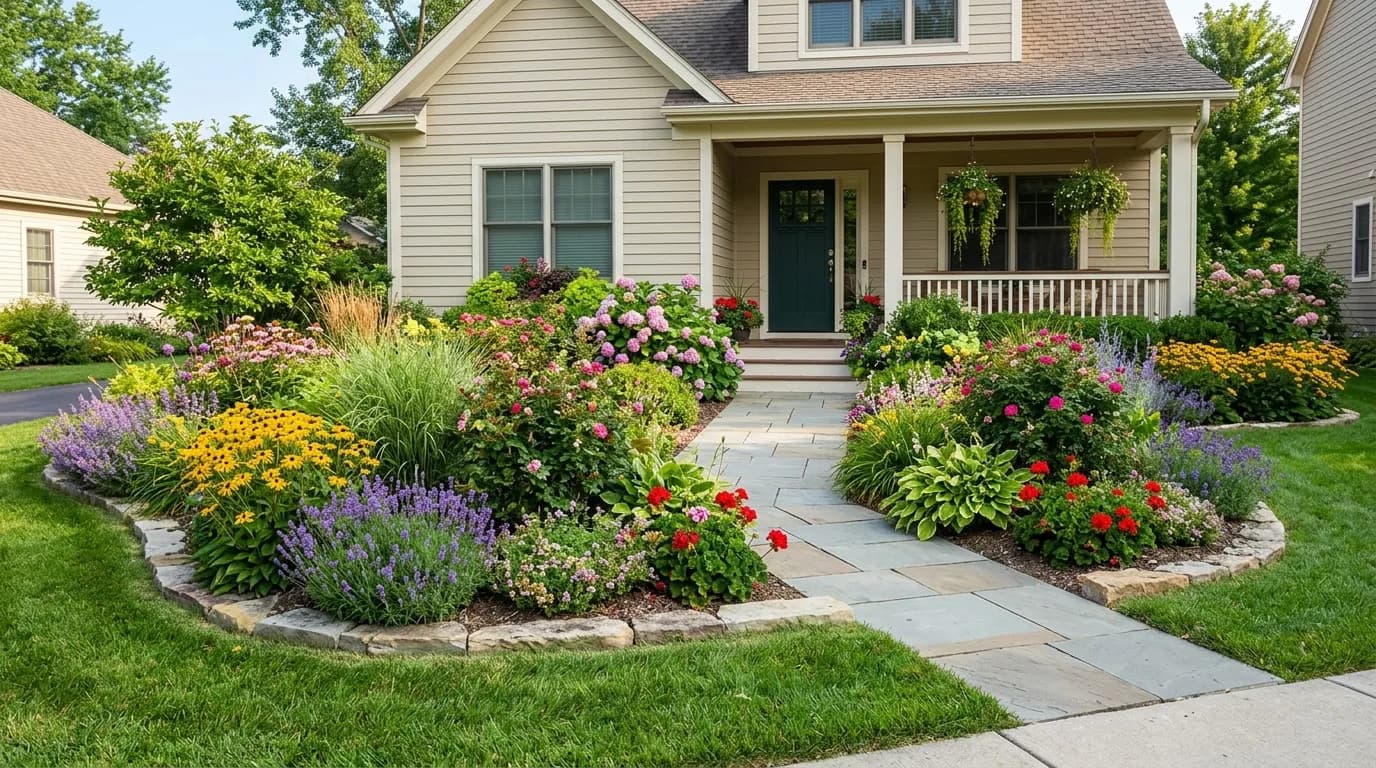
A well-designed front yard flower bed is the single highest-ROI landscaping upgrade you can make. The National Association of Realtors puts landscaping's return on investment at 100–200% — dollar for dollar, planting a beautiful front bed beats almost any other home improvement project.
But the difference between a flower bed that looks professional and one that looks like a random assortment of plants is design. Plant selection, layering, color sequencing, and seasonal timing all matter. Here are 45 front yard flower bed ideas that actually work — with specific plants, layout strategies, and cost estimates.
The Foundation: Design Principles That Make Beds Look Professional
Before any specific ideas, these four principles separate magazine-worthy beds from average ones:
1. Layer by height: Tall plants (3+ ft) in back, medium (1–3 ft) in middle, low (under 1 ft) at front. This creates depth and ensures every plant is visible.
2. Plant in odd numbers: Groups of 3, 5, or 7 of the same species look intentional. Groups of 2 or 4 look accidental.
3. Repeat plants: Use the same 3–4 species throughout the bed for visual cohesion. One-of-everything beds look chaotic.
4. Plan for 3-season interest: Choose plants that bloom at different times — spring bulbs → summer perennials → fall asters — so the bed always has something happening.
Front Yard Flower Bed Ideas by Style
Cottage Garden Beds
#### 1. Classic English Cottage Border
Best for: Traditional, Victorian, or craftsman homes
Signature plants: Lavender, roses, catmint, foxglove, salvia, echinacea
How to do it: Create a 4–6 ft deep curved border along the front of your property. Use roses as anchors (3 shrub roses, evenly spaced), fill in with masses of lavender and catmint, and add vertical interest with foxglove and salvia. Let plants self-seed slightly for an authentic cottage look.
Cost: $200–400 for a 20-ft section | Maintenance: Medium (deadheading, rose care)
#### 2. Wildflower Meadow Strip
Best for: Craftsman, farmhouse, or naturalistic homes
Signature plants: Coneflower, black-eyed Susan, wild bergamot, lanceleaf coreopsis, prairie dropseed grass
How to do it: Sow a native wildflower mix in fall or early spring. Add 3–5 clumps of prairie dropseed grass as anchors. Install a clean steel or stone edge to contain it and signal intentional design.
Cost: $30–80 for seed mix | Maintenance: Very low (cut back once in late winter)
#### 3. Romantic Rose Bed
Best for: Traditional homes, warm climates (Zones 5–9)
Signature plants: Drift roses, 'Knock Out' roses, lavender underplanting, Nepeta
How to do it: Plant Knock Out roses (disease-resistant, minimal care) in groups of 3. Underplant each group with Nepeta 'Walker's Low' for a purple skirt. Edge with white Drift roses for a formal frame.
Cost: $300–600 | Maintenance: Medium (seasonal pruning, fertilizing)
Modern and Minimalist Beds
#### 4. Ornamental Grass + Perennial Strip
Best for: Modern, contemporary, mid-century homes
Signature plants: Karl Foerster feather reed grass, blue oat grass, rudbeckia, black-eyed Susan
How to do it: Plant Karl Foerster grasses (4 ft, narrow, upright) at 4-ft spacing along the back of the bed. Mass rudbeckia in front. Edge with a thin steel strip. The grasses move in wind and catch morning light — architectural year-round.
Cost: $150–300 | Maintenance: Very low (cut back once in spring)
#### 5. Gravel + Agave Modern Desert Bed
Best for: Desert Southwest, California, dry climates (Zones 8–11)
Signature plants: Blue agave, desert spoon, red yucca, Mexican feather grass, bougainvillea
How to do it: Remove turf and install 4 inches of decomposed granite. Plant 1 large agave as the focal point, flanked by desert spoon and red yucca. Add Mexican feather grass for movement. The result is a low-water, high-drama bed that looks expensive.
Cost: $400–800 (including gravel) | Maintenance: Very low
#### 6. Black and White Garden
Best for: Modern, contemporary homes
Signature plants: White coneflower, white salvia, Japanese silver grass, dusty miller, black mondo grass
How to do it: Use silver and white foliage (dusty miller, white salvia) as the base. Accent with black mondo grass in groups of 5. Add white coneflower for late summer blooms. The high-contrast palette photographs beautifully and looks intentional from the street.
Cost: $150–250 | Maintenance: Low
Color-Focused Beds
#### 7. Hot Tropical Burst
Best for: Warm climates (Zones 8–11), bold modern or Mediterranean homes
Signature plants: Canna 'Tropicanna', crocosmia 'Lucifer', rudbeckia, red salvia, ornamental pepper
How to do it: Use Tropicanna canna as the back anchor (5 ft, striped foliage + orange flowers). Fill with crocosmia and red salvia. Edge with ornamental peppers in fall.
Cost: $150–250 | Maintenance: Medium (cannas need winter mulching in zones 7–8)
#### 8. Cool Blue and Purple Border
Best for: Any style home; particularly effective against red brick or warm-toned siding
Signature plants: Russian sage, catmint, salvia 'May Night', veronica, allium 'Purple Sensation'
How to do it: Mass Russian sage along the back (4 ft, silvery blue). Plant catmint as the middle layer, salvia as a lower front accent. Add allium bulbs throughout — they pop up in late spring before perennials fill in.
Cost: $150–250 | Maintenance: Low (Russian sage is drought-tolerant once established)
#### 9. All-White Moon Garden
Best for: Formal, colonial, or farmhouse homes; particularly effective in evening light
Signature plants: White hydrangea 'Incrediball', white echinacea, white salvia, white alyssum, white phlox
How to do it: Anchor with 3 Incrediball hydrangeas (4 ft, massive white blooms). Fill in with white echinacea and phlox. Edge with alyssum. These beds glow at night and look clean and classic during the day.
Cost: $300–500 | Maintenance: Low-medium
Foundation Flower Beds (Directly Against the House)
Foundation beds are the most visible flower beds in any front yard. Here's how to do them right.
#### 10. Classic Foundation Planting
Best for: Any home style
Formula: 1 anchor shrub per corner + 1 mass of mid-height shrub along the foundation + 1 low perennial at the front edge
Best plants by role:
- Corner anchors: Viburnum, Oakleaf hydrangea, Holly, Arborvitae
- Foundation mass: Boxwood, Knock Out rose, spirea, nandina
- Front edge: Daylily, hosta (shade), catmint, liriope
Cost: $300–600 for a typical 40-ft foundation | Maintenance: Low-medium
#### 11. All-Season Foundation Bed
Spring: Tulips + daffodils planted in fall (bulbs, $30-50)
Summer: Knockout roses, salvia, echinacea (perennials, $80-120)
Fall: Autumn joy sedum, asters, ornamental kale (perennials/annuals, $40-60)
Winter: Evergreen boxwood or nandina, ornamental grasses (permanent structure)
This 4-season approach ensures your foundation bed always has color — critical for curb appeal year-round.
#### 12. Shade Foundation Bed (North-Facing)
Best for: North-facing fronts with full shade
Signature plants: Hosta 'Sum and Substance' (giant golden), astilbe, hellebore, bleeding heart, impatiens, coral bells
How to do it: Use giant Sum and Substance hostas as anchors (3 ft wide, chartreuse). Fill with coral bells (colorful foliage year-round) and astilbe (feathery summer blooms). Add impatiens for continuous summer color.
Cost: $150–300 | Maintenance: Low
Upload a photo of your current front yard and our AI generates 3 photorealistic designs showing you exactly what it could look like — with a complete plant list matched to your climate zone, soil type, and sun exposure.
Native Plant Flower Beds
Native plantings require 50–75% less water and maintenance than conventional plantings once established. Here are the best regional approaches.
#### 13. Northeast Native Pollinator Garden (Zones 4–7)
Signature plants: Wild bergamot, purple coneflower, black-eyed Susan, little bluestem grass, butterfly weed, Joe Pye weed
Best placement: Full sun, any size front bed
Bloom sequence: May–October with zero gaps
Setup: Plant little bluestem grass in back as structure. Mass echinacea in middle. Wild bergamot + black-eyed Susan fill in naturally. Add butterfly weed as a front accent (orange flowers, monarch caterpillar host plant).
Cost: $80–150 (native plants are often less expensive) | Maintenance: Very low
#### 14. Midwest Prairie Strip (Zones 4–7)
Signature plants: Prairie dropseed, compass plant, rattlesnake master, prairie blazing star, black-eyed Susan
Best for: Flat lots, full sun
How to do it: This is the classic American prairie front garden — deeply rooted, drought-proof after establishment, and wildly attractive to pollinators. Edge it cleanly to signal intentional design.
Cost: $100–200 | Maintenance: Very low (one annual cut-back)
#### 15. Pacific Northwest Native Garden (Zones 7–9)
Signature plants: Salal, sword fern, Oregon grape, red-flowering currant, camas, western columbine
Best for: Shaded or partly shaded fronts
How to do it: These plants evolved in the Pacific Northwest and need almost no supplemental water after year 1. Red-flowering currant blooms February–March — earlier than almost anything else in the garden.
Cost: $150–300 | Maintenance: Very low
#### 16. California Native Front Garden (Zones 8–10)
Signature plants: Cleveland sage, California buckwheat, toyon, penstemon, blue-eyed grass, fescue
Best for: Replacing thirsty turf in drought-prone areas
How to do it: Plant toyon as a tall back anchor (6 ft, red berries attract birds in winter). Mass Cleveland sage in mid-ground. Fill remaining space with California buckwheat and penstemon. This garden survives on rainfall after establishment — no irrigation.
Cost: $200–400 | Maintenance: Very low
Front Yard Flower Beds on a Budget
#### 17. Seed-Started Annual Bed ($30–60 Total)
Direct sow sunflowers, zinnias, cosmos, and marigolds in spring. For under $30 in seed, you can fill an entire 20-ft bed with color from June through October. Bonus: zinnias and marigolds are some of the best cut flowers in existence.
#### 18. Division-Filled Bed ($0–50)
If you or a neighbor have established hostas, daylilies, ornamental grasses, or irises, divide them in spring or fall — it's free. Most perennials double in size every 2–3 years and need dividing anyway. A single mature hosta can be divided into 8 starts.
#### 19. Thrift Store + Nursery Combination
End-of-season nursery sales (late summer) offer perennials at 50–70% off. Many perennials sold in late August will still have time to root before frost and will return full-size next year. Shop late July through August for the best deals.
How to Design a Front Yard Flower Bed: Step-by-Step
Step 1: Measure your bed. Sketch the shape and dimensions. Note what direction it faces (sun exposure) and what's behind it (fence, foundation, street).
Step 2: Choose your anchor plants first. Every great bed has 1–3 anchor plants — usually a large shrub, ornamental grass, or multi-stemmed tree. These define the structure. Everything else fills in around them.
Step 3: Select for 3-season bloom. Make a chart: Spring (April–May), Summer (June–August), Fall (September–October). Make sure each column has at least one blooming plant in your bed.
Step 4: Plan your layers. Back layer (tallest), middle layer, front edge (shortest). Most beds need 3 layers.
Step 5: Use the 1/3 rule for bed depth. Bed depth should be at least 1/3 of its length. A 15-ft long bed should be at least 5 ft deep. Shallow beds can't accommodate proper layering.
Step 6: Add mulch last. 3 inches of dark hardwood mulch after planting ties everything together and suppresses weeds.
Common Front Yard Flower Bed Mistakes (And How to Fix Them)
| Mistake | Fix |
|---|---|
| Planting too close to foundations | Keep plants 18–24 inches from the house wall for air circulation |
| Mixing plants with incompatible water needs | Group thirsty plants (hydrangeas, astilbe) away from drought-tolerant ones (lavender, Russian sage) |
| Planting too shallow | Most perennials need 18+ inches of good soil — amend with compost before planting |
| No edge definition | Install steel, stone, or aluminum edging — it's what separates a bed from a yard |
| All blooming at the same time | Stagger bloom times across spring, summer, and fall |
| No structure in winter | Add at least 2 evergreen plants or ornamental grasses that look good year-round |
Frequently Asked Questions
Q: What is the best low-maintenance flower bed for the front yard?
A: Ornamental grasses + native perennials. A combination of Karl Foerster feather reed grass, purple coneflower (echinacea), and black-eyed Susan creates a bed that blooms June through October, never needs deadheading, survives drought, and only requires one annual cut-back in late winter. Cost: $150–250 for a 20-ft bed.
Q: What flowers grow best in front of the house?
A: It depends on your sun exposure. Full sun: lavender, salvia, rudbeckia, coneflower, catmint. Part shade: astilbe, coral bells, Japanese anemone, impatiens. Full shade: hosta, ferns, hellebore, bleeding heart. Choose plants matched to your actual conditions — the wrong plant will fail regardless of quality.
Q: How do I make a flower bed in front of my house?
A: Mark the bed shape with a hose or string. Cut the sod edge with a flat spade. Remove sod and loosen soil 12 inches deep. Mix in 3–4 inches of compost. Plant your chosen plants per their spacing requirements. Water well. Apply 3 inches of mulch. Water every day for the first week, every other day for weeks 2–4, then weekly through the first season.
Q: How wide should a front yard flower bed be?
A: At minimum, 3–4 feet. For a layered, professional look, aim for 5–8 feet of depth. Beds narrower than 3 feet can only accommodate one layer and look shallow and underdeveloped.
Q: What should I plant in a front yard flower bed for curb appeal?
A: For maximum curb appeal, focus on: (1) plants with a long bloom season, not just a short burst; (2) foliage that looks good when not blooming (ornamental grasses, hostas, lavender); (3) a mix of heights — anchor shrubs + perennials + low edging. The specific plants matter less than the structure and layering.
Q: How do I start a flower bed from scratch?
A: The two main methods are: (1) Sod removal — cut and remove sod with a flat spade, then amend soil. Best for small to medium areas. (2) Newspaper/cardboard sheet mulching — lay overlapping cardboard over grass, cover with 4–6 inches of compost and mulch. Grass smothers in 4–8 weeks. Best for large areas or if you want to preserve the sod's existing organic matter.
Q: What's the easiest flower bed to maintain?
A: A native perennial bed. Once established (typically 2–3 years), native plants in their appropriate region need no fertilizer, minimal water, and only one annual maintenance session (cutting back in late winter). The first 2 years require watering and weeding, but after that, a well-designed native bed largely takes care of itself.
Q: Should I put rocks or mulch in my flower bed?
A: Organic mulch (wood chips, shredded hardwood bark) is usually the better choice for flower beds. It improves soil as it decomposes, provides moderate insulation, and looks natural. Rocks/gravel work well for dry Mediterranean or desert-style beds with succulents and drought-tolerant plants, but they don't improve soil and can overheat roots in hot climates.
Ready to see exactly what a beautiful flower bed would look like in your front yard? Upload a photo and get 3 free AI landscape designs showing your specific house, with a complete plant list matched to your climate →