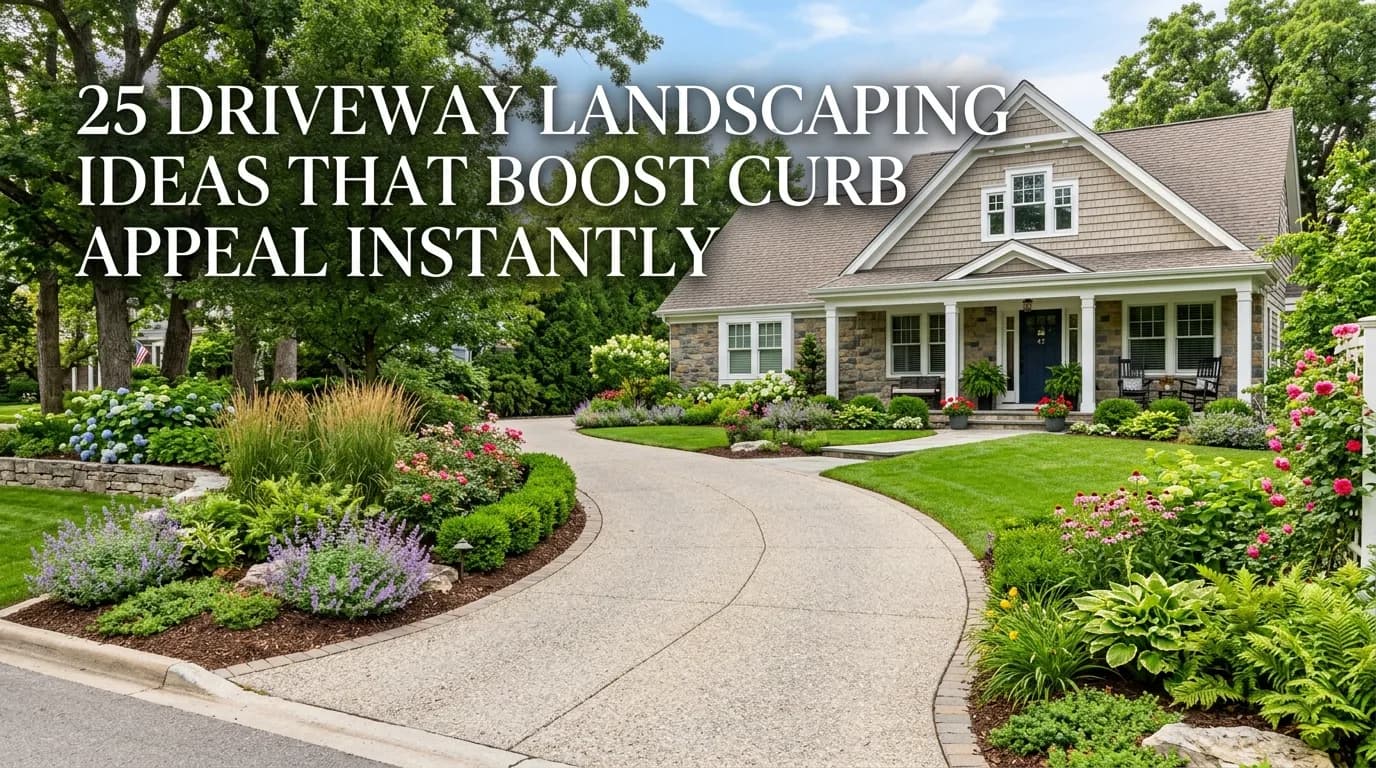
The driveway covers 20–40% of most front yards, yet homeowners rarely think about it as a landscaping opportunity. Done right, driveway landscaping doubles your curb appeal, frames your home's architecture, and can even add $10,000–$20,000 to your property's perceived value. Here are 25 ideas to transform your driveway from a boring slab of concrete into a design statement.
Why Driveway Landscaping Matters
Real estate agents consistently report that the driveway approach is one of the first things potential buyers notice. A well-landscaped driveway signals a cared-for property and creates a sense of arrival — something even a freshly painted house can't achieve on its own.
Beyond aesthetics, smart driveway landscaping:
- Softens hard surfaces — concrete and asphalt are visually heavy; plants break them up
- Improves drainage — border plantings and permeable edging channels runoff away from the foundation
- Defines the property edge — clear borders between driveway and lawn look polished and intentional
- Adds privacy — strategic shrubs and trees screen neighbors and street traffic
Driveway Border Ideas
1. Classic Boxwood Hedges
Low, clipped boxwood hedges running the length of a straight driveway create a formal, structured look that works beautifully with Colonial, Georgian, and Craftsman architecture. Plant them 18 inches from the driveway edge so they have room to fill out. Height: 18–24 inches. Trimming: 2–3 times per year.
2. Ornamental Grass Borders
For a more casual, modern look, mass plantings of Karl Foerster feather reed grass or Blue Oat grass create movement and texture year-round. They're virtually maintenance-free once established and look stunning in fall when the seed heads catch the light. Plant in drifts of 5–7 for a natural feel.
3. Lavender Borders
In zones 5–9, a lavender border along a driveway is one of the most beautiful and fragrant landscaping choices you can make. The silvery foliage provides year-round structure; purple blooms appear in early summer. Use English lavender ('Hidcote' or 'Munstead') for compact, tidy growth. Bonus: the fragrance greets you every time you pull in.
4. Daylily Drifts
Daylilies are the workhorse of driveway borders — easy, cheap, colorful, and nearly indestructible. Mix orange, yellow, and red cultivars for a cottage-garden feel, or stick to a single color for sophistication. They naturalize and spread over time, so a small initial investment fills in beautifully over 3–5 years.
5. Catmint Edging
Catmint (Nepeta 'Walker's Low') produces a haze of lavender-blue flowers from late spring through fall. It's drought-tolerant, deer-resistant, and softens the edge of a driveway with a relaxed, romantic look. Cut it back by half in midsummer for a fresh flush of blooms.
6. Creeping Phlox Ground Cover
If you have a slope next to your driveway, creeping phlox is extraordinary. It forms a dense mat that explodes in pink, purple, or white flowers in spring, then stays as attractive green ground cover the rest of the year. Nearly zero maintenance once established.
Driveway Entrance Ideas
7. Flanking Evergreen Shrubs
Place matching shrubs on either side of the driveway entrance for instant formality and structure. Good choices: Sky Pencil Holly (narrow, vertical, evergreen), arborvitae, or 'Little Giant' globe cedar. These frame the entrance year-round without blocking sightlines.
8. Statement Ornamental Trees
A single weeping cherry or Japanese maple positioned at the driveway entrance creates a dramatic focal point that anchors the whole front yard design. These trees peak in spring with blooms but provide year-round interest through bark color, leaf form, and structure.
9. Entrance Columns with Climbers
If you have existing masonry pillars, plant climbing roses ('New Dawn' or 'Cécile Brünner'), wisteria, or climbing hydrangea at their base. Within 2–3 years you'll have a romantic, flowering entrance that looks like it cost a fortune.
10. Lighted Entry Pillars with Plantings
Low landscape lighting fixtures flanking a planted entrance create a welcoming look day and night. Pair bollard lights with rounded hydrangea shrubs for a classic pairing. The light investment ($200–$500 for fixtures) pays dividends in curb appeal at dusk.
11. Wrought Iron or Wood Arbor
Frame the driveway entrance with an arbor draped in climbing roses or clematis. This works especially well for properties with a defined entrance away from the street, where the arbor becomes an architectural moment you drive through.
Driveway Surface and Edge Details
12. Belgian Block Edging
Granite or Belgian block cobblestones along both edges of a driveway add elegance and durability. They define the edge clearly, prevent lawn from encroaching, and look excellent with any home style. Cost: $10–$20 per linear foot installed.
13. Soldier-Course Brick Borders
Brick laid on edge along the driveway border creates a traditional, high-end look especially suited to Colonial and Georgian homes. The warm red tones soften the grey of concrete and complement red-brick house fronts beautifully.
14. Permeable Gravel Strips
If your driveway is wide (two-car), consider replacing a center strip with decorative gravel and low ground covers like sedum or thyme. The result is a French-style "jardin de graviers" look that reduces runoff and adds texture. Functional and beautiful.
15. Grass Joints Between Pavers
For pavers or concrete sections, remove alternating sections and fill with grass or ground cover. This softens the look dramatically and creates a pattern that's visually interesting from above (great for homes with second-floor views).
Low-Maintenance Driveway Landscaping
16. Ornamental Conifers
Dwarf Alberta spruce, 'Gold Mops' cypress, or 'Blue Star' juniper require almost no care once established. Plant in a staggered row along one or both sides of the driveway for a textured, year-round look that never needs pruning. They grow slowly, staying in their spot for decades.
17. Native Wildflower Strip
Replace a traditional mulched border with a native wildflower meadow strip. In most regions, you can establish a mix of black-eyed Susans, coneflowers, wild bergamot, and asters that need zero irrigation after year one. Cut once annually in early spring. Cost: $50–$200 for seed; lasts indefinitely.
18. Groundcover Instead of Mulch
Replace mulched beds along the driveway with low-growing groundcovers: creeping jenny for sun, pachysandra for shade, or sedum for dry spots. Groundcovers eliminate annual mulching costs and look neater longer. Initial cost is slightly higher, but the long-term maintenance savings are significant.
19. River Rock with Succulents
A river rock border with intermittent succulent plantings (agave, yucca, ice plant) creates a modern, drought-proof border that never needs mulching or irrigation. Ideal for the Southwest, Southern California, and anywhere water is a concern.
Creative and Distinctive Ideas
20. Pollinator Corridor
Design a driveway border specifically as a pollinator habitat — a continuous strip of native plants chosen to bloom sequentially from April through October. Include milkweed for monarchs, bee balm for bumblebees, and Joe Pye weed for late-season pollinators. It's a conversation piece that your neighbors will compliment.
21. Fragrance Garden Border
Curate your driveway border as a fragrance experience: Russian sage, catmint, lavender, sweet alyssum, and gardenias arranged so the scent builds as you drive in. Place the most fragrant plants nearest the driver's window — where the car pauses or slows.
22. Four-Season Interest Plan
Design the border to have something happening in every season: bulbs for spring (tulips, alliums), perennials for summer (rudbeckia, phlox), grasses and seed heads for fall, and evergreen structure + red-twig dogwood for winter. This takes some planning upfront but the result is a driveway that looks interesting year-round.
23. Illuminated Stone Pathway Borders
Combine flat stone or flagstone stepping-stone strips alongside the driveway with solar-powered light fixtures. This creates a pathway effect that guides guests and looks dramatic at night. The combination of hardscape and soft light makes the driveway feel like a resort entrance.
24. Espalier Trees Against a Wall or Fence
If your driveway runs along a wall or fence, train an espalier — an apple tree, pear, or flowering quince flattened against the surface. It's a centuries-old technique that produces a stunning, architectural plant form in tight spaces. The flowers and fruit are bonuses.
25. Rain Garden Along the Low Side
If your driveway has a slope, the low side often collects runoff. Convert it into a rain garden planted with moisture-tolerant natives: swamp milkweed, cardinal flower, blue flag iris, and sedges. A rain garden handles drainage, looks intentional, and supports wildlife. Win on every dimension.
Visualize Your Driveway Before You Plant
Before you buy a single plant or paver, it's worth seeing what your driveway landscaping could look like with different design approaches. Yardcast's AI design tool lets you upload a photo of your front yard, describe your style and climate, and generate three distinct landscape design options in about 60 seconds.
You'll see plant suggestions, color palettes, and layout recommendations — all specific to your property. It's the fastest way to test ideas before committing money to plants and installation.
Driveway Landscaping: Cost Breakdown
| Project | DIY Cost | Professional Cost |
|---|---|---|
| Mulched border with perennials (50 linear ft) | $150–$400 | $600–$1,500 |
| Ornamental grass border (50 linear ft) | $300–$600 | $1,000–$2,500 |
| Belgian block edging (per linear ft) | $8–$12 | $15–$25 |
| Entrance shrubs (pair) | $80–$200 | $300–$600 installed |
| Landscape lighting (6 fixtures) | $100–$300 | $500–$1,200 installed |
| Full driveway landscaping redesign | $1,500–$4,000 | $5,000–$15,000 |
The biggest ROI comes from: defined edging + a few anchor plants at the entrance + fresh mulch. That combination costs $300–$800 DIY and transforms the look instantly.
Design Principles for Driveway Landscaping
Scale appropriately. A long driveway needs taller, bolder plants to hold the visual weight. A short city driveway looks best with compact, restrained choices.
Mirror both sides. Even if you can only afford to plant one side now, design both sides from the start. Asymmetrical driveway borders look accidental; symmetry looks intentional.
Keep sightlines clear. At the entrance, keep plants below 2–3 feet unless they're set back significantly from the street. Safety and visibility trump aesthetics.
Think about the view from inside. You pull into your driveway far more often than visitors do. Design for the experience of arriving, not just for the street view.
Start with a free AI landscape design for your front yard →
Frequently Asked Questions
What plants work best along a driveway?
The best driveway border plants tolerate reflected heat from pavement, occasional splashing from cars, and some foot traffic near the edge. Top performers: ornamental grasses, lavender, catmint, daylilies, boxwood, and low junipers. Avoid plants with shallow roots close to the edge — compaction from the pavement edge can stress them.
How wide should a driveway border planting be?
For a straight driveway, 18–36 inches of planting bed on each side looks proportional and gives plants enough root space. For a curved driveway or a wider property, you can go up to 4–5 feet without it looking overwhelming. Anything wider needs substantial plants (shrubs, ornamental trees) to fill the space well.
What's the best low-maintenance driveway landscaping?
The lowest-maintenance driveway landscaping uses: ornamental grasses or dwarf conifers (no pruning needed), a deep mulch layer (3–4 inches to suppress weeds), and a solid edging material (steel, stone, or concrete) to prevent grass encroachment. You can get away with one maintenance pass per year — cut the grasses in early spring, refresh the mulch, and you're done.
How do I stop grass from growing into my driveway border?
Install a physical barrier: steel landscape edging, concrete mow border, or Belgian block. Push the edging 3–4 inches into the soil to stop underground rhizome spread. For existing encroachment, cut along the edge with a flat spade or edging tool, then install the barrier. Herbicide isn't recommended near paved surfaces due to runoff.
Can I landscape along a concrete driveway without damaging it?
Yes — keep plants at least 12–18 inches from the concrete edge to prevent root damage over time. Avoid large trees within 10–15 feet of the driveway; their roots can heave concrete. The best plants for close-to-concrete placement are ornamental grasses, lavender, boxwood, and other shrubs with non-aggressive root systems.
How much does driveway landscaping cost?
DIY driveway landscaping with borders, mulch, and a few shrubs runs $300–$800 for a typical residential driveway. A professionally designed and installed project — including edging, plantings, and possibly lighting — typically costs $2,000–$8,000 depending on scope. The entrance statement (flanking shrubs or trees) is usually the highest-impact single investment you can make.
What's the best way to light a driveway for curb appeal?
For curb appeal, use low bollard lights or in-ground uplights along the borders, and taller post lights or lanterns at the entrance. Solar lights have improved significantly and work well for border lighting. Wired low-voltage systems (connected to a transformer) are more reliable and brighter for entrance lighting. Warm white (2700–3000K) light color works best with plants and stone.