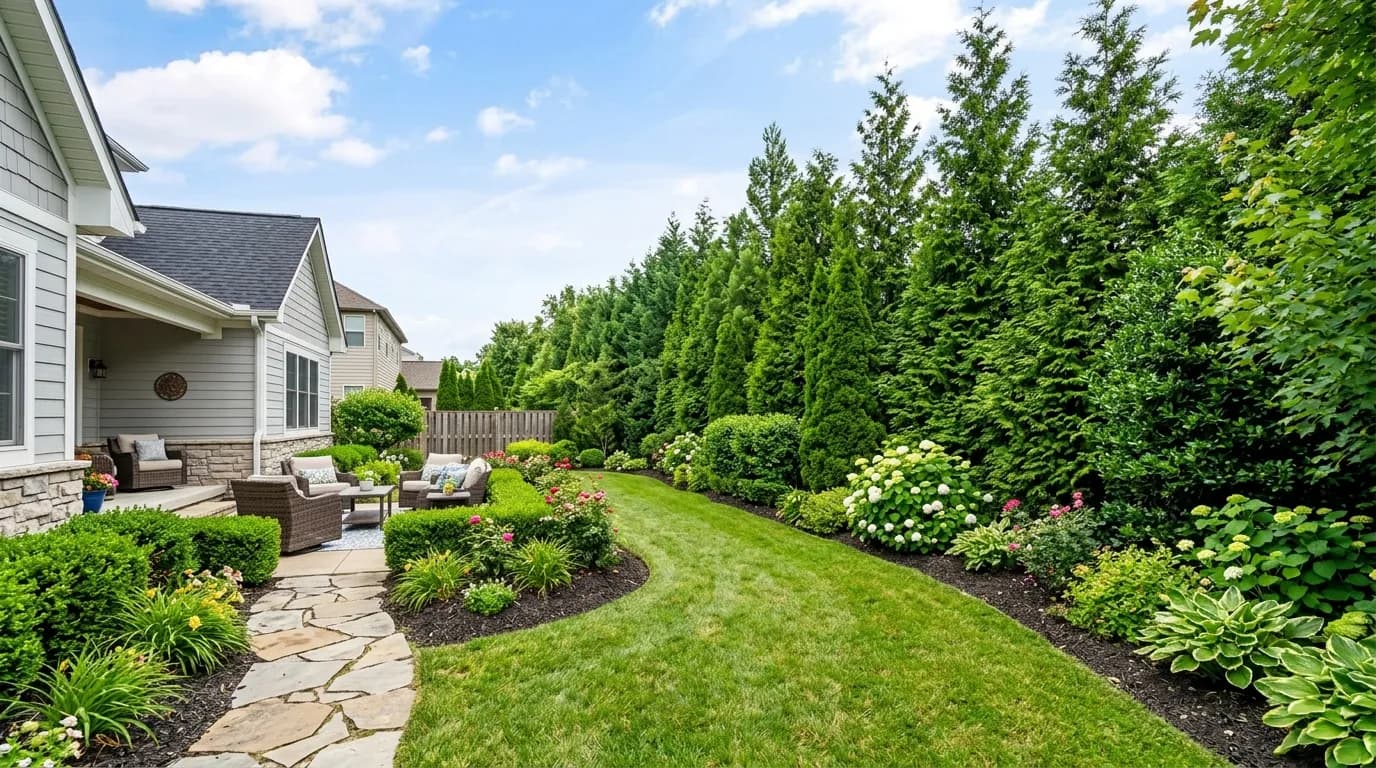
Nothing feels quite like a backyard you can truly relax in — unseen by neighbors, shielded from street noise, and buffered from the world. The right privacy trees can transform an exposed yard into a private retreat in 3–7 years, and unlike fences, they provide habitat, shade, noise reduction, and year-round beauty. This guide covers the 20 best privacy trees for backyards, with climate data, growth rates, and a cost comparison so you can make the right choice for your yard.
Why Trees Beat Fences for Privacy
Before choosing between a fence and privacy trees, consider what trees do that fences can't:
Noise reduction. A dense row of trees can reduce traffic noise by 5–10 decibels — the difference between hearing a distant conversation and not. Fences provide almost no sound attenuation.
Year-round cooling. A well-placed tree row can reduce summer cooling costs by 15–25% by blocking direct sunlight. Fences create wind turbulence without providing shade.
Property value. Mature trees consistently add 3–10% to property values. Fences depreciate and need replacement every 15–20 years.
Wildlife habitat. Trees provide nesting sites, berries, and insect habitat. Fences provide none.
Longevity. A well-chosen tree planted today could be screening your yard for 100 years. Fences last 15–25 years before requiring significant work.
HOA compliance. Many HOAs limit fence heights to 4–6 feet. Trees are rarely subject to the same restrictions (though some HOAs do limit tree height — always check).
Ready to see how privacy trees would look in your yard? Design your private backyard with Yardcast's free AI tool — upload your yard photos and see your screening options rendered in photorealistic detail.
Best Evergreen Privacy Trees (Year-Round Screening)
1. Green Giant Arborvitae (Thuja standishii × plicata 'Green Giant')
Height: 30–40 feet | Growth rate: 3–5 feet per year | Zones: 5–9 | Sun: Full to partial
The #1 recommended privacy tree in America — and for good reason. Green Giant arborvitae grows faster than almost any other evergreen tree (3–5 feet per year when young), reaches 30–40 feet at maturity, maintains a naturally narrow, pyramidal shape that requires almost no pruning, and is resistant to deer, bagworms, and most diseases that plague other arborvitae. Plant 5–6 feet apart for a solid hedge, or 8–10 feet apart to keep individual specimens distinct. This is the single best choice for most homeowners in zones 5–9.
Best for: Large backyards needing fast, full screening; zones 5–9; low-maintenance approach
Cost: $30–$80 per 3-gallon container; $80–$200 per 6–8 foot specimen
2. Emerald Green Arborvitae (Thuja occidentalis 'Smaragd')
Height: 10–15 feet | Growth rate: 6–9 inches per year | Zones: 3–8 | Sun: Full sun
Where Green Giant is for large-scale screening, Emerald Green arborvitae is the choice for smaller spaces and colder climates (to zone 3). Its compact, narrow form (2–3 feet wide) allows tight spacing without overcrowding. The foliage stays a rich, emerald green through winter without bronzing. It's slower than Green Giant but extremely long-lived, deer-resistant where populations aren't extreme, and elegant in formal settings.
Best for: Small backyards; cold climates (zone 3–4); formal hedges; tight spaces near fences
Cost: $25–$60 per 2-gallon; $60–$140 per 4–5 foot specimen
3. Leyland Cypress (× Cupressocyparis leylandii)
Height: 60–70 feet | Growth rate: 3–4 feet per year | Zones: 6–10 | Sun: Full sun
A classic fast-growing privacy tree for warm climates. Leyland cypress is extremely fast-growing, heat-tolerant, and adaptable to a wide range of soil conditions. The downside: it can develop Seiridium canker disease in humid southeastern climates, and it grows very large if not maintained. Regular shearing keeps it to any desired height and density. Best used in warm climates (zones 6–10) where its rapid growth is most beneficial.
Best for: Southeast; warm climates; large properties needing fast screening; windbreaks
Cost: $20–$60 per 3-gallon; $70–$180 per 6–8 foot specimen
4. Eastern Red Cedar (Juniperus virginiana)
Height: 30–40 feet | Growth rate: 1–2 feet per year | Zones: 2–9 | Sun: Full sun
Native to most of the eastern US, Eastern Red Cedar is a tough, adaptable privacy tree for difficult sites — poor soil, dry conditions, cold exposure — where other trees fail. Its dense, evergreen foliage provides year-round screening, and female plants produce blue-grey berries that birds love. It's slower than arborvitae but also more adaptable to harsh conditions. Use where the site is too dry, too poor, or too exposed for softer alternatives.
Best for: Harsh sites; clay or rocky soils; dry climates; native wildlife gardens; zones 2–9
Cost: $15–$40 per 2-gallon; $50–$120 per 4–5 foot specimen
5. Skip Laurel (Prunus laurocerasus 'Schipkaensis')
Height: 8–12 feet | Growth rate: 1–2 feet per year | Zones: 5–9 | Sun: Full sun to full shade
One of the best privacy trees for shade — a rare quality among screening plants. Skip laurel's large, glossy leaves create a lush, tropical-looking hedge even in deep shade under a tree canopy. It responds beautifully to pruning and can be maintained as a formal hedge or left natural. It's also tolerant of clay soil and urban conditions. In spring, it produces small white flower spikes that are mildly fragrant.
Best for: Shade situations; formal hedges; urban gardens; zones 5–9; moist soils
Cost: $20–$50 per 2-gallon; $60–$150 per 4–5 foot specimen
6. American Holly (Ilex opaca)
Height: 15–30 feet | Growth rate: 1–2 feet per year | Zones: 5–9 | Sun: Full sun to partial shade
Provides year-round privacy with extraordinary additional value: brilliant red berries throughout fall and winter that attract cedar waxwings, robins, mockingbirds, and dozens of other bird species. The prickly leaves deter both deer browsing and unwanted foot traffic along the property line. American holly is native to the eastern US and requires virtually no care once established. Plant one male per 3–5 females for berry production.
Best for: Wildlife gardens; native planting; four-season interest; zones 5–9; shaded properties
Cost: $25–$60 per 2-gallon; $80–$200 per 6–8 foot specimen
7. Portuguese Laurel (Prunus lusitanica)
Height: 10–20 feet | Growth rate: 1–2 feet per year | Zones: 7–10 | Sun: Full sun to partial shade
The most elegant privacy hedge tree available for warm climates. Portuguese laurel has smaller, more refined leaves than cherry laurel, produces more white flower spikes in spring, and has attractive dark red stems through winter. It's adapted to Mediterranean climates and summer drought. In the Pacific Northwest, California, and the Southeast, it creates some of the most beautiful formal hedges imaginable.
Best for: Pacific Northwest; California; Mediterranean climates; formal hedges; zones 7–10
Cost: $30–$70 per 2-gallon; $80–$200 per 5–6 foot specimen
8. Nellie R. Stevens Holly (Ilex × 'Nellie R. Stevens')
Height: 15–25 feet | Growth rate: 3 feet per year | Zones: 6–9 | Sun: Full sun to partial shade
A fast-growing hybrid holly that combines year-round screening with outstanding ornamental appeal. 'Nellie R. Stevens' is one of the fastest-growing hollies available, producing dense pyramidal growth with large, glossy dark-green leaves and abundant red berries. It's self-fertile (no male required for most berry production), deer-resistant, and extremely adaptable to southern US conditions where other hollies struggle.
Best for: Southeast US; fast-growing evergreen; wildlife value; zones 6–9
Cost: $25–$60 per 2-gallon; $80–$200 per 5–6 foot specimen
Best Fast-Growing Privacy Trees
9. Willow Hybrid (Salix hybrid)
Height: 40–75 feet | Growth rate: 6–10 feet per year | Zones: 4–9 | Sun: Full sun
The fastest-growing privacy tree available — period. Willow hybrids can grow 6–10 feet per year in optimal conditions, meaning you can have a 20-foot privacy screen in 2–3 years. The downside: they're short-lived (15–25 years), their roots aggressively seek water and can damage pipes and foundations, and they're deciduous (no winter privacy). Use them for fast temporary screening while slower, permanent trees establish alongside them.
Best for: Fast temporary screening; wet areas; large properties well away from structures
Cost: $15–$40 per 2-gallon; often sold as rooted stakes
10. Hybrid Poplar (Populus hybrid)
Height: 40–60 feet | Growth rate: 5–8 feet per year | Zones: 3–9 | Sun: Full sun
Similar to willow hybrids — extremely fast-growing but deciduous and relatively short-lived. Hybrid poplars are best used in very cold climates (zones 3–4) where most other fast-growing options aren't hardy, or on large properties where their mature size isn't an issue. Like willows, keep well away from septic systems and underground pipes.
Best for: Very cold climates; fast temporary screening; large rural properties; windbreaks
Cost: $10–$25 per rooted cutting; $30–$70 per 2-gallon
11. Dawn Redwood (Metasequoia glyptostroboides)
Height: 70–100 feet | Growth rate: 2–4 feet per year | Zones: 5–9 | Sun: Full sun
A deciduous conifer — it looks like an evergreen but drops its needles in fall. Dawn redwood grows quickly, develops a beautiful pyramidal form, and turns a warm copper-orange in fall before dropping. It's also remarkably adaptable to wet soils and clay. Not a year-round screen, but a magnificent specimen tree that provides dense summer and fall privacy and extraordinary visual impact.
Best for: Wet areas; large properties; specimen tree; dramatic fall color; zones 5–9
Cost: $30–$70 per 2-gallon; $80–$200 per 5–6 foot specimen
Best Privacy Trees for Small Yards
12. 'Sky Pencil' Holly (Ilex crenata 'Sky Pencil')
Height: 8–10 feet | Width: 18–24 inches | Zones: 5–9 | Sun: Full sun to part shade
The narrowest privacy option available. Sky Pencil holly forms an extreme column just 18–24 inches wide — perfect for tight urban backyards, narrow side yards, or anywhere you need vertical height without horizontal spread. It's also deer-resistant and requires no pruning to maintain its columnar form. Plant 2 feet apart for a solid, narrow screening hedge.
Best for: Small urban backyards; side yards; anywhere horizontal space is limited; zones 5–9
Cost: $20–$50 per 2-gallon; $60–$140 per 4–5 foot specimen
13. Columnar European Hornbeam (Carpinus betulus 'Fastigiata')
Height: 30–40 feet | Width: 15–20 feet | Zones: 4–8 | Sun: Full sun to partial shade
The most elegant formal screening tree for cold climates. European hornbeam has beautiful grey fluted bark and rich green leaves that turn yellow-orange in fall. The 'Fastigiata' form is strongly upright and columnar, making it excellent for screening. It tolerates pollution, compacted soil, and urban conditions better than most trees. Hornbeam also tolerates heavy pruning and can be pleached (trained into a flat screen on stilts) for the most formal hedge effect.
Best for: Cold climates; formal gardens; urban environments; pollution-tolerant; zones 4–8
Cost: $40–$100 per 3-gallon; $120–$300 per 6–8 foot specimen
14. Italian Cypress (Cupressus sempervirens)
Height: 40–70 feet | Width: 3–5 feet | Zones: 7–11 | Sun: Full sun
The signature privacy tree of Mediterranean landscapes. Italian cypress has an extremely narrow, columnar form that makes it ideal for tight spaces needing significant height. Plant 3–4 feet apart for an impenetrable visual screen that also evokes Tuscany, Provence, or California wine country. Drought-tolerant once established, heat-loving, and long-lived.
Best for: California; Southwest; Mediterranean climates; narrow spaces; formal gardens
Cost: $20–$60 per 5-gallon; $80–$200 per 6–8 foot specimen
Privacy Tree Comparison Chart
| Tree | Growth Rate | Mature Height | Evergreen? | Best Zones | Key Advantage |
|---|---|---|---|---|---|
| Green Giant Arborvitae | Very fast (3–5 ft/yr) | 30–40 ft | Yes | 5–9 | Best all-around choice |
| Emerald Green Arborvitae | Slow (6–9 in/yr) | 10–15 ft | Yes | 3–8 | Cold hardiness, small space |
| Leyland Cypress | Fast (3–4 ft/yr) | 60–70 ft | Yes | 6–10 | Fastest evergreen |
| Skip Laurel | Moderate (1–2 ft/yr) | 8–12 ft | Yes | 5–9 | Grows in full shade |
| American Holly | Moderate (1–2 ft/yr) | 15–30 ft | Yes | 5–9 | Wildlife + screening |
| Eastern Red Cedar | Slow–moderate | 30–40 ft | Yes | 2–9 | Extreme cold/drought tolerance |
| Willow Hybrid | Fastest (6–10 ft/yr) | 40–75 ft | No | 4–9 | Fastest screening overall |
| Sky Pencil Holly | Slow (6–10 in/yr) | 8–10 ft | Yes | 5–9 | Narrowest footprint |
| Italian Cypress | Moderate (2 ft/yr) | 40–70 ft | Yes | 7–11 | Mediterranean aesthetic |
| Portuguese Laurel | Moderate (1–2 ft/yr) | 10–20 ft | Yes | 7–10 | Most elegant formal hedge |
How Many Trees Do You Need?
The number of trees depends on the gap you're screening and how dense you want the coverage:
For a solid, opaque hedge (maximum privacy): Plant trees at 50–60% of their mature width. Green Giant arborvitae (mature width: 8 feet) planted 5 feet apart will eventually merge into a solid wall.
For natural, airy screening: Plant at 70–80% of mature width. Individual trees retain their distinct form while still providing significant visual screening.
Formula: Gap length ÷ spacing = number of trees needed
Example: 60-foot gap ÷ 5 feet = 12 Green Giant arborvitae
Privacy Tree Installation Guide
Step 1: Site preparation. Mark the planting line. Check for underground utilities (call 811 in the US — it's free and required by law before digging). Note existing sun, drainage, and soil conditions.
Step 2: Dig proper holes. Dig each hole 2× wider than the root ball but no deeper. Setting the tree too deep is the #1 cause of privacy tree failure.
Step 3: Amend the backfill. Mix native soil with 20–30% compost. Avoid straight compost or peat — it creates a "container" effect that limits root spread.
Step 4: Plant and stake. Set the tree so the root flare is at or slightly above grade. Backfill, firm gently. Stake only if in a windy site — trees establish better root systems when they can move slightly.
Step 5: Mulch deeply. Apply 3–4 inches of wood chip mulch in a 2–3 foot radius. Keep mulch away from the trunk. This is the single most important step for establishment.
Step 6: Water deeply and consistently in year 1. New trees need 10–15 gallons per week during their first growing season. A slow drip for 2–3 hours is more effective than a quick surface spray.
Ready to design your private backyard? Start your free Yardcast AI design — tell us your privacy goals and yard dimensions and see exactly how a privacy tree row would transform your outdoor space.
Cost of Installing a Privacy Tree Row
| Scenario | Trees Needed | Plant Cost | Professional Install | Total |
|---|---|---|---|---|
| 30-ft gap, Green Giant (6-ft spacing) | 5 trees | $400–$900 | $300–$600 | $700–$1,500 |
| 60-ft gap, Green Giant (5-ft spacing) | 12 trees | $960–$2,200 | $700–$1,400 | $1,660–$3,600 |
| 100-ft gap, Leyland Cypress (6-ft spacing) | 17 trees | $1,200–$3,000 | $1,000–$2,200 | $2,200–$5,200 |
| 30-ft gap, Emerald Green (3-ft spacing) | 10 trees | $600–$1,400 | $400–$800 | $1,000–$2,200 |
DIY planting saves 30–50% of total cost. For trees in containers up to 15 gallons, most homeowners can plant successfully with basic tools. Balled-and-burlapped trees over 6 feet typically require professional equipment.
Common Privacy Tree Mistakes to Avoid
Planting too close to structures. Most evergreen screening trees will eventually reach 10–40 feet. Plant them at least half their mature width away from the house, fence, or underground utilities.
Choosing the wrong size. A 60-foot Leyland cypress planted in a 25-foot-wide yard will eventually become a massive, shade-casting problem. Match the mature size to your space.
Planting a monoculture. A single row of all one species creates a single pest/disease vulnerability. If bagworms or a disease hit, you can lose your entire screen. Mix 2–3 species for resilience.
Skipping the first-year water commitment. The most common cause of privacy tree failure is underwatering in year 1. Commit to consistent deep watering for the entire first growing season.
Ignoring HOA rules. Always check HOA restrictions for height limits, species lists, and placement requirements before planting.