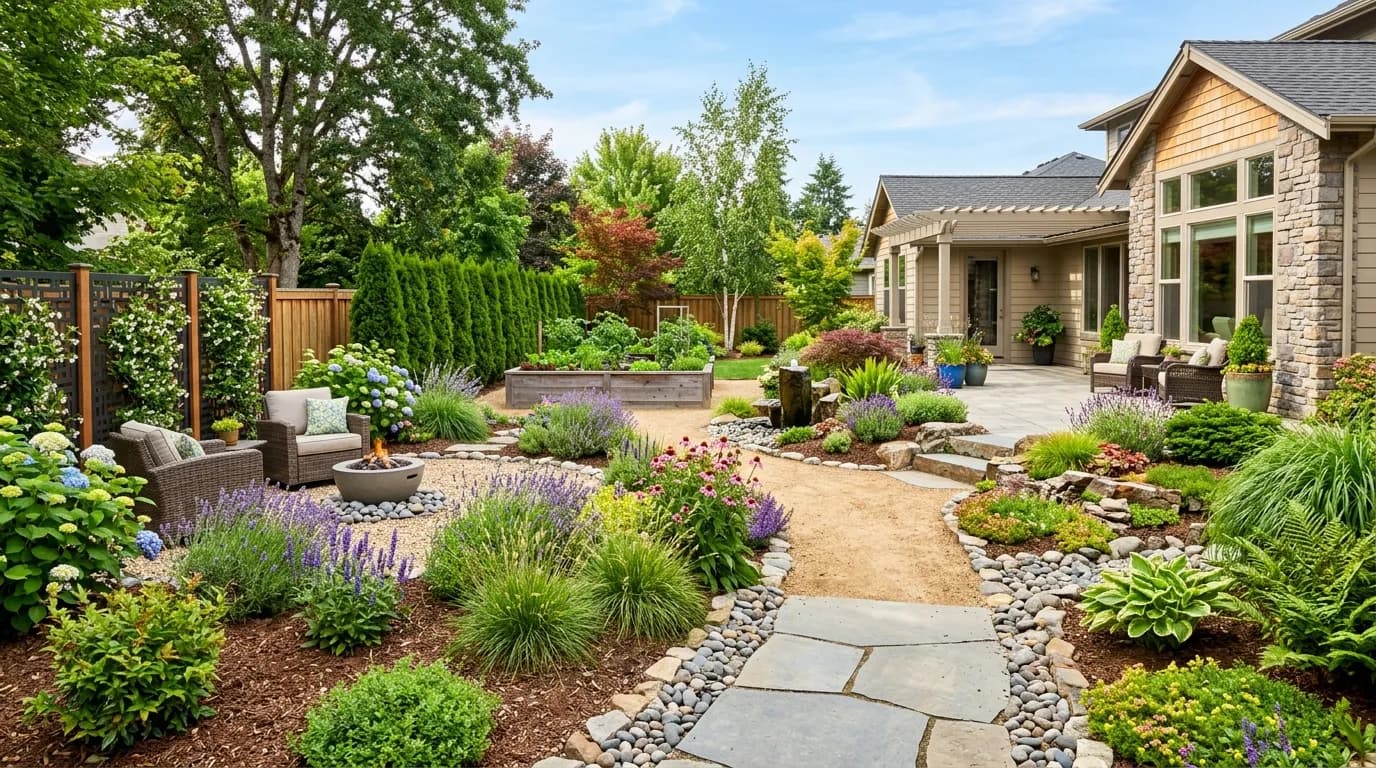
Most homeowners want the same thing: a backyard that looks great without consuming every free weekend. The good news? With the right design choices, you can cut yard maintenance by 70–80% while actually improving how your yard looks. This guide covers 25 proven low maintenance backyard ideas, organized by approach — from planting strategies to hardscaping choices that do the work for you.
Why Most Backyards Are High-Maintenance Traps
Traditional backyard design was built around the lawn. A big green lawn requires mowing every 5–7 days in summer, watering 1–2 inches per week, fertilizing 2–4 times per year, edging, aerating, overseeding — and that's before you count fighting weeds, grubs, and brown patches. Add in high-maintenance annual plantings that die every fall and need replanting every spring, and the average homeowner spends 150–200 hours per year on yard work.
Low maintenance backyard design flips this model. Instead of fighting your yard's natural conditions, you work with them. The result: a yard that gets better every year as plants mature, soil health improves, and everything fills in naturally.
1. Replace Turf with Native Groundcovers
Lawn is the single biggest maintenance driver in any backyard. Even replacing half your lawn area with a low-growing native groundcover cuts your yard work in half. Great options by region:
- Northeast/Midwest: Wild ginger, creeping phlox, Pennsylvania sedge (stays 4–6 inches without mowing)
- South/Southeast: Liriope, society garlic, creeping thyme
- Pacific Northwest: Kinnikinnick, low-growing Oregon grape, native sedge
- Southwest: Buffalograss, blue grama, desert marigold
These plants establish in 1–2 seasons and require zero mowing, minimal irrigation once established, and no fertilizer.
2. Build a Decomposed Granite Patio Area
A DG (decomposed granite) patio or pathway is one of the most cost-effective ways to eliminate maintenance. It's permeable (manages stormwater naturally), stays cool underfoot, looks naturally elegant, and requires essentially zero upkeep besides occasional raking. Cost: $1–$3 per square foot for DIY installation.
3. Install a Drip Irrigation System on a Timer
If you're going to have any planted beds, drip irrigation is non-negotiable for low maintenance. A properly designed drip system eliminates hand-watering entirely, cuts water use by 30–50% versus sprinklers, and delivers moisture directly to roots where it's most effective. Add a smart controller (like Rachio or RainBird) and the system adjusts automatically based on rainfall and evapotranspiration data. Setup cost: $200–$600 DIY, $800–$2,000 professionally installed.
4. Choose Native Shrubs That Never Need Pruning
Ornamental shrubs are a common maintenance trap — boxwood, arborvitae, and privet all look great but require frequent shearing to stay tidy. Swap them for naturally compact, slow-growing natives that maintain their shape without any intervention:
- Inkberry Holly (Ilex glabra) — stays 4–6 feet, berries for birds, no pruning needed
- Dwarf Fothergilla — 2–3 feet, spectacular fall color, never needs shearing
- Serviceberry (Amelanchier) — edible berries, multi-season interest, self-maintaining
- Dwarf Spirea — stays 2–3 feet, flowers reliably, zero maintenance after planting
5. Use Mulch Generously (4-Inch Depth)
A 4-inch layer of shredded wood mulch does the work of weeding for you. At this depth, weed germination drops by 90%+, soil moisture is retained (cutting watering by 25–30%), and soil temperature is regulated. Refresh every 2–3 years as mulch breaks down. Cost: $3–$7 per bag, or buy bulk for large areas.
6. Build a Raised Bed Vegetable Garden with Clean Borders
If you want to grow food, raised beds are the low maintenance solution. Define the bed with cedar or composite lumber, fill with high-quality amended soil, and mulch paths between beds with wood chips or gravel. You'll never deal with soil compaction, tilling, or grass encroachment. One weekend of setup → years of easy gardening.
Want to see all 25 ideas visualized on your actual yard? [Generate a free AI landscape design](/redesign) in 60 seconds — upload a photo and get 3 low-maintenance backyard concepts with full plant lists and cost estimates.
7. Add a Permeable Paver Patio
Traditional concrete patios crack, stain, and eventually heave. Permeable concrete or stone pavers last 30+ years, allow rainwater to percolate naturally (no puddling), and are easy to repair if needed — you just lift and replace individual pavers. The key to low maintenance: a high-quality polymeric sand jointing compound that prevents weeds from growing between pavers.
8. Plant Ornamental Grasses as Year-Round Structure
Ornamental grasses are the ultimate low maintenance plant. Plant them once, cut them back to 4–6 inches in late February, and ignore them the rest of the year. They provide dramatic movement and texture in summer, golden structure in fall, and snow-catching form in winter:
- Karl Foerster Feather Reed Grass — 4–6 feet, upright, architectural, zones 4–9
- Blue Oat Grass — 18 inches, silver-blue, evergreen in warm zones
- Prairie Dropseed — 18 inches, fragrant flowers, stunning orange fall color
- Muhly Grass — 3–4 feet, pink autumn plumes, southeast native
9. Create a "No-Mow Zone" with Meadow Planting
Designate one corner or back section of your yard as a mini meadow. Sow native wildflower and grass seed, add a simple split-rail fence or natural boulder border, and let it naturalize. After two seasons, this area requires one cutting per year (in late winter) versus the 20–25 mowings a lawn needs. It also becomes habitat for birds, butterflies, and beneficial insects.
10. Add a Fire Pit with Surrounding Gravel or Flagstone
A well-designed fire pit area creates a backyard focal point that's inherently low maintenance. A circle of irregular flagstone or decomposed granite surrounds the pit, eliminating any grass or plantings that would require attention. Add 3–4 Adirondack chairs, a few drought-tolerant ornamental grasses in pots for seasonal color, and you have an outdoor living room with essentially zero upkeep.
11. Espalier Fruit Trees Along a Fence Line
Espalier — training fruit trees flat against a fence or wall — is one of the most beautiful and practical low maintenance approaches to productive landscaping. A single espalier apple or pear produces fruit in a fraction of the space of a standard tree, requires only one annual pruning session, and acts as a living privacy screen. Perfect for narrow side yards or fence lines.
12. Install Landscape Lighting on Smart Timers
Low-voltage LED landscape lighting (solar or wired) requires almost zero maintenance: one bulb replacement every 7–10 years, and zero wiring complexity with solar options. Smart timers automatically adjust for seasonal changes in sunset time. Lighting transforms a backyard from usable only during daylight to an evening space year-round — dramatically increasing your enjoyment without adding any work.
13. Choose Perennials Over Annuals Everywhere
This is the highest-leverage single swap in low maintenance gardening. Annual plants — impatiens, marigolds, petunias — look great but die every fall and must be replanted every spring (plus they need regular deadheading and fertilizing all season). Perennials come back every year, spread to fill gaps over time, need no replanting, and generally require less fertilizing because their root systems are established. One initial investment; years of return.
14. Add a Rain Garden for Zero-Effort Stormwater Management
If your yard has a drainage challenge — areas that puddle after rain, water flowing toward the house — a rain garden solves it naturally with zero ongoing maintenance. A shallow planted depression (12–18 inches deep) with native water-tolerant plants captures runoff, filters pollutants, and recharges groundwater. After a one-time installation, it's entirely self-sustaining.
15. Use Raised Bed Edges and Metal Edging to Define Boundaries
Nothing adds more visual polish to a low maintenance yard than clean, defined edges between lawn, beds, and hardscaping. Cor-ten steel edging or black aluminum edging costs $2–$4 per linear foot, lasts 20+ years, and eliminates the need to edge with a trimmer along the same line repeatedly. Install it once; the clean line maintains itself.
16. Plant a Hellebore Border for Year-Round Interest
Hellebores (Lenten roses) are the ultimate no-care perennial for shaded areas. They're evergreen in most zones, bloom February through April when nothing else does, multiply slowly on their own over years, require zero deadheading (the seed heads are beautiful), and are deer-resistant. Plant once under a tree canopy and enjoy them for 20+ years without any intervention.
17. Create a Pebble or River Rock Accent Bed
A river rock accent bed along a fence line or foundation does double duty: it looks beautiful AND eliminates a high-maintenance edge zone. Lay landscape fabric, cover with 4–5 inches of river rock, and plant a few dramatic specimens (agave, ornamental grass, or a dwarf conifer) for vertical interest. Maintenance: zero beyond the initial installation.
18. Train a Climbing Vine on an Existing Fence
If you have an ugly fence that needs softening, a climbing vine is the highest-impact, lowest-maintenance solution. Clematis, climbing hydrangea (for shade), or native Virginia creeper will cover 10–15 linear feet of fence per plant with minimal attention. Prune once per year in late winter. One plant = a transformed fence in 2–3 seasons.
19. Add Evergreen Shrubs for Winter Structure
The classic mistake: planting a gorgeous summer garden that turns into bare brown sticks in winter. Evergreen structure plants (boxwood alternatives like inkberry, yew, or Japanese plum yew) hold the garden's architecture year-round, meaning your backyard looks intentional in January, not abandoned.
20. Build a Dry Creek Bed for Natural Drainage
Where traditional drainage solutions require pipes, gravel sumps, and maintenance, a dry creek bed is a natural, beautiful alternative. River rocks arranged in a naturalistic channel guide water flow away from problem areas while creating a year-round landscape feature. Plant ornamental grasses and water-tolerant natives along the edges, and you have a design element that's completely self-managing.
21. Use Raised Planters for Seasonal Color Instead of In-Ground Annual Beds
A pair of large planters flanking a back door or patio allows you to have seasonal color without committing your entire planting bed. Swap the plantings twice a year (spring and fall) with minimal effort — a few minutes and a bag of annuals. The rest of your beds stay perennial and permanent.
22. Plant a Native Pollinator Garden Strip
A 3-foot-wide strip of native wildflowers and prairie plants along any sunny fence line requires one mowing per year and dramatically reduces the amount of lawn you're maintaining. Candidates for any region: coneflower, black-eyed Susan, native salvia, wild bergamot, and goldenrod. These plants also support 4–10x more wildlife than traditional ornamental plantings.
23. Add Stepping Stones Through Planted Areas
If you need to navigate through a planted area for any reason (to reach a spigot, get to a side gate, access a compost bin), a path of stepping stones or irregular flagstone eliminates worn grass and muddy patches. Pick stones 18–24 inches diameter, set them into the ground so the top surface is flush with grade, and plants can grow right up to the edges.
24. Select Disease-Resistant Plant Varieties
Many of the most beautiful garden plants are also the most high-maintenance because they're prone to disease and pest pressure. Roses spray weekly, euonymus gets scale, arborvitae attract bagworms. Choosing disease-resistant varieties from the start eliminates most of this: Knock Out roses (zero spray), Endless Summer hydrangea (blooms on old and new wood), native dogwood varieties (no anthracnose issues). One design decision; years of saved time.
25. Get an AI Design That Optimizes for Low Maintenance
The biggest factor in how much time your backyard takes is design. A poorly laid-out yard — with awkward grass strips, shallow beds that dry out, plants in the wrong light conditions, or drainage problems that cause replanting — will always be high maintenance no matter how individual plants are chosen. A thoughtfully designed backyard eliminates these structural inefficiencies from the start.
Yardcast's AI landscape designer lets you visualize a complete low maintenance backyard redesign in 60 seconds — free, before you commit to anything. Upload 2–4 photos of your current yard, choose your low maintenance priorities (minimal watering, no-mow zones, hardscaping percentage), and get 3 distinct design directions with full plant lists optimized for your climate zone, sun exposure, and soil type.
Quick-Start Low Maintenance Backyard: 3 Actions This Weekend
If you want results fast without a full redesign, these three high-impact actions make a measurable difference:
- 1Lay 4 inches of mulch in every existing planted bed. Eliminates 80% of weeding immediately.
- 2Outline one lawn area to convert to groundcover or gravel this season. Start with the hardest-to-mow spots (slopes, narrow strips, under trees).
- 3Get a design plan — use Yardcast to generate a free concept, then decide which elements to phase in over 1–2 seasons.
The best low maintenance backyard isn't one that requires zero work — it's one designed so that the work you do is meaningful, efficient, and yields visible results. Plan first, then plant.