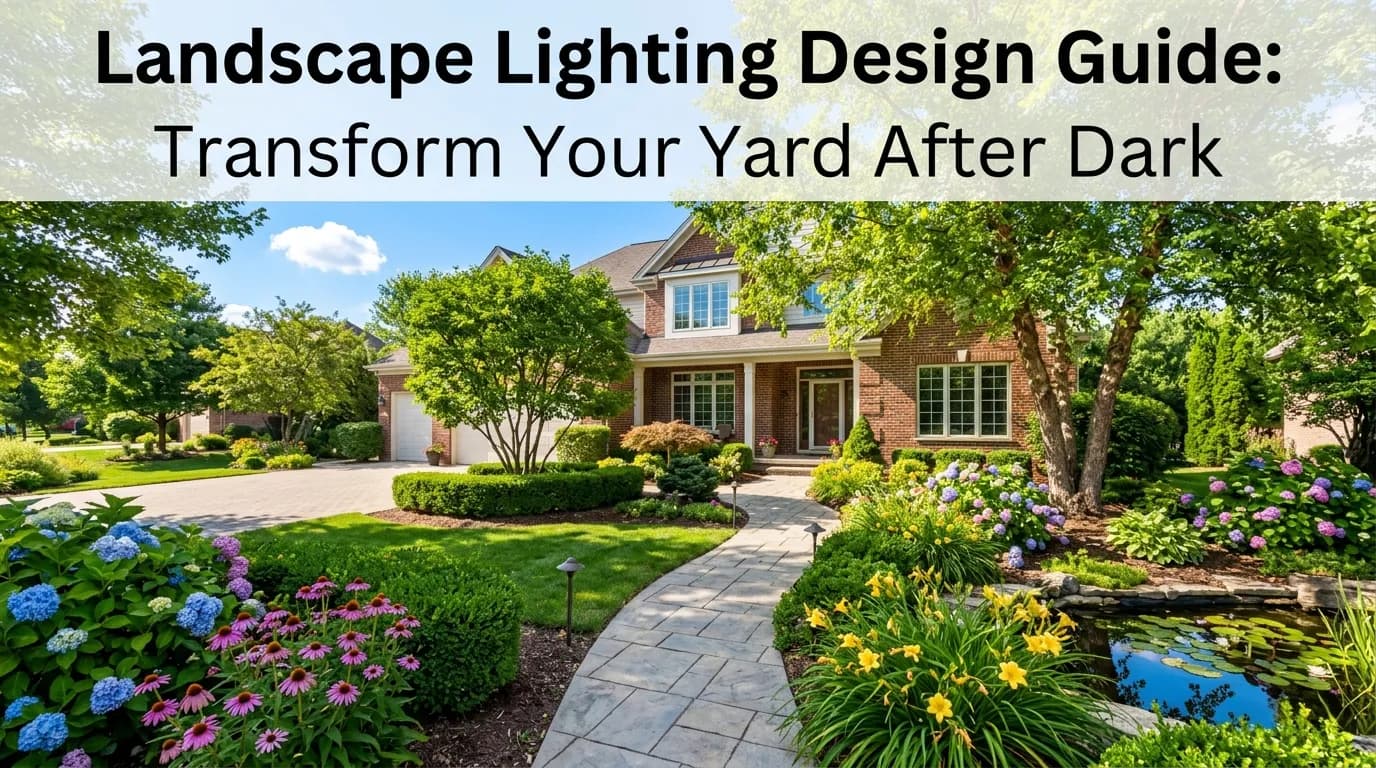
Most homeowners stop thinking about their yard when the sun goes down. But nighttime is when landscape lighting creates a completely different experience — and adds measurable value to your home.
Professional landscape lighting increases home value, enhances security, extends the usable hours of your outdoor space, and provides a visual experience that daylight can't match.
Here's how to design landscape lighting that looks intentional, not like random solar stakes scattered around the yard.
The Three Goals of Landscape Lighting
Safety: Illuminating paths, stairs, and entry areas to prevent falls. This is the minimum — what most homeowners do with cheap path lights.
Security: Reducing hiding spots around the property perimeter, activating motion detection, creating the impression of occupancy.
Aesthetics: This is what elevates a property. Using light to highlight architecture, specimen plants, and landscape features in ways that create a curated nighttime experience.
Most landscape lighting projects should achieve all three. Focus your budget on aesthetics — safety and security are byproducts.
The 7 Types of Landscape Lighting
1. Uplighting
Fixtures placed at the base of trees, large shrubs, or architectural features, pointed upward. Creates drama and the illusion of height. The most impactful technique in landscape lighting.
Best for: Specimen trees, architectural columns, tall hedges, flag poles.
Key rule: Use warm white (2700K–3000K) for deciduous trees. Cooler white (4000K) for stucco or white architectural elements.
2. Downlighting / Moonlighting
Fixtures mounted high in trees, pointing downward. Simulates the effect of moonlight filtering through branches. Creates soft, dappled light patterns on the ground.
Best for: Seating areas under mature trees, dining areas, anywhere you want soft ambient light without visible fixtures.
Installation note: Requires fixtures mounted 15–25 feet up in the tree. Best done by a professional electrician.
3. Path Lighting
Low-voltage fixtures along walkways, driveways, and garden paths. The most common landscape lighting — and the most often done poorly.
Key design mistake: Runway effect. Two straight lines of identical fixtures make a path look like an airport runway. Instead: alternate sides, vary spacing slightly, mix path lights with other fixture types.
Better approach: Place path lights at each significant turn or transition. Fill with uplighting on adjacent plants rather than relying entirely on path lights.
4. Accent Lighting / Spotlighting
Directed beams highlighting specific plants, stones, or architectural details. More focused than uplighting — typically a narrower beam angle (15–30 degrees).
Best for: Japanese Maple, specimen stones, entry features, unique plants.
5. Well Lights
In-grade fixtures set flush with ground or hardscape surface. Clean, unobtrusive, excellent for uplighting trees on patios where aboveground fixtures would be tripped on.
Best for: Patios, driveways, formal gardens where aboveground fixtures would be visible and awkward.
6. String Lights / Festoon Lighting
Edison bulb or LED string lights suspended between structures. Creates a warm, social atmosphere. Almost mandatory for outdoor entertaining spaces.
Use: Over dining areas, fire pits, and outdoor kitchens. 3000K warm white only — cool white looks institutional.
Hang from: Posts, pergola beams, trees, or custom-installed wire between poles.
7. Step and Wall Lighting
Fixtures integrated into steps, retaining walls, and raised beds. Creates visual depth and safety simultaneously. LED strip lights inside a step riser or small directional fixtures on step faces.
Designing Your Lighting Plan
Start with the focal points. List the 3–5 most important visual elements in your yard (specimen tree, architectural feature, entry, dining area). These get primary lighting budget.
Work outward. Path and safety lighting fills in around the focal points.
Avoid over-lighting. The most common DIY mistake. Dark areas between lit elements create contrast and make lit elements pop. A yard with every surface lit equally looks flat and institutional.
Color temperature consistency. Warm white (2700K–3000K) throughout. Don't mix warm and cool — it looks uncoordinated.
Layer the light. Vary fixture height and light direction. Combine uplighting, moonlighting, and path lighting in the same area for depth.
Wired vs. Solar vs. Low-Voltage Systems
Wired 120V: Maximum brightness, maximum reliability, professional installation required. Best for permanent whole-property systems.
Low-voltage (12V): DIY-friendly, easily repositioned, daisy-chain installation. Less bright than line voltage. The most popular landscape lighting system.
Solar: Zero installation cost, zero electricity cost, but unreliable output, lower quality light, and limited placement flexibility (must have 6+ hours sun). Best for casual path lighting in areas not suited to wiring.
Budget Guide
Minimum effective system (front entry + 1 tree): $300–$600 DIY with quality low-voltage fixtures.
Mid-range front yard (5–8 fixtures, timer, transformer): $800–$1,500 DIY; $1,500–$3,000 installed.
Full property (front + back, multiple tree uplights, path lighting, dining): $3,000–$8,000 installed.
Your Landscape Lighting Plan
Your Yardcast design pack includes a complete lighting plan for your yard — uplighting positions, path lighting layout, fixture type recommendations, and electrical load calculation. Bring it to any electrician or lighting installer.