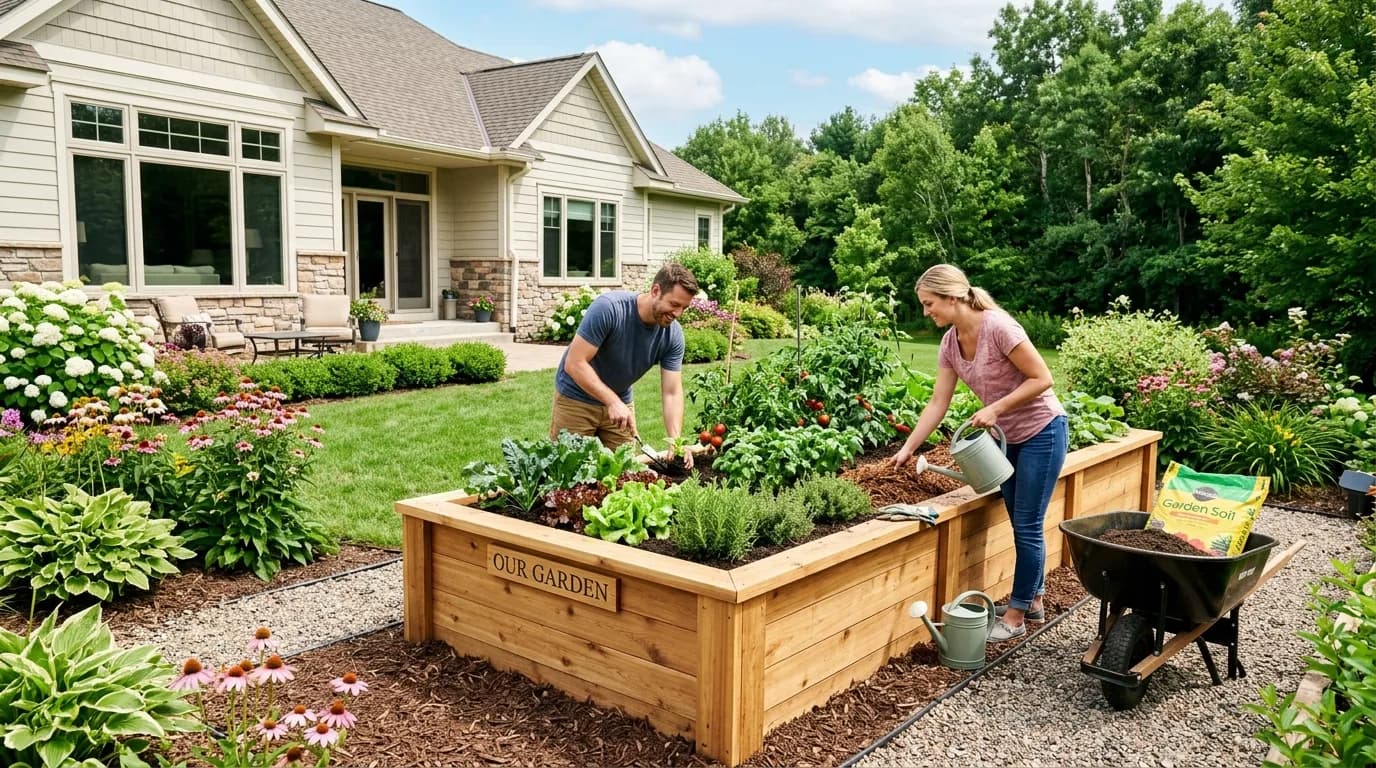
A raised garden bed is the single best upgrade you can make to a home landscape. You control the soil, drainage is excellent, weeds are minimal, and you can start growing food or flowers almost anywhere — even on concrete or hard clay. Better yet, a solid 4×8 cedar bed costs $80–$150 in materials and takes about 2–3 hours to build.
This guide covers everything: choosing materials, sizing your bed, filling it with the right soil, and planting for maximum production. Whether you're a first-time gardener or adding your fifth bed, this is the complete reference.
Why Raised Beds Outperform In-Ground Gardens
Before the how-to, understand why raised beds work so well:
Better soil from day one. You fill with a custom mix — not the clay, compaction, or contamination that plagues most backyards. Plants establish faster and produce more in loose, nutrient-dense soil.
Fewer weeds. Weed seeds blow in from above, but you're not starting with a seed bank already in the ground. A 3-inch mulch layer handles the rest.
Better drainage. Water moves through freely. No standing water, no root rot. Even heavy clay lots can grow vegetables above grade.
Warmer soil. Raised beds warm up 2–3 weeks earlier in spring than in-ground soil. More growing days per season.
Ergonomics. A 12-inch-tall bed puts your plants at a comfortable working height. A 24-inch bed (ADA-accessible height) eliminates bending entirely.
Defined space. Clean edges separate your growing area from lawn. No creeping grass, no muddy paths through the garden.
Choosing Materials: The Complete Comparison
| Material | Cost (4×8 bed) | Lifespan | Safety | Best For |
|---|---|---|---|---|
| Cedar (untreated) | $80–$140 | 10–15 years | Safe for food | All-purpose, most popular |
| Douglas fir (untreated) | $40–$70 | 4–7 years | Safe for food | Budget builds |
| Redwood | $120–$180 | 20+ years | Safe for food | Premium builds |
| Composite lumber (Trex) | $150–$250 | 25+ years | Safe for food | Low-maintenance |
| Galvanized steel kit | $120–$200 | 20–30 years | Safe (no zinc leach at food levels) | Modern look |
| Cinder blocks | $40–$80 | Indefinite | Safe for food (avoid older blocks) | Budget, adjustable layout |
| Corrugated metal | $80–$150 | 15–20 years | Safe for food | Contemporary, low-profile |
What to avoid: Pressure-treated wood with CCA (chromated copper arsenate) — common in older lumber. All modern pressure-treated lumber uses ACQ or CA, which the EPA considers safe for raised beds, but many gardeners still prefer naturally rot-resistant untreated cedar or redwood for food gardens. Never use railroad ties or telephone poles (creosote contamination).
Best overall pick: 2×10 or 2×12 rough-sawn cedar. Naturally rot-resistant, no chemical treatment needed, beautiful weathered gray color after a season, and lasts well over a decade.
Sizing Your Raised Bed
Width: Maximum 4 feet. This lets you reach the center from both sides without stepping into the bed. If it's against a wall or fence, keep it 2 feet wide so you can reach from one side only.
Length: 8 feet is the sweet spot — fits standard lumber lengths (no waste), workable without feeling like you're walking forever, and easy to cover with row fabric or a hoop house. 12 feet works too if you have the space.
Height:
- 6 inches — minimal lumber, works well for deep-rooted vegetables if your native soil is decent
- 12 inches — the sweet spot for most vegetables and flowers; deep enough for roots, high enough to see
- 18–24 inches — accessible gardening; works on patios and hard surfaces; no bending
Spacing: Leave at least 24 inches between beds for comfortable access with a wheelbarrow. 36 inches is ideal.
What You'll Need to Build a Standard 4×8 Bed
Materials
- 3 boards of cedar 2×10×8 (rip two of them into 4-foot lengths for the ends; use one full board for each 8-foot side — you'll need 4 total 8-foot boards and 4 4-foot end boards for a 12-inch-tall bed)
- Or simpler: Buy four 2×10×8 boards and two 2×10×4 boards for a single-course 10-inch-tall bed
- 2½-inch exterior screws (stainless or hot-dipped galvanized for longevity)
- Landscape fabric (optional — prevents weeds and gopher infiltration from below)
- Corner brackets (optional but make assembly foolproof)
Tools
- Circular saw or miter saw
- Drill/driver
- Speed square
- Measuring tape
- Level
- Shovel (for site prep)
Cost Estimate
| Item | Cost |
|---|---|
| Cedar 2×10×8 boards (4) | $60–$90 |
| Cedar 2×10×4 boards (2) | $20–$35 |
| Stainless screws (box) | $8–$12 |
| Landscape fabric | $10–$15 |
| Total | $98–$152 |
Galvanized steel kits from Birdies or Vego Garden run $120–$200 all-in and assemble in under 30 minutes with no tools.
🌿 Already planning a larger landscape project? [Get 3 AI-generated yard design concepts in under 60 seconds →](/redesign)
Step-by-Step: Building Your Raised Bed
Step 1: Choose and Prepare the Site
Pick a spot that gets 6–8 hours of direct sun per day — essential for most vegetables. Morning sun is preferred to afternoon sun if you must choose.
Clear the area of grass and weeds. If you're placing the bed on lawn, lay cardboard or newspaper directly on the grass and wet it down — this smothers the grass without digging (lasagna method). The cardboard decomposes in 2–3 months.
Check that the ground is reasonably level with a long level or a string line. Minor slopes (up to 1 inch over 4 feet) are fine — you can compensate when filling. Bigger slopes need leveling or stepped terracing.
Step 2: Cut Your Lumber
For a 4×8 bed with 10-inch-tall boards (one course of 2×10):
- Two boards at 8 feet (sides)
- Two boards at 4 feet (ends)
- No cuts needed if you buy pre-cut 4-foot boards
For a 12-inch-tall bed (one course of 2×12 or two courses of 2×6):
- Same dimensions, different board width
Mark and cut with a circular saw if needed. Cedar cuts easily — no special blade required.
Step 3: Assemble the Frame
Lay out your four boards in a rectangle on a flat surface. Position the end boards inside the long sides (this creates a clean corner and the 4-foot measurement accounts for board thickness automatically).
Pre-drill pilot holes 1 inch from the ends of your end boards (prevents splitting). Drive two 2½-inch screws per corner through the end board into the long side board.
Check that corners are square — measure diagonally from corner to corner. Both diagonal measurements should be equal. Adjust before tightening screws fully.
For extra strength, add corner brackets on the inside. These are optional for a single-course bed but helpful for tall 18–24-inch beds.
Step 4: Position and Level the Bed
Place your assembled frame in its final location. Use a 4-foot level to check that the top edge is level — this matters for irrigation and even water distribution.
If the site isn't perfectly level, dig down slightly on the high side rather than shimming up the low side. The bottom board should have full contact with the ground for stability.
Step 5: Line with Landscape Fabric (Optional)
Landscape fabric on the bottom prevents weeds from growing up through the soil and blocks gophers and voles in areas where they're a problem. Use a 3–4 oz woven fabric — not the cheap plastic sheet kind.
Staple or fold it up the inside edges 2–3 inches. Trim excess. Some gardeners skip fabric entirely and rely on cardboard smothering plus regular mulching — both work.
Step 6: Fill with the Right Soil
This is the most important step. Never fill a raised bed with straight topsoil or garden soil — both compact too much.
The classic Mel's Mix (Square Foot Gardening formula):
- ⅓ peat moss or coco coir (aeration, water retention)
- ⅓ coarse vermiculite or perlite (drainage, prevents compaction)
- ⅓ compost blend (5+ sources = more complete nutrition)
This mix is expensive (~$4–$8 per cubic foot) but produces exceptional results.
The budget blend:
- 50% good quality topsoil
- 30% compost
- 20% perlite or coarse sand
How much soil do you need?
| Bed Size | 10" depth | 12" depth | 18" depth |
|---|---|---|---|
| 4×4 | 11 cu ft | 13 cu ft | 20 cu ft |
| 4×8 | 22 cu ft | 26 cu ft | 40 cu ft |
| 4×12 | 33 cu ft | 40 cu ft | 60 cu ft |
Bags of soil are 1–2 cubic feet each. Bulk delivery (by the yard = 27 cubic feet) is more economical for multiple beds.
Allow the soil to settle 2–3 inches before planting. Top off as needed.
Step 7: Mulch and Plant
After filling, apply a 2–3 inch layer of mulch over the entire surface before planting. This locks in moisture and suppresses weeds. Remove mulch from planting holes as you go.
In vegetable beds, many gardeners skip mulch and plant intensively using square-foot spacing — dense plantings shade out weeds naturally.
Plant Spacing for Raised Beds
Raised beds let you plant more densely than traditional rows because there's no need for equipment access. Use these spacings:
| Plant | Spacing |
|---|---|
| Tomatoes | 18–24 inches |
| Peppers | 12–18 inches |
| Zucchini | 24 inches |
| Lettuce | 6–8 inches |
| Spinach | 4–6 inches |
| Kale | 12 inches |
| Carrots | 3–4 inches |
| Radishes | 3 inches |
| Basil | 8–12 inches |
| Onions | 4 inches |
| Beans | 4–6 inches |
| Cucumbers | 12 inches (vertical) |
Making Your Raised Bed Part of a Beautiful Landscape
A raised bed doesn't have to look utilitarian. With the right design context — gravel paths, a low fence, companion flowers along the edges — kitchen gardens can be beautiful enough to anchor an entire backyard design.
Key design principles:
- Repeat materials. Use the same cedar or steel in raised beds AND nearby pergola posts, edging, or planters for a cohesive look.
- Create a path system. Gravel, stepping stones, or compacted decomposed granite between beds reads as an intentional design rather than an afterthought.
- Add height. A central trellis or obelisk for tomatoes, cucumbers, or pole beans gives vertical structure that makes the garden feel designed.
- Frame with flowers. A border of marigolds, zinnias, or nasturtiums along the outside edge of a raised bed brings pollinator support and serious visual impact.
If you're planning a larger yard design around raised beds — or want to see how a kitchen garden fits into your full landscape — try Yardcast's AI design tool. Upload your yard photos, answer a few questions, and get 3 concept designs in under a minute.
Year-Round Raised Bed Calendar
| Month | Task |
|---|---|
| January–February | Plan layout, order seeds |
| March | Start seeds indoors; direct sow cool crops (spinach, peas) |
| April–May | Transplant tomatoes, peppers (after last frost) |
| June–August | Succession plant lettuce; harvest regularly; water 1–2×/week |
| September | Plant fall crops: garlic, kale, chard, spinach |
| October–November | Harvest; cut back; top with 2 inches compost |
| December | Rest; plan next year |
Cost Comparison: DIY vs. Pre-Built Kits vs. Hiring Out
| Option | 4×8 Bed Cost | Time |
|---|---|---|
| DIY cedar build | $98–$152 | 2–3 hours |
| Galvanized steel kit | $120–$220 | 30–60 minutes |
| Composite/Trex kit | $200–$350 | 1–2 hours |
| Custom contractor build | $300–$600 | None |
DIY builds are genuinely approachable for anyone who can drive a screw. Pre-built steel kits are the easiest entry point — high quality, long-lived, no cuts required.
Design your full outdoor space to see how raised beds fit into your yard's layout →
Related: [Raised Garden Bed Ideas](/blog/raised-garden-bed-ideas) · [Raised Vegetable Garden Ideas](/blog/raised-vegetable-garden-ideas) · [Companion Planting Guide](/blog/companion-planting-guide) · [Soil Testing Guide](/blog/soil-testing-guide)