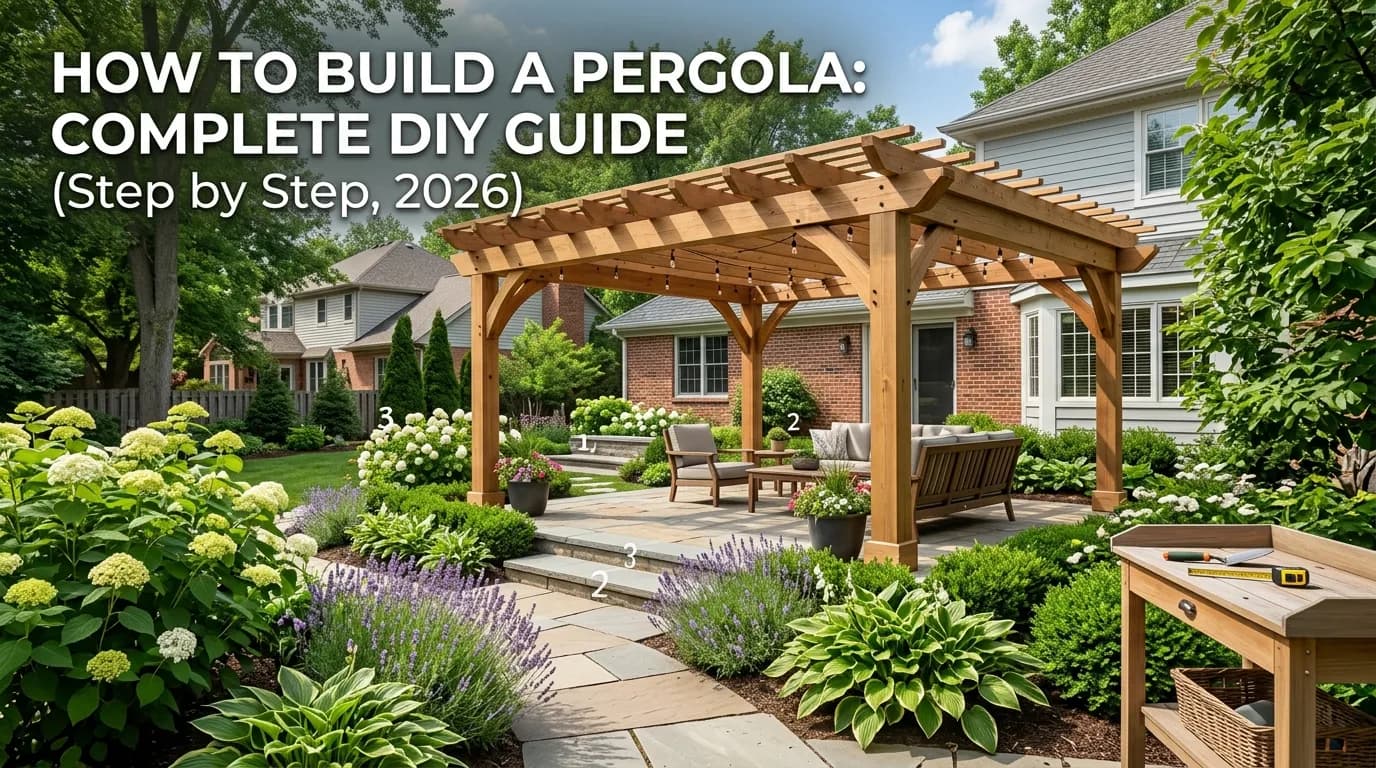
A pergola is one of the highest-impact additions you can make to any outdoor space. It defines a room, creates shade, supports climbing plants, and adds structure where there was only open sky. And unlike a full covered patio, it's a project most determined homeowners can tackle themselves — or hire out for a fraction of what an enclosed structure costs.
This guide walks you through everything: planning your pergola, choosing materials, calculating costs, and a step-by-step construction sequence that works for 10×10, 12×16, and larger footprints.
What Is a Pergola?
A pergola is an open-roof outdoor structure supported by posts with a latticed or beamed roof. Unlike a gazebo (which has a solid roof) or a patio cover (fully enclosed), a pergola creates partial shade while keeping an open, airy feel. Climbing plants like wisteria, roses, or clematis often grow up and over the structure, creating a living canopy.
Common uses:
- Outdoor dining and entertainment areas
- Poolside lounge structures
- Garden focal points and walkway tunnels
- Covered areas for outdoor kitchens
Pergola Cost Overview
Before you start building, understand the cost landscape:
| Type | DIY Material Cost | Professional Install |
|---|---|---|
| Kit pergola (10×10) | $1,200–$3,500 | $3,000–$6,000 |
| Kit pergola (12×16) | $2,500–$6,000 | $5,000–$10,000 |
| Custom wood pergola | $2,000–$8,000 | $5,000–$15,000 |
| Aluminum pergola | $3,000–$9,000 | $6,000–$16,000 |
| Vinyl pergola | $2,000–$6,000 | $4,500–$12,000 |
| Attached pergola (house-mounted) | $1,800–$7,000 | $4,000–$12,000 |
Labor alone for professional pergola installation runs $50–$100/hour, with most projects taking 2–4 days.
Want to see what a pergola would look like in your actual backyard? [Get 3 AI landscape designs with your pergola included — free to preview →](/redesign)
Step 1: Plan Your Pergola
Choose the Right Size
Standard pergola sizes:
- 10×10: Fits a bistro table for 4. Good starter size.
- 12×12: Comfortable for a dining table for 6.
- 12×16: Fits a full dining set plus lounge area.
- 16×20+: Large entertainment space, often anchored to the house.
Sizing rule: Allow 2 feet of clearance on all sides between the table/furniture and the posts.
Freestanding vs. Attached
Freestanding pergolas stand alone in the yard with 4+ posts. More versatile in placement — you can position them over a patio, beside a pool, or in a garden.
Attached (lean-to) pergolas connect to the house with a ledger board. They extend your home's living space and often feel more architecturally integrated — but require proper flashing to prevent water intrusion.
Permit Requirements
Most municipalities require a building permit for permanent pergolas. Typical triggers:
- Structure attached to the house
- Post footings deeper than 18 inches
- Structures over 200 square feet
Always check with your local building department before starting. Unpermitted structures can create problems when you sell your home.
Choose Your Material
| Material | Pros | Cons | Lifespan |
|---|---|---|---|
| Pressure-treated pine | Affordable, strong, widely available | Needs sealing/staining, can warp | 15–30 years |
| Cedar | Naturally rot-resistant, beautiful grain | More expensive than PT pine | 20–40 years |
| Redwood | Premium look, excellent durability | Expensive, harder to find | 25–50 years |
| Vinyl/PVC | No maintenance, won't rot or fade | Less natural look, limited customization | 30+ years |
| Aluminum | Lightweight, won't rot or rust, powder coated | Can feel less substantial, higher upfront | 30+ years |
| Douglas fir | Strong, more affordable than cedar | Needs more sealing, heavier | 15–25 years |
Best choice for most DIYers: Cedar or pressure-treated pine. Cedar is worth the slight price premium for its natural look and rot resistance.
Step 2: Gather Materials and Tools
Materials for a Freestanding 12×12 Pergola (4 Posts)
- 4 posts: 6×6 lumber, 10–12 feet long
- 2 beams (ledgers): 2×8 or 2×10, 12–16 feet long
- 8–10 rafters: 2×6, 12–16 feet long
- 8–12 purlins (top slats): 2×2 or 2×4, cut to length
- Post bases or concrete footings
- Hardware: post base brackets, joist hangers, lag screws, carriage bolts, galvanized screws
- Post caps (decorative)
- Concrete (60 lb bags, ~3 per post hole)
- Stain, sealant, or paint
Tools Required
- Post hole digger or rented auger
- Level (4-foot and 2-foot)
- Tape measure
- Circular saw or miter saw
- Drill and impact driver
- Socket wrench or ratchet
- Speed square
- String line and stakes
- Safety glasses and gloves
- Ladder
Step 3: Lay Out and Dig Post Footings
Mark Your Layout
- 1Drive stakes at each corner of your pergola footprint
- 2Run string lines between stakes to define the perimeter
- 3Use the 3-4-5 method to confirm square corners: measure 3 feet along one side, 4 feet along the adjacent side — if the diagonal is exactly 5 feet, the corner is square
- 4Double-check by measuring both diagonals — they should be equal
Dig the Holes
Post hole depth depends on:
- Your local frost depth (go 6–12 inches below the frost line)
- Post height (minimum 1/3 of the post length in the ground)
- Local code requirements
General rule: For a 10-foot post, dig 36–42 inches deep. Hole diameter should be 3× the post width (18+ inches for a 6×6 post).
Set Posts in Concrete
- 1Add 4–6 inches of gravel to the bottom of each hole for drainage
- 2Set the post in the center of the hole
- 3Brace the post plumb in two directions using temporary 2×4 braces
- 4Mix concrete (follow bag instructions) and fill the hole
- 5Create a slight mound at the surface to shed water away from the post
- 6Let cure for 24–48 hours before loading with any weight
Alternative: Post base hardware (like Simpson Strong-Tie ABA post bases) sits on a concrete pier — keeps wood out of direct soil contact, extending life dramatically. This is the preferred method for most modern builds.
Step 4: Install the Beams
Beams run the length of the pergola on top of the posts, perpendicular to the rafters.
- 1Mark beam height on all posts using a level and chalk line — ensure all marks are at the same height
- 2Cut posts to the correct height (use a circular saw or hand saw, taking care to keep the cut level)
- 3Install post caps (decorative caps that create a saddle for the beam to sit in)
- 4Set beams into post caps or notched post tops
- 5Fasten with carriage bolts through the post — pre-drill and use washers and nuts
- 6For long beams over 10 feet, support the center with a temporary prop while bolting
Double beam trick: For spans over 12 feet, sandwich two 2×10s together (with spacers) instead of a single large timber. Lighter, easier to handle, and often stronger.
Step 5: Install the Rafters
Rafters run perpendicular to the beams, creating the main overhead structure.
- 1Space rafters 16–24 inches on center (closer spacing = more shade and a more dramatic look)
- 2Mark positions on both beams with a pencil and square
- 3Create decorative tails: Before installation, cut the rafter ends to a decorative profile — a common choice is a 45-degree angle, double arc, or stepped cut. Do all cuts before mounting.
- 4Attach with joist hangers or toe-screw into the beam at an angle
- 5Verify level as you go — a slight variation at the first rafter gets amplified by the last
Step 6: Install the Purlins (Top Slats)
Purlins run perpendicular to the rafters on top, completing the grid pattern.
- 1Space purlins 12–18 inches apart (tighter = more shade)
- 2Attach with galvanized deck screws at each rafter crossing
- 3Let purlins overhang the outer rafters by 6–12 inches for visual proportion
- 4For climbing plants: install eye bolts or horizontal wires between posts to guide plant growth
Step 7: Finishing Touches
Sanding and Sealing
Sand all cut ends and rough spots. Apply an exterior-grade wood stain, sealer, or paint. For cedar and redwood, a clear water-repellent sealer preserves the natural color. For pine, an opaque stain is more protective.
Add Lighting
- String lights: The easiest upgrade — run across rafters in a zigzag pattern
- Pendant lights: Wire a junction box to a rafter beam; hang one or two pendants above the table
- Solar post cap lights: No wiring required, sit on top of posts
Add Curtains, Shade Cloth, or a Canopy
- Outdoor curtain panels on tension rods between posts create privacy and shade
- Shade cloth (50–80% block) draped over the rafters significantly reduces summer heat
- Louvered or retractable canopy kits convert a basic pergola into an adjustable shade structure
Plant Climbing Vines
The best climbers for pergolas:
- Wisteria — fragrant, fast, dramatic; needs strong structure (it gets heavy)
- Climbing roses — classic, fragrant, hundreds of varieties
- Clematis — fast-growing, hundreds of colors, can be cut back hard
- Virginia creeper — native, very fast, stunning fall color
- Trumpet vine — native, hummingbird magnet, vigorous (contain it)
- Grapes — edible, beautiful, creates deep shade
Common Pergola Mistakes to Avoid
Skipping the permit: Unpermitted structures create headaches when selling and can be required to be removed. Get the permit.
Posts too shallow: In freeze-thaw climates, shallow footings heave and tip over time. Go below the frost line.
Undersized beams: A span of 12 feet or more with 2×6 beams will sag. Size up — use 2×8 or 2×10, or double up the boards.
Not checking plumb and square early: Small errors in post placement get magnified as you build up. Check square at the footing stage, not after the beams are up.
Forgetting wood movement: Wood expands and contracts with moisture. Pre-drill all holes slightly oversize and use exterior-grade hardware that won't rust and seize.
No maintenance plan: Even cedar needs resealing every 2–3 years. Factor in a maintenance schedule from the start.
How to Design Your Pergola Into the Larger Yard
A pergola looks best when it's designed as part of a cohesive outdoor space, not dropped in as an afterthought. Consider:
- Alignment: Orient the pergola so it connects naturally to the house door or existing patio
- Plantings: Frame the posts with climbing plants, ornamental grasses, or foundation shrubs
- Paving: Extend an existing patio or lay pavers beneath the pergola for a defined floor
- Sightlines: Position so the pergola frames a garden view, not a fence or utility area
Before you build, visualize the full picture: where does the pergola sit relative to the house? What's planted around it? How does it connect to the rest of the yard?
[See what your yard could look like with a pergola — get 3 free AI landscape designs at Yardcast →](/redesign)
Upload a photo of your yard, describe your style, and get three photorealistic designs in 60 seconds — each with a plant list, cost estimate, and contractor-ready layout.
FAQ: How to Build a Pergola
Q: Is building a pergola a good DIY project for beginners?
A: A basic freestanding pergola is manageable for a motivated DIYer with basic carpentry skills — the techniques are straightforward, though the posts and beams are heavy (working with a helper is essential). Kit pergolas simplify the process significantly. Allow 2–4 weekends for a typical 12×12 build.
Q: Do I need a permit to build a pergola?
A: Usually yes if the pergola is attached to the house, exceeds 200 square feet, or has footings deeper than 18 inches. Requirements vary by municipality — always check with your local building or planning department before starting.
Q: How long does a pergola last?
A: A well-built cedar pergola lasts 20–40 years with regular sealing every 2–3 years. Pressure-treated pine: 15–30 years. Vinyl and aluminum last 30+ years and are essentially maintenance-free.
Q: What size pergola should I build?
A: Match the pergola to your furniture. A dining table for 4–6 fits under a 12×12. A lounging area with sectional needs 14×16 or larger. Leave 2 feet of clearance between furniture and posts on all sides. When in doubt, go slightly larger — a pergola that feels cramped can't be expanded easily.
Q: How deep do pergola posts need to be?
A: Posts should be buried at least 1/3 of their total length underground, plus extend at least 6 inches below your local frost depth. For a 10-foot post in a region with a 30-inch frost depth, that means digging about 36–40 inches deep.
Q: Can I attach a pergola to my house?
A: Yes — attached pergolas use a ledger board bolted directly to the house framing. This requires proper flashing (a metal cap that diverts water away from the ledger) to prevent rot and moisture intrusion. Always attach to the structural framing, not just the siding.
Q: What's the difference between a pergola and a gazebo?
A: A gazebo has a solid roof (hexagonal or octagonal, fully covered) and is a freestanding structure. A pergola has an open lattice or beam roof that allows light through, and can be attached to a house. Pergolas are more flexible and less expensive; gazebos provide full weather protection.
Q: How much weight can a pergola hold?
A: A properly built pergola with 6×6 posts and correctly sized beams can support 500–1,000+ lbs of load (climbing plants, light fixtures, shade cloth). Wisteria is notoriously heavy as it matures — size your structure accordingly, and anchor posts in concrete rather than using post bases if you plan to grow heavy vines.