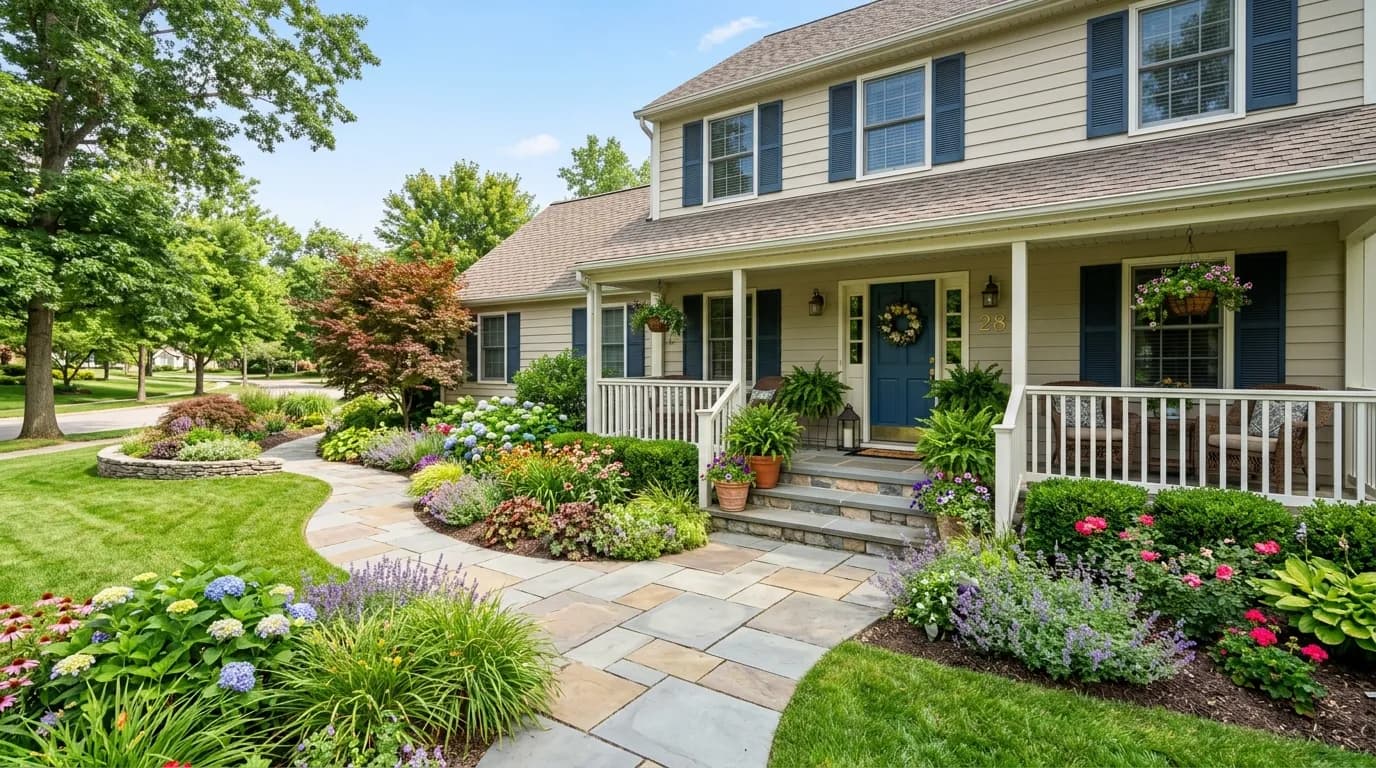
Your front porch and entry are the first things every visitor, neighbor, and potential buyer sees. More importantly, they're what you see every time you come home.
Good front porch landscaping doesn't have to be elaborate or expensive. It needs to do three things: welcome people in, frame the house well, and feel intentional. These 28 ideas show you exactly how to do that — for porches of every size, style, and budget.
Container and Pot Ideas
1. Classic Symmetrical Urn Planters
A matched pair of large urns flanking the front door is the single highest-impact front porch move available. Go large — most people under-scale containers. Use a thriller-filler-spiller combination: one tall spike or ornamental grass, seasonal flowers, and a trailing vine. Replant seasonally for year-round interest.
2. Clustered Heights: Three Pots, Three Sizes
A grouping of three containers in progressively smaller sizes — tall on the outside, medium in the middle, low in front — creates a layered composition that feels abundant without requiring a large planting bed. Use the same pot material and vary only size and plant height.
3. Window Box Under Porch Windows
Window boxes beneath porch-level windows visually lower the house, add horizontal emphasis, and maximize planting area without using floor space. Use brackets that complement the architectural style (black iron for Victorian, white wood for farmhouse, clean metal for modern). Plant densely — window boxes look best when overflowing.
4. Tall Topiaries as Door Sentinels
Matching boxwood or spiral topiary trees (or their faux counterparts for zero maintenance) flanking the door add formal structure and visual height without taking up horizontal space. Real topiaries require annual pruning; quality faux topiaries have improved dramatically and are appropriate in many contexts.
5. Seasonal Swap Containers
Designate a pair of statement containers for seasonal plantings that you refresh four times a year: spring tulips → summer petunias and calibrachoa → fall mums and ornamental cabbage → winter evergreen boughs and berries. The same containers at the same location provide year-round structure with constant seasonal freshness.
6. Hanging Baskets
Hanging baskets from porch ceiling hooks add vertical interest and color without using any floor space. Trailing petunias, calibrachoa, fuchsia (for shade), or trailing impatiens are all reliable choices. Use large baskets (16+ inches) — small baskets dry out quickly and look skimpy. Daily watering in summer is essential.
Planting Bed Ideas
7. Foundation Planting Refresh
If existing foundation planting looks tired, an editing-and-refresh is often more impactful than a complete replacement. Remove dead or overgrown shrubs, define bed edges cleanly, apply 3 inches of fresh mulch, and add a few seasonal accents. The crisp edge alone transforms the appearance before you change a single plant.
8. Layered Shrub Border
A layered foundation border uses tall shrubs at the house wall (5–7 feet), medium shrubs in front (3–4 feet), and low edging plants or groundcover at the bed edge. This stair-stepped silhouette reads as designed and sophisticated. Classic layering combinations: arborvitae + boxwood + mondo grass; viburnum + knockout rose + liriope; holly + hydrangea + pachysandra.
9. Flowering Shrub Feature Bed
One statement flowering shrub on each side of the entry — hydrangeas, gardenias, lilacs, or roses depending on climate — creates seasonal drama and a memorable scent experience as guests approach. Choose a cultivar that doesn't need much pruning to stay in bounds.
10. Ornamental Grass Framing
Clumping ornamental grasses (Karl Foerster feather reed grass, Blue Oat Grass, Little Bluestem) flanking the front walk create a modern, low-maintenance framing. The movement of grass in the breeze adds life and texture that static shrubs can't match. Grasses look especially good in front of contemporary or farmhouse-style homes.
11. Pollinator Garden in the Front Bed
Converting the front foundation bed to a pollinator garden (coneflowers, black-eyed Susans, salvia, butterfly weed, bee balm) creates a striking seasonal display and supports local ecology. These plants require very low maintenance once established, and the wildlife activity adds life to the front yard.
12. Native Groundcover Underplanting
Replace bare soil under larger shrubs with native groundcovers — creeping phlox, Pennsylvania sedge, pachysandra, or sweet woodruff. These fill in weed-prone areas, reduce mulch needs, and look lush and intentional. Underplanting with groundcover is one of the best low-maintenance investments in a front bed.
Pathway and Hardscape Ideas
13. Defined Entry Path with Bed Edging
The simplest upgrade to a front porch is defining the edges. Steel edging, brick, or natural stone edging along the bed perimeter creates a crisp separation between planting and lawn or hardscape. This single change — costing as little as $50–$150 in materials — makes the entire front look more maintained and designed.
14. Pathway Widening
Standard concrete walkways (36 inches) feel cramped for two people walking side by side. Widening to 48–60 inches, or adding a widened landing at the porch step, dramatically improves the sense of welcome. Use matching pavers, flagstone, or brick to extend the path width.
15. Flagstone Path with Groundcover Between
Irregular flagstone stepping stones with creeping thyme, Irish moss, or clover planted in the gaps creates a romantic, cottagey entry. The groundcover softens the hardscape and reduces weed pressure in the gaps. This works especially well with cottage garden or English garden-style planting.
16. Bordered Formal Entry Path
A straight brick or concrete path bordered by low hedge (boxwood, germander, or lavender) creates a formal allée effect that feels classic and welcoming. The strong geometry contrasts beautifully with loose planting elsewhere in the yard.
🌿 See your front porch transformed with AI
[Generate your free landscape design at Yardcast →](/redesign)
Upload a photo of your front porch or yard, answer 4 questions, and see 3 AI-generated designs in under a minute — free to preview before you pay anything.
Lighting Ideas
17. Path Lighting
Low-voltage LED path lights (6–8 inches tall) installed every 6–8 feet along the front walkway create a welcoming nighttime approach. Solar options require no wiring. Avoid path lights that are too tall or too bright — the goal is subtle guidance, not stadium lighting.
18. Uplighting Statement Trees or Shrubs
A single well-placed uplight on a statement tree or large shrub creates dramatic nighttime curb appeal. Warm white LEDs (2700–3000K) on a Japanese maple, magnolia, or large hydrangea give it a gallery-quality presence at night.
19. Step Lighting
In-tread step lights or under-riser step lights illuminate porch stairs safely while adding a designed, hotel-quality look. These are especially impactful on deep porches with multiple steps.
20. String Lights on Porch Ceiling
Warm white string lights on the porch ceiling create instant atmosphere and extend evening use of the porch. Use café-style bulbs (Edison style) spaced 12–18 inches for the most pleasing effect. Plug into a timer for effortless automation.
Style-Specific Front Porch Ideas
21. Farmhouse Front Porch
Farmhouse style: black iron lantern pendant lights, white railing with black accents, large galvanized metal containers, lavender and salvia in the beds, and a bold wreath on the door. White painted porch boards and classic rocking chairs complete the look.
22. Craftsman Bungalow Porch
Craftsman style: deep-set porch with tapered columns, matching urns with dwarf Japanese maples, low flowering shrubs (azaleas, camellias), river stone mulch in beds, and bronze lanterns. The goal is natural materials, handcrafted detail, and a sense of honest construction.
23. Cottage Garden Porch
Cottage style: overflowing mixed planting of roses, lavender, foxglove, hollyhocks, and clematis climbing the porch posts. More is more. Mismatched vintage terracotta pots with herbs and flowers. A gate and garden arch if space allows.
24. Modern Minimalist Porch
Modern style: one or two large-scale architectural plants (agave, bird of paradise, or clumping bamboo) in simple concrete planters. Clean-edged beds with ornamental grasses and a single species (not a mix). No decorative accessories. Black hardware. The porch says everything through restraint.
25. Tropical Porch (Florida, Hawaii, Gulf Coast)
Tropical style: large tropical container plants (bird of paradise, philodendron, palms) flanking the door, bougainvillea trained up a column, and a layered foundation bed of bromeliads, ornamental gingers, and agapanthus. Bold color, bold texture, lush abundance.
Seasonal and Color Ideas
26. Spring Bulb Sequence in Foundation Beds
Plant spring bulbs (crocus → daffodil → tulip → allium) in the foundation beds in fall for a sequential spring bloom that runs February through May. Layer bulb sizes so the sequence reads from small to large as spring progresses. This is one of the highest-value investments in front yard seasonal interest.
27. Four-Season Container Strategy
Design containers with year-round structure: a central evergreen anchor (dwarf Alberta spruce, boxwood ball, or upright juniper) that provides structure all year, surrounded by seasonal plantings that change three or four times. The permanent anchor makes seasonal swaps easier and keeps the porch looking "finished" even between seasons.
28. Color-Coordinated Planting Theme
Choose a two- or three-color scheme and stick to it: all white and green for a classic look; soft pink and silver for romantic; yellow and blue for cheerful; burgundy and chartreuse for drama. Consistent color makes even simple plantings look designed and intentional.
Making It All Work: The Fundamentals
Good front porch landscaping follows a few non-negotiable principles:
Scale matters more than specific plants. A well-scaled plant that fits its space looks better than a beautiful plant that's the wrong size for the location. Measure before you plant, and buy mature-size appropriate plants.
Symmetry signals welcome. Even a loose, cottage-style planting benefits from approximate symmetry around the door axis. Humans read symmetrical entries as welcoming and intentional.
Maintenance honesty. Choose plants you'll actually maintain. A beautifully designed but overgrown-in-year-two planting looks worse than a simpler, well-maintained planting. Be honest about how much time and water you'll provide.
Light matters enormously. Identify whether your porch is full sun, part shade, or full shade before buying plants. This single variable eliminates the majority of plant failures.
Not sure where to start? Generate a free AI landscape design for your front yard at Yardcast.ai → — upload a photo of your porch, answer four questions, and see three professional designs in under a minute.
Your front porch sets the tone for every part of the experience of your home. Make it count.