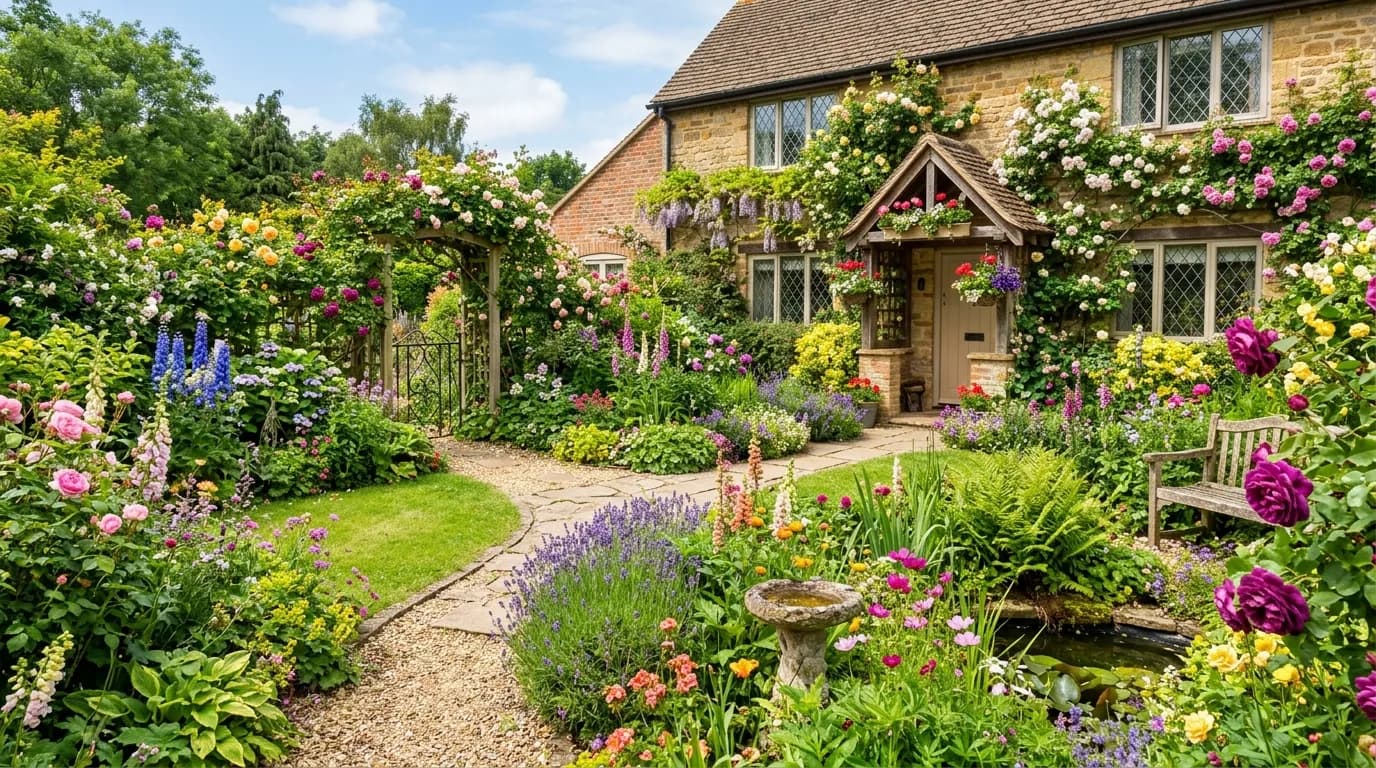
The English garden is the most imitated landscape style in the world — and the most misunderstood. It looks effortless, even accidental: plants spilling over paths, climbing roses tangled with clematis, perennials massed in billowing drifts of color. But behind every great English garden is careful planning. The wild abundance is deliberately cultivated.
Whether you have a small urban garden, a suburban backyard, or acreage in the country, these 35 ideas will help you capture the romantic, layered beauty of the English cottage garden aesthetic.
What Makes an English Garden
The English garden style emerged from the 18th-century reaction against formal French and Dutch parterre gardens. Rather than imposing geometric order on nature, English garden design celebrated naturalistic curves, romantic abundance, and the illusion of controlled wildness.
In practice, an English garden has these hallmarks:
Lush planting density. Every square inch of soil is planted. Paths are softened by plants spilling over their edges. No bare soil visible by midsummer.
Mixed planting. Annuals, perennials, shrubs, roses, and small trees are interplanted rather than segregated. A cottage border might have delphiniums, roses, lavender, foxgloves, catmint, and veronicastrum all growing together.
Repeated color drifts. The same plants appear in multiple places throughout the garden to create visual rhythm and cohesion.
Structural elements. Despite the apparent randomness, good English gardens have strong bones: hedges, topiary, stone walls, paths, and pergolas that anchor the lushness and prevent it from becoming chaos.
Year-round interest. English gardens are planned to have something blooming or attractive from late winter snowdrops through late autumn asters.
35 English Garden Ideas
1. Plant a double herbaceous border. The classic English garden feature: two parallel deep borders (8–12 feet deep) flanking a central lawn or grass path, planted with a full palette of perennials, with taller plants at the back graduating to shorter ones at the front. Gertrude Jekyll perfected the form.
2. Let roses climb everything. Climbing and rambling roses (Rosa 'Cecile Brunner', 'Blaze', 'New Dawn', 'The Generous Gardener') should cover every available structure: pergolas, arches, fences, old trees, and rustic tripods. English gardens without climbing roses feel incomplete.
3. Interplant clematis through roses. The classic English combination: a climbing rose with a compatible clematis threaded through it. Try deep purple 'Jackmanii' through pink 'New Dawn', or white 'Henryi' through red 'Don Juan'. The vine extends the flowering season.
4. Build a rose arch at the entrance. A wooden or metal arch over the garden gate, covered with climbing roses, sets the scene immediately. 'Zephirine Drouhin' (thornless, very fragrant) or 'American Pillar' (exuberant, climbs 20 feet) are classics.
5. Mass lavender along paths. English lavender (Lavandula angustifolia 'Hidcote' or 'Munstead') planted in generous drifts along either side of a stone or brick path creates fragrance with every footstep and a silvery-purple haze throughout summer. Trim hard after flowering to keep compact.
6. Plant foxgloves for vertical drama. Digitalis purpurea (common foxglove) is quintessentially English. Biennial in most climates but self-sows freely — once established in a garden, it perpetuates itself. Tall spikes of spotted tubular flowers in white, pink, and purple work beautifully behind roses and shrubs.
7. Use an informal hedge as a backdrop. English yew (Taxus baccata) clipped into an informal hedge provides a rich dark green backdrop that makes all other colors pop. Hornbeam and beech hedges work similarly, holding their dead leaves through winter for year-round structure.
8. Add a walled garden aesthetic. Even without actual stone walls, you can create the enclosed feel of a walled kitchen garden with tall hedges or wooden trellises on three sides, a simple arch entrance, and raised beds inside for vegetables and cutting flowers.
9. Grow heritage roses. Modern hybrid tea roses are too stiff and upright for the English style. Instead, grow David Austin English roses (Rosa 'Olivia Rose', 'Gertrude Jekyll', 'The Poet's Wife'), old garden roses (gallicas, albas, Bourbons), and shrub roses. These have the cupped, many-petalled blooms and intoxicating fragrance the style demands.
10. Plant cottage garden classics in drifts. The English cottage palette: delphiniums (the blue spike), hollyhocks (against walls and fences), lupines (early summer drama), peonies (lush June globes), phlox (late summer scent), echinacea (native-friendly addition), rudbeckia, and asters for autumn.
11. Allow self-seeders to naturalize. The English garden relies on self-sowing annuals and biennials to fill gaps. Welcome: forget-me-nots (spring blue carpet), honesty (Lunaria, silver seed pods), aquilegia (columbine, beautiful in every color), sweet alyssum, and borage. Edit each year but don't eliminate — these create the spontaneous, naturalistic quality.
12. Build a pergola as a garden room. A timber pergola covered with roses, wisteria, and clematis creates an outdoor room with a dappled canopy. Furnish underneath with a table and benches. This is one of the most dramatic and livable English garden features.
13. Install a sundial or stone birdbath. Focal points — sundials, stone urns, birdbaths, small sculptures — anchor plantings and give the eye a place to rest amid the abundance. Stone weathers beautifully and acquires moss and lichens over time, adding authenticity.
14. Use gravel or worn brick for paths. Formal cut stone is too precise for the English style. Gravel (pea gravel or crushed limestone), worn brick in a basket-weave or herringbone pattern, or stepping stones set in creeping thyme create the right relaxed, aged feel.
15. Plant white borders for evening gardens. Gertrude Jekyll's famous white gardens (Sissinghurst White Garden being the most famous) create a luminous quality at dusk and dawn. White roses, white phlox, white astilbe, Shasta daisies, white foxgloves, and silver foliage (artemisia, stachys) glow at twilight.
16. Grow sweet peas on rustic supports. Annual sweet peas (Lathyrus odoratus) climbed up twiggy hazel canes, bamboo tripods, or wire obelisks are irreplaceable for cutting and for the most intensely fragrant flowers in the English garden. Sow in autumn in mild climates or early spring. Pick flowers constantly to prolong blooming.
17. Edge beds with low box hedging. Dwarf boxwood (Buxus sempervirens 'Suffruticosa') clipped into low edging 6–8 inches high around bed borders creates a formal frame for informal planting — the signature contrast of the English style.
18. Plant a wild corner. Allow one corner of the garden to go naturalistic: nettles for butterflies, cow parsley, wild violets, and native grasses. This ecological generosity and aesthetic contrast between cultivated and wild is deeply English.
19. Train pyracantha or roses against brick walls. Espaliering pyracantha (firethorn), roses, or ceanothus flat against a brick or stone wall creates spectacular seasonal displays (spring flowers, autumn berries) while maximizing space in small gardens.
20. Mass peonies for June impact. Peonies (Paeonia lactiflora 'Sarah Bernhardt', 'Festiva Maxima', 'Bowl of Beauty') planted in groups of 3–5 create late May to early June impact that is difficult to match. Fragrant, long-lived (50+ years in the same spot), and gorgeous as cut flowers.
21. Use old fruit trees as climbing rose supports. An old apple or pear tree with a vigorous rambling rose (Rosa 'Kiftsgate', 'Wedding Day', 'Seagull') scrambling through it is one of the most spectacular sights in the June English garden — towers of white or pale pink flowers covering the entire tree.
22. Plant ornamental alliums for the gap between tulips and summer. Allium 'Globemaster', 'Purple Sensation', and 'Mount Everest' fill the late May to June gap between spring bulbs and summer perennials with dramatic spherical flowerheads on tall stalks. They dry on the stem and look beautiful through the summer.
23. Include climbing hydrangea on shaded walls. The north or east wall of a house in an English garden is properly covered with climbing hydrangea (Hydrangea petiolaris) — self-clinging, June-flowering white lacecaps, beautiful exfoliating bark in winter.
24. Create a cutting garden. A separate area (could be the vegetable garden) devoted to cutting flowers — sweet peas, dahlias, zinnias, cosmos, lisianthus, amaranth, strawflowers — gives you an endless supply for the house without depleting the ornamental borders.
25. Plant hostas for shade. Shaded areas under trees in an English garden are planted with large-leaved hostas in a variety of leaf colors and textures, combined with astilbe, bleeding heart, pulmonaria, and epimedium for a lush, green, year-round tapestry.
26. Allow thyme and creeping phlox to fill path crevices. Plant creeping thyme (Thymus serpyllum) between paving stones and at path edges. It fills crevices, releases fragrance when walked on, and blooms with tiny pink or purple flowers in June. Creeping phlox provides spring color.
27. Grow a topiary as an accent. A single topiary — a cloud-pruned boxwood, a clipped yew spiral, or a round ball on a standard stem — provides formal contrast to informal planting. It's a statement piece that signals this is a garden, not an accident.
28. Install a kitchen garden with cutting flowers. Mix vegetables and flowers in raised or flat beds. Mixing marigolds, nasturtiums, and sweet peas with tomatoes, beans, and squash is both practical (pest control, pollination) and beautiful.
29. Plant banks of catmint as edging. Nepeta 'Walker's Low' or 'Six Hills Giant' planted in generous drifts along path edges creates the soft blue-grey haze that defines the English look. Trim back after the first flush of flowers and it reblooms reliably through summer.
30. Use aged terracotta pots. Large terracotta urns and pots planted with standard roses, agapanthus, or clipped bay laurel add formality and age. Leave them outside year-round to develop moss and weathering.
31. Plant a spring bulb carpet. Mass plantings of snowdrops (Galanthus), crocus, muscari, and early daffodils under deciduous shrubs and between perennials create the carpet of spring color that defines the English garden in February and March.
32. Build a stone wall with planting pockets. Dry stone walls with gaps between rocks planted with aubrieta, alyssum, dianthus, creeping phlox, and sedums create vertical garden habitat and the aged, romantic aesthetic that is impossible to fake with materials that look too new.
33. Plant a pleached lime or hornbeam avenue. On a grander scale, pleached trees (branches trained horizontally and intertwined) create architectural stilted hedges that provide privacy and structure while looking extraordinarily beautiful in all seasons.
34. Add night-fragrant plants near seating. Night-scented stock (Matthiola longipetala), evening primrose, jasmine, and tobacco plant (Nicotiana) planted near outdoor seating release their fragrance most intensely in the evening — creating the immersive sensory experience that defines the English garden at its best.
35. Let the front garden say hello. The classic English cottage front garden: a simple straight path to the door, boxed in by narrow borders packed with cottage perennials, roses, and sweet peas. A climbing rose over the doorway. No grass. This look, even in a very small space, is immediately and unmistakably English.
Want a personalized English garden design for your yard? Use Yardcast's free AI landscape designer → — upload photos of your yard, select the English cottage style, and receive 3 photorealistic designs with a complete plant list for your climate zone.
Essential English Garden Plants
| Category | Must-Have Plants |
|---|---|
| Climbing roses | New Dawn, Cecile Brunner, Zephirine Drouhin, Generous Gardener |
| Shrub roses | Gertrude Jekyll, Olivia Rose, Felicia, Buff Beauty |
| Perennials | Delphiniums, foxgloves, peonies, hollyhocks, phlox, catmint |
| Bulbs | Allium, tulips, snowdrops, muscari, camassia |
| Edging plants | Lavender, catmint, box hedging, creeping thyme |
| Climbers | Clematis, sweet peas, climbing hydrangea, wisteria |
| Structural | Yew hedge, pleached hornbeam, box topiary |
| Self-seeders | Forget-me-nots, honesty, aquilegia, foxgloves, sweet alyssum |
English Garden Cost Guide
| Project Scope | DIY Cost | Professional Install |
|---|---|---|
| Small cottage border (50–100 sq ft) | $300–$800 | $1,500–$4,000 |
| Rose arch + path planting | $200–$600 | $800–$2,500 |
| Full cottage front garden | $500–$1,500 | $2,500–$8,000 |
| Pergola + climbing plants | $800–$3,000 | $3,000–$10,000 |
| Full English back garden makeover | $3,000–$10,000 | $15,000–$50,000+ |
Heritage roses, large specimen plants, and custom stonework are the biggest cost variables. Many English gardens are built over 5–10 years, adding plants gradually each season.
Getting the English Garden Look: 3 Rules
Rule 1: Plant generously or not at all. A single delphinium looks lonely. Five delphiniums in a drift look intentional. English gardens succeed because plants are used in bold quantities — the abundance itself is the aesthetic.
Rule 2: Choose the right rose. Nothing says English garden like David Austin shrub roses. But even perfect roses look wrong if they're stiff hybrid teas. Choose roses with cupped, many-petalled, fragrant blooms that nod gracefully on their stems.
Rule 3: Maintain the contrast. The English garden's magic is the tension between structure (clipped hedges, stone walls, formal paths) and wildness (billowing plants, self-seeders, naturalized bulbs). Lean too far toward structure and it becomes a French formal garden. Lean too far toward wildness and it becomes a mess. The contrast is the point.