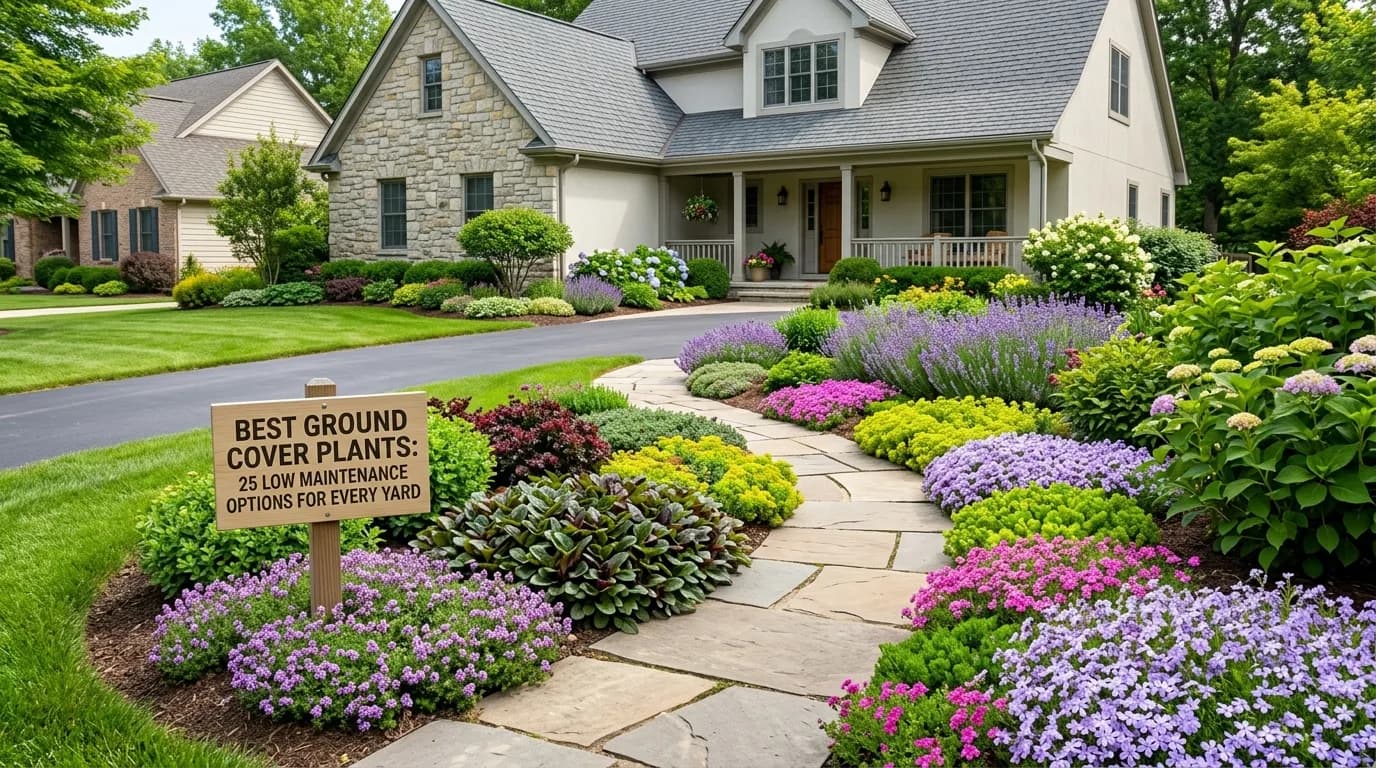
Ground covers are one of the most underused tools in landscape design. They solve the problems that grass can't: deep shade, steep slopes, compacted soil, tree root competition, drought, erosion. And unlike lawn, they largely maintain themselves once established — no mowing, no weekly watering, no reseeding.
This guide covers 25 best ground cover plants organized by light requirement, size, and use case — with specific variety recommendations, spacing guidance, and tips for every climate zone. Whether you're replacing a struggling patch of lawn, solving an erosion problem on a hillside, or filling in around trees and shrubs, there's an option here that works.
Why Ground Covers Beat Grass in Difficult Spots
Turfgrass is the default answer for outdoor floor coverage, but it's the wrong answer in a lot of situations:
- Deep shade — most turf grasses need 4+ hours of direct sun; ground covers can thrive in full shade
- Slopes — mowing is dangerous; ground covers spread without intervention
- Tree root zones — grass competes with trees and usually loses; ground covers coexist
- Around structures — lawn needs trimming against every edge; ground covers eliminate the trim line
- Water restrictions — many ground covers need a fraction of lawn's water once established
The trade-off: ground covers aren't meant to be walked on (with exceptions). They're floor treatments, not surfaces.
Ground Covers for Sun (6+ Hours Direct Light)
1. Creeping Thyme (Thymus serpyllum)
The gold standard for sunny, dry, well-drained areas. Spreads 12–18 inches wide per plant, grows only 2–4 inches tall, tolerates light foot traffic, blooms lavender-pink in early summer, and releases fragrance when brushed or stepped on. Drought-tolerant once established, deer-resistant, attracts pollinators.
Best varieties: 'Elfin' (most compact, best for stepping stones), 'Red Creeping Thyme' (red flowers), 'Pink Chintz' (pink flowers, very flat growth habit)
Spacing: 12–18 inches; fills in completely within 2 seasons in full sun
Best for: Between stepping stones, hillsides, replacing lawn in small sunny patches, rock gardens
2. Sedum (Stonecrop)
Succulents that spread reliably, tolerate poor soil, require almost no water once established, and provide year-round interest. Low-growing sedums (2–6 inches tall) function as ground cover; taller varieties provide accent.
Best low-growing varieties: Sedum acre (golden carpet), Sedum spurium 'Dragon's Blood' (red-tinted foliage, red flowers), Sedum album (white flowers, evergreen), Sedum 'Angelina' (golden-yellow, eye-catching)
Best for: Rock gardens, slope stabilization, parking strips, anywhere with poor soil or heat reflection
3. Creeping Phlox (Phlox subulata)
One spring, creeping phlox will stop traffic. It blooms in an absolute carpet of color (pink, white, lavender, or bicolor) in April–May, then holds its evergreen mat through the rest of the year. Extremely cold-hardy (Zone 3), drought-tolerant once established, deer-resistant.
Spacing: 18 inches. Plant on slopes — creeping phlox is excellent for erosion control and transforms a bare hill into a spring spectacle.
4. Ice Plant (Delosperma)
In warm climates (Zone 6 and south), ice plant is a color-saturated, nearly indestructible ground cover that blooms in neon magenta, orange, or yellow for weeks. Nearly zero water once established. Exceptional for California, Arizona, and the Southwest.
Not for: Areas with hard winters (Zone 5 and north) or poorly drained soil.
5. Daylilies (Hemerocallis)
Often overlooked as ground cover, daylilies are some of the toughest, most drought-tolerant plants available. They spread by rhizome, fill in solid masses, bloom for weeks, and provide excellent erosion control on slopes. 'Stella de Oro' and 'Happy Returns' are repeat-bloomers; 'Hyperion' is fragrant.
Best for: Large areas to fill, slopes, areas where you want summer color without irrigation
Ground Covers for Shade (Less Than 4 Hours Direct Sun)
6. Pachysandra (Japanese Spurge)
The most widely planted shade ground cover in North America for good reason: reliable, evergreen, spreads steadily, and requires almost zero maintenance once established. White flowers in spring; glossy dark green foliage year-round.
Spacing: 6–12 inches. It spreads slowly the first two years, then accelerates. Plant under trees, on shaded slopes, or along shaded north-facing foundations.
Caution: Invasive in some northeastern states. Check local regulations. Use the native Allegheny spurge (Pachysandra procumbens) as an alternative — it's equally beautiful and native to the eastern U.S.
7. Hostas
The undisputed kings of shade gardening. Hostas range from mouse-sized miniatures to 4-foot whale-class specimens. Used as ground covers, they create a lush, layered landscape under trees where nothing else will grow.
Best ground-cover varieties: 'Ground Master' (tight habit, good spreader), 'Halcyon' (blue, slug-resistant), 'Sum and Substance' (giant gold, shade-brightening), 'Patriot' (white-edged, very vigorous)
Best for: Under shade trees, north-facing beds, areas that get summer water (hostas appreciate moisture)
8. Ajuga (Bugleweed, Ajuga reptans)
Fast-spreading, low-growing (4–6 inches), semi-evergreen in most zones. Blooms brilliant blue-purple in spring. Foliage often purple-bronze or variegated. Excellent erosion control; spreads quickly by runners.
Best for: Problem areas under trees, slopes, areas where you want fast coverage
Caution: Can be aggressive — avoid planting adjacent to lawn, as it will spread into it.
9. Sweet Woodruff (Galium odoratum)
Delicate-looking but remarkably tough. Spreads by rhizome into a 6–8 inch carpet of whorled leaves topped with small white flowers in spring. Fragrant when dried (classic May wine herb). Excellent under deciduous trees and shrubs.
Best for: Cottage-style shade gardens, under roses, areas with good moisture
10. Epimedium (Bishop's Hat)
One of the most underused shade plants in American gardens. Epimedium tolerates dry shade (the hardest condition in gardening) better than almost any other plant. Delicate spring flowers, semi-evergreen foliage that often turns bronze-red in fall. Slow to establish, then virtually maintenance-free.
Best varieties: 'Sulphureum' (yellow, vigorous), 'Frohnleiten' (yellow, large leaves), 'Lilafee' (purple flowers)
Ground Covers for Slopes and Erosion Control
11. Crown Vetch (Coronilla varia)
If you need to stop erosion fast on a steep slope with poor soil, crown vetch does it faster than anything else. Pink-lavender flowers in summer, deep fibrous root system, spreads aggressively. Often used on highway embankments.
Warning: Crown vetch is highly invasive in many regions. Contain it with infrastructure (walls, paved borders) and never plant it near natural areas.
12. Creeping Juniper (Juniperus horizontalis)
A woody, spreading conifer that grows 6–12 inches tall and spreads 6–8+ feet wide over time. 'Blue Chip' stays blue-silver; 'Wiltonii' (Blue Rug) is the flattest variety. Excellent drought tolerance, winter interest, deer resistance, and erosion control.
Best for: Slopes, parking strips, areas needing year-round structure
13. Cotoneaster (Creeping Cotoneaster, Cotoneaster horizontalis)
Spreads horizontally in a fishbone branching pattern, hugging slopes beautifully. White flowers in spring, red berries beloved by birds in fall, bronze-red fall color. Extremely tough — tolerates poor soil, drought, and neglect.
Ground Covers for Wet Areas
14. Creeping Jenny (Lysimachia nummularia)
Neon-yellow 'Aurea' variety lights up wet, shaded areas. Spreads rapidly by runners; works well at pond edges, rain gardens, and areas with poor drainage that kill most plants. Can be grown as a trailing container plant too.
15. Blue Star Creeper (Pratia pedunculata)
In warm climates, blue star creeper forms a dense, low carpet (1–2 inches tall) dotted with tiny blue flowers from spring through fall. Tolerates light foot traffic and moist to average soil.
Ground Covers for Hot, Dry Climates
16. Lantana (Trailing varieties)
In Zone 8–11, trailing lantana is one of the most effective ground covers for hot, dry slopes and large areas. Blooms nonstop in orange, yellow, purple, or mixed from spring through frost. Extremely drought-tolerant once established.
Note: Lantana is invasive in Florida. Use sparingly or choose sterile varieties.
17. Rosemary (Prostrate/Trailing varieties)
Trailing rosemary ('Huntington Carpet', 'Irene') grows 1–2 feet tall and spreads 4–6 feet wide. Culinary use, bee magnet, drought-tolerant, deer-resistant, fragrant. Beautiful cascading over walls.
Best for: Mediterranean-style landscapes, California, Southwest, dry climates
18. Gazania (Treasure Flower)
In warm climates, gazania forms a dense mat and blooms in brilliant orange, yellow, and red-striped flowers that open in sun and close at night. Very drought-tolerant; used extensively in California parkway strips.
Native Ground Covers
19. Wild Ginger (Asarum canadense)
Native to the eastern U.S., wild ginger spreads slowly into a lush, kidney-shaped leaf carpet in deep shade. Almost impossible to grow in other ways. Snail-resistant; unusual brownish spring flowers.
20. Pennsylvania Sedge (Carex pensylvanica)
The lawn alternative for shade in the Northeast and Midwest. Fine-textured, 6-inch-tall native grass that can be mowed once or twice per year or left natural. Spreads by rhizome, tolerates dry shade under oaks.
21. Native Violets (Viola sororia)
Often treated as a weed in lawns, native violets are beautiful, wildlife-friendly ground covers in naturalistic settings. Purple spring flowers, heart-shaped leaves, self-seeding. Host plant for fritillary butterflies.
22. Bearberry (Arctostaphylos uva-ursi)
Native evergreen ground cover for full sun in cool climates (excellent in the Northeast, Pacific Northwest, mountain regions). Red berries in fall, pinkish-white flowers in spring, rich red fall color. Excellent for slopes and sandy, acidic soil.
Mid-Article: Visualize Ground Covers in Your Yard
Not sure which ground covers would work best in your specific space? [Try Yardcast's free AI landscape design →](/redesign) — upload a photo of the area you want to cover, answer 4 questions, and see three professional designs showing exactly how ground covers could transform that space. Specific plant recommendations for your climate and light conditions included.
Ground Cover Spacing and Coverage Calculator
| Plant | Spacing | Plants per 100 sq ft | Time to Fill |
|---|---|---|---|
| Creeping thyme | 12 in | 100 | 2–3 seasons |
| Pachysandra | 8 in | 225 | 2–3 seasons |
| Sedum | 12–18 in | 65–100 | 2 seasons |
| Ajuga | 12 in | 100 | 1–2 seasons |
| Hostas (medium) | 24 in | 25 | 3–4 seasons |
| Creeping juniper | 36–48 in | 10–15 | 3–5 seasons |
| Daylilies | 18–24 in | 25–40 | 2 seasons |
Closer spacing = faster coverage but higher plant cost. Wider spacing = slower coverage but lower initial cost. Mulch heavily while plants establish.
How to Plant Ground Cover (Step by Step)
- 1Eliminate existing weeds completely. This is non-negotiable. Solarize with clear plastic for 6 weeks in summer, or hand-clear and wait for regrowth to emerge before planting.
- 1Amend soil. Work in 2–3 inches of compost. Most ground covers aren't fussy, but good organic matter helps establishment.
- 1Lay weed barrier fabric (optional but helpful). For pachysandra and other slow spreaders, landscape fabric under 2 inches of mulch buys you 2–3 weed-free establishment years.
- 1Plant at appropriate spacing. See table above. Closer spacing costs more upfront but eliminates the weeding window.
- 1Mulch immediately. 2–3 inches of shredded bark or wood chips between plants suppresses weeds and retains moisture.
- 1Water consistently for the first season. Most ground covers establish in year one and become largely self-sufficient in year two.
- 1Edge at borders. Install metal or plastic landscape edging where ground cover meets lawn to prevent invasion in both directions.
Get a Professional Ground Cover Plan for Your Yard
Choosing the right ground cover for your specific conditions — light, moisture, soil, climate zone, slope — requires knowing what you're working with. Guessing wrong means replanting.
[Generate a free AI landscape design at Yardcast.ai →](/redesign)
Upload a photo of the problem area in your yard, answer 4 quick questions, and get three professional designs with specific ground cover recommendations matched to your exact USDA hardiness zone and site conditions. Free preview, $29 for the full PDF with plant list, quantities, spacing plan, and cost estimate.
Stop fighting your yard. Let the right plants do the work.